Selecting a hair brush factory for OEM or private label production is one of the most consequential sourcing decisions a brand makes. The wrong manufacturing partner can result in inconsistent product quality, delayed shipments, or inadequate certification coverage — all of which carry commercial risk in retail and e-commerce environments.
This guide outlines seven specific questions that B2B buyers should ask when evaluating a hair brush manufacturer before placing any production order. The questions are structured around operational capability, quality systems, and sourcing transparency.
1. What Types of Hair Brushes Does the Factory Specialise In?
A factory’s core product range directly determines its engineering depth. Manufacturers focused on a narrow product category — such as paddle brushes and cushion brushes — tend to maintain more developed tooling libraries, bristle-setting expertise, and relevant production equipment than general hair accessory factories producing a wide mix of unrelated items.
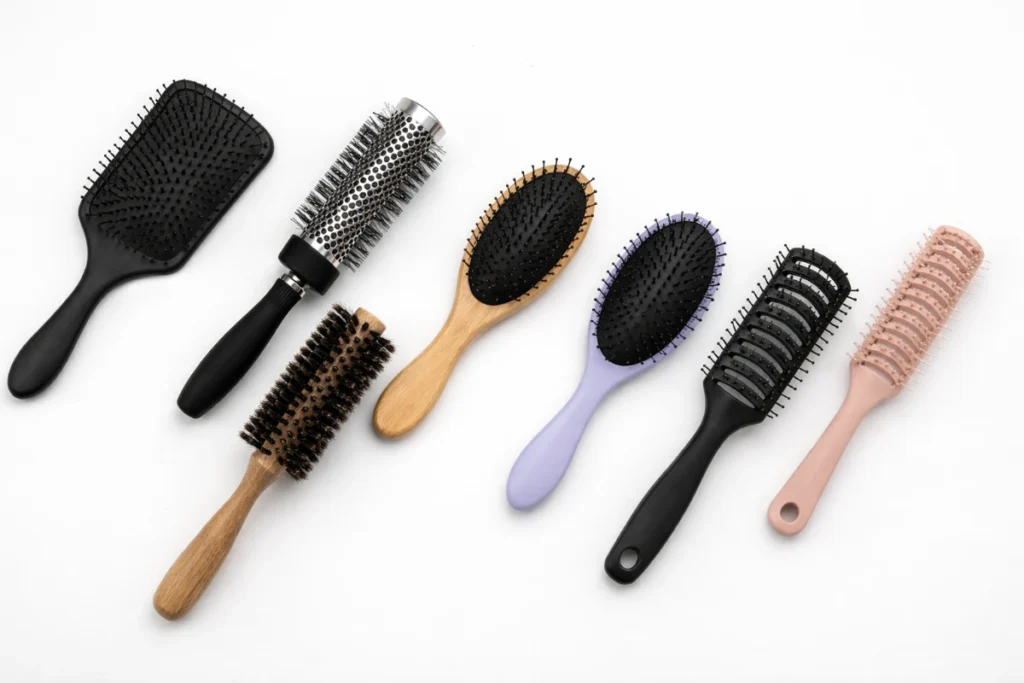
When reviewing a factory’s capabilities, buyers should confirm which brush categories are in active production, not just listed in a catalogue. Key categories in commercial demand include:
- Paddle brushes (nylon pin, mixed bristle, cushion base)
- Round brushes (boar bristle, nylon, or blended bristle; various barrel diameters)
- Detangling brushes (flexible nylon pins, wet-hair-safe construction)
- Cushion brushes (scalp stimulation, anti-static pins)
- Vented brushes (heat-optimised for blow-dry use)
Factories with documented experience across multiple brush types — and the in-house tooling to support them — generally present lower product risk for buyers developing multi-SKU ranges.
2. What Bristle Materials and Cushion Bases Are Available?
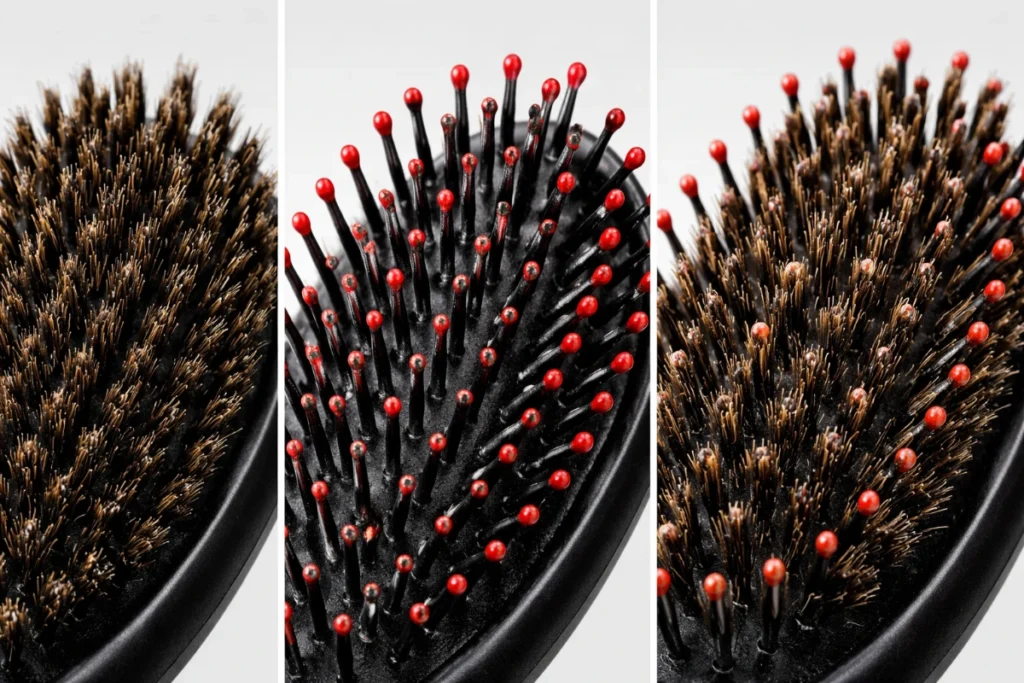
The bristle specification is the most technically significant variable in hair brush manufacturing. It determines the end-use performance, target hair type, and appropriate retail positioning. A capable factory should be able to explain the differences clearly and offer multiple material options.
The comparison below summarises the most common bristle types and their characteristics:
| Bristle Type | Source | Best For | Key Properties |
|---|---|---|---|
| Boar bristle (pure) | Natural animal | Fine, normal hair | Smoothing, shine, gentle |
| Nylon bristle | Synthetic polymer | Thick, coarse hair | Detangling, durability |
| Mixed (boar + nylon) | Combined | All hair types | Balanced performance |
| Carbon fibre pins | Synthetic | Anti-static use | Heat-resistant, durable |
| Flexible nylon pins | Synthetic | Wet hair, detangling | Gentle, low breakage |
Beyond bristle material, buyers should ask about cushion base construction. Air-cushion bases (rubber or silicone membrane over a hollow chamber) allow pin flex during brushing, which reduces scalp abrasion. Non-cushion bases are firmer and better suited for styling precision.
Factories should be able to supply material data sheets and confirm bristle origin for brands requiring GRS (Global Recycled Standard) or animal welfare documentation.
3. What Is the Factory’s MOQ and Standard Lead Time?
Minimum order quantities and production lead times vary significantly between manufacturers, and both directly affect a brand’s inventory planning, cash flow, and go-to-market timeline.
For reference, typical industry benchmarks for hair brush OEM production are:
- MOQ: 500–3,000 units per SKU for standard production; lower MOQ (200–500 units) may be available for factories with existing mold libraries matching the buyer’s design brief
- Sample lead time: 10–20 business days for pre-production samples
- Mass production lead time: 30–60 days post-sample approval, depending on order volume and material sourcing
Buyers developing private label ranges with multiple brush types should specifically ask whether the factory supports consolidated shipments across SKUs — this reduces freight cost and simplifies logistics management.
4. Which Quality Certifications Does the Factory Hold?
Certifications are not marketing claims — they are third-party-verified operational standards that affect a buyer’s ability to sell into regulated retail channels. Missing certifications can result in products being blocked at import, rejected by retail buyers, or flagged during audits.
The following certifications are most relevant for hair brush manufacturers supplying global retail brands:
- ISO 9001:2015 — quality management system; confirms documented production processes and internal audit cycles
- amfori BSCI — social compliance; required by many European retail chains
- BRCGS (Consumer Products) — product safety and traceability; relevant for branded retail and pharmacy channels
- GRS 4.0 — Global Recycled Standard; required for brushes using recycled plastic or fibre content
- REACH compliance — chemical substance restrictions applicable to EU market goods
Buyers should request current certificate copies with validity dates. Certificates that expired more than 12 months ago without renewal may indicate lapses in compliance activity.
5. Can the Factory Support Custom Mold Development, and What Is the Cost?
Custom tooling is often the highest upfront cost in private label brush development. Factories with existing mold libraries — covering standard handle shapes, base dimensions, and cushion configurations — can significantly reduce or eliminate tooling costs for buyers whose designs align with available tooling.
When tooling investment is required, buyers should clarify:
- Mold ownership: Does the mold become buyer property after full payment? This affects future production flexibility and supplier switching.
- Tooling cost structure: One-time fee vs. amortised across a minimum production volume
- Mold maintenance responsibility: Who bears the cost of mold repair or replacement during production runs?
- Design files required: Factories typically require 3D CAD files (STEP or IGES format) or technical drawings before quoting tooling
Factories with large in-house mold libraries (typically 1,000+ molds) are better positioned to offer low-tooling or tooling-free development for buyers sourcing standard brush forms.
6. What Customisation Options Are Available for Private Label Production?
Private label hair brush production involves more than applying a logo. Buyers developing a brand presence need to confirm the range of customisation options the factory supports across handle design, bristle specification, packaging, and branding execution.
Common customisation parameters include:
- Handle material: ABS plastic, PP, rubberised coating, recycled plastic, bio-based materials
- Handle colour: Pantone-matched solid colours, gradient finishes, translucent options
- Bristle colour and length: Coloured tips, varying pin heights, split-tip nylon options
- Logo application: Embossing, debossing, hot stamping, UV printing, in-mold labelling
- Packaging: Retail blister card, kraft paper sleeve, gift box, private label sticker, FSC-certified options
Buyers should request a customisation specification sheet and confirm which processes are supported in-house versus outsourced to third-party finishers. In-house execution generally offers better quality consistency and shorter turnaround.
7. How Does the Factory Handle Quality Control During and After Production?
Quality control is not limited to a final inspection before shipment. Reliable manufacturers apply structured QC checkpoints throughout the production cycle to catch defects at source rather than at the point of packing.
A factory’s QC documentation should cover:
- Incoming material inspection: Bristle diameter, bristle tip condition, cushion base Shore hardness, handle dimensional checks
- In-process inspection: Bristle setting density per unit area, cushion air retention test, pin alignment visual check
- Pre-shipment inspection (PSI): AQL sampling (typically AQL 2.5 for cosmetic products), functional testing, packaging integrity check
- Third-party inspection option: Confirm whether the factory cooperates with independent inspection agencies (SGS, Bureau Veritas, Intertek)
Buyers placing significant orders — particularly for launch SKUs — are advised to commission an independent pre-shipment inspection regardless of factory QC claims. This provides objective verification and a documented record.
Conclusion
Choosing a hair brush factory requires systematic evaluation across product capability, material transparency, certification coverage, tooling economics, customisation depth, and quality process rigour. Buyers who ask these seven questions during the sourcing process are better positioned to identify manufacturers suited to their product and market requirements.
Manufacturers such as JunYi Beauty, which operates integrated in-house mold libraries and production facilities in Dongguan with over 25 years of OEM manufacturing experience across the full range of hair brush types, represent the category of factory-direct supplier suited for brands seeking verified quality systems and scalable custom production capacity.