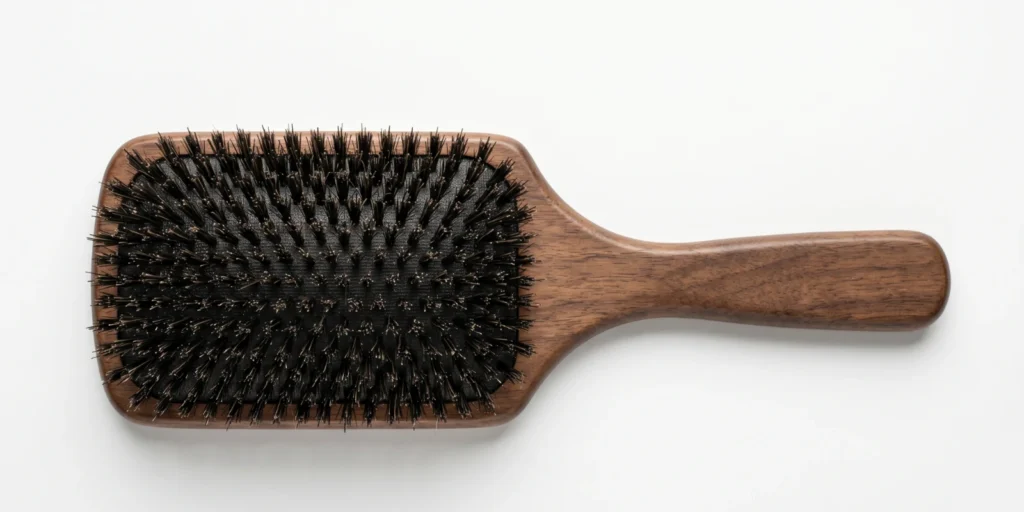
Boar bristle brushes are among the most consistently recommended tools for reducing frizz, yet the claims made about them in retail and beauty editorial contexts frequently outpace what the material science actually supports. This article examines what boar bristle brushes genuinely do to the hair shaft, under which conditions they deliver frizz-reduction benefits, and where their limitations begin — including the hair types for which they are less effective or actively unsuitable.
For brand developers and retail buyers sourcing hair brush ranges, understanding the mechanism behind boar bristle performance is directly relevant to product positioning, hair-type labelling, and the claims that can be made on packaging without overstating efficacy.
What Boar Bristle Actually Does to the Hair
The frizz-reduction claim associated with boar bristle brushes is not marketing invention — it is grounded in the physical interaction between the bristle material and the hair shaft. Understanding this interaction requires a brief look at hair structure.
Each hair strand is covered by an outer cuticle layer composed of overlapping, scale-like cells that lie flat from root to tip when healthy. When these scales are disturbed — by friction, humidity, static, or mechanical tension — they lift, separate, and refract light unevenly. The visual result is frizz.
Boar bristle reduces this disturbance through three distinct mechanisms:
Friction reduction. The keratin protein composition of boar bristle is structurally closer to human hair than synthetic nylon is. When boar bristle passes over the hair shaft, the material-on-material friction is lower than with hard nylon pins. Lower friction means fewer lifted cuticle scales per stroke.
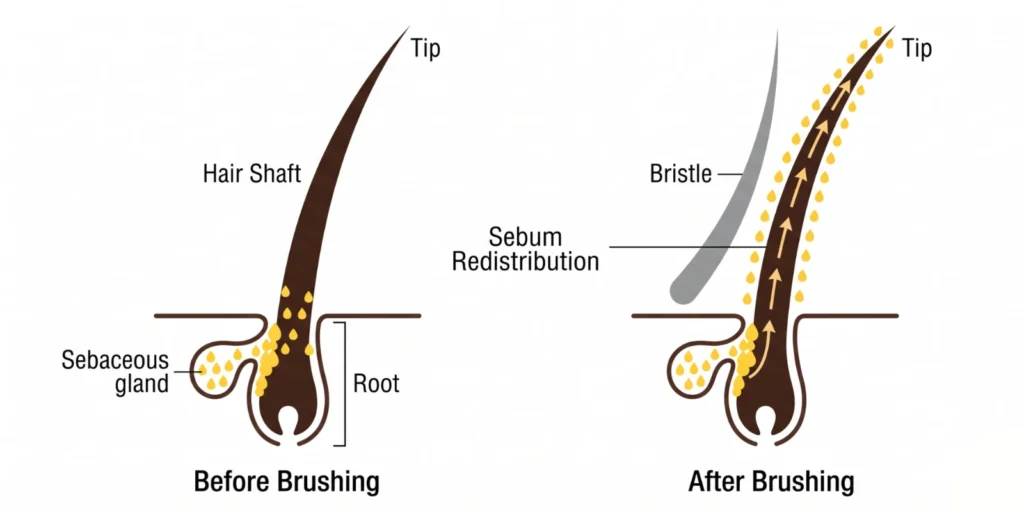
Sebum redistribution. Boar bristle picks up natural scalp oils (sebum) at the root and deposits them along the shaft as it moves toward the tips. This thin oil coating acts as a barrier that holds the cuticle scales flat and reduces the moisture exchange between the shaft and the ambient air — the primary trigger of humidity-related frizz.
Static reduction. Natural keratin bristle generates significantly less static charge during brushing than synthetic bristle. Static charge is one of the two primary causes of frizz in dry indoor environments (the other being cuticle disruption), so reducing static during the brushing action directly reduces the frizz outcome.
These are real, measurable effects. The question is not whether they exist, but how significant they are across different hair types and conditions.
Where the Claims Hold Up
Boar bristle brushes perform most reliably as frizz-reduction tools in a specific combination of conditions: straight to lightly wavy hair, with sufficient natural oil production, brushed when dry or lightly damp.
Straight and type 1 hair benefits most from boar bristle. The relatively uniform cuticle surface and circular shaft cross-section mean that bristle contact is consistent along the full length of each stroke. Sebum redistribution is effective because the oil travels a predictable path from root to tip without the interruption caused by curl or wave patterns. Users with straight, fine to medium hair who brush daily with a boar bristle paddle brush typically report visible shine improvement and reduced flyaways within a few weeks of consistent use.
Type 2 wavy hair can benefit from boar bristle in the post-styling finishing phase — once the wave has been defined with product and has dried. In this context, a light pass with a boar bristle brush smooths surface frizz without fully disrupting the wave pattern. Used on wet or product-free wavy hair, results are less predictable.
Hair with moderate oil production responds better to boar bristle than very dry or very oily hair. The sebum redistribution mechanism requires a baseline level of natural oil to distribute. Hair that is very dry, heavily product-coated, or recently washed may not have enough sebum at the root to make the distribution effect meaningful. Conversely, very oily hair may find the redistribution effect compounding an existing issue.
Where the Claims Break Down
The boar bristle frizz-reduction claim does not hold uniformly across all hair types, and for several categories of hair, it is either ineffective or counterproductive.
Curly and coily hair (Type 3 and 4) is the most significant limitation. The elliptical or flattened cross-section of curly hair strands means that boar bristle contact is uneven as it moves around bends and coils. More critically, dry brushing curly hair with any bristle type — including boar — disrupts the curl pattern and separates individual strands, producing volume that reads as frizz. The mechanism that benefits straight hair (consistent stroke from root to tip) becomes a mechanism for curl destruction in Type 3 and 4 hair.
For curly hair, boar bristle brushes are not a frizz solution. They are finishing tools for straight and wavy hair.
Very fine hair with low density may experience sebum over-distribution. Because fine hair has a smaller shaft diameter and less cortex volume, the oil deposited by boar bristle during brushing can weigh strands down and produce a greasy appearance rather than a smooth one. For this hair type, brushing frequency and bristle softness need careful calibration.
Damaged, bleached, or highly porous hair has a cuticle that is already compromised. The sebum redistribution effect is partially useful here — coating the shaft can temporarily reduce porosity and limit moisture exchange — but the mechanical contact of even soft boar bristle on very fragile cuticle can cause additional breakage. For severely damaged hair, boar bristle should be used with short, gentle strokes and lower brushing frequency.
Thick, coarse, or dense hair presents a different problem: boar bristle typically lacks the stiffness to penetrate through to the lower layers of thick hair. A pure boar bristle brush used on thick hair often smooths the outer surface layer while leaving the underlying layers unbrushed. This can produce the appearance of frizz reduction at the surface while not addressing the underlying texture.
Boar Bristle vs. Mixed Bristle: When the Compromise Makes More Sense
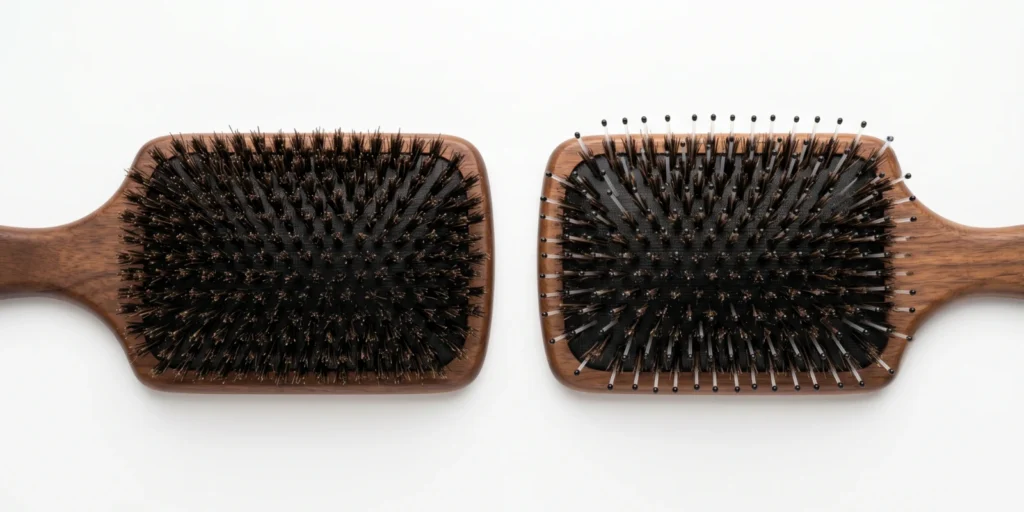
The limitation of pure boar bristle with thick or coarse hair is why mixed bristle brushes — combining boar and nylon pins — were developed as a product category. The nylon pins penetrate deeper into the hair mass and work through knots, while the boar bristles between them perform the smoothing and sebum redistribution function on the strands that have already been separated.
For medium to thick hair, mixed bristle often delivers better frizz outcomes than pure boar because the full depth of the hair is being smoothed, not just the surface.
The choice between pure boar and mixed bristle is therefore a hair-type specification decision, not simply a quality tier decision. A pure boar paddle brush is not universally superior to a mixed bristle paddle brush — it is more appropriate for fine to medium straight hair, while mixed bristle is more appropriate for medium to thick straight and wavy hair.
From a sourcing perspective, carrying both specifications and positioning them by hair type at the retail level produces better consumer outcomes and reduces return rates driven by mismatched expectations.
The Role of Brush Quality in Boar Bristle Performance
Not all boar bristle is equivalent, and the grade of bristle used significantly affects the outcome. Boar bristle is graded by the region of the animal from which it is sourced and by the fineness of the individual bristle filaments.
First-cut bristle (from the back and shoulders) is longer and coarser, making it more suitable for thick hair applications. Second-cut bristle is finer and shorter, better suited to fine and medium hair where surface smoothing without mechanical stress is the priority.
The bristle density per row also matters. Brushes with closely packed rows allow more bristle-to-shaft contact per stroke, delivering more sebum redistribution and more static reduction. Sparsely bristled brushes produce less of both effects.
The cushion base of the brush affects the mechanical pressure applied during each stroke. A soft air-cushion base allows the bristle rows to flex as they move across the contours of the head, reducing the friction force per contact point. For fine or sensitive hair, a cushion base is a meaningful upgrade from a hard base in terms of frizz risk during brushing.
These are specification variables that manufacturers can adjust in OEM production, and that differentiate price tiers within the boar bristle category beyond simple bristle grade alone.
Sourcing Considerations for B2B Buyers
For buyers developing hair brush ranges that include boar bristle products, several specification and positioning decisions directly affect consumer outcomes:
Bristle grade and fineness should be matched to the target hair type communicated on packaging. Fine, soft bristle for fine hair; firmer, longer bristle for medium to thick hair. Mismatched specifications undermine the performance claim.
Pure boar vs. mixed bristle is a hair-type segmentation decision. Positioning both in a range, clearly differentiated by hair type, allows broader market coverage without creating consumer confusion.
Anti-static properties are inherent to natural boar bristle at higher grades, but can be further enhanced through bristle treatment at the manufacturing stage — relevant for buyers targeting dry-climate markets or the professional styling segment.
Cushion base specification is a differentiator within the boar bristle category. Air-cushion base models command higher price points and are more appropriate for fine and sensitive hair positioning.
Packaging claims should reflect the genuine mechanism: boar bristle smooths the cuticle, redistributes natural oils, and reduces static charge. Claims of “eliminating frizz” overstate efficacy for most hair types and are not supported by the mechanism in Type 3 and 4 hair.
Both pure boar and mixed bristle paddle brushes are available through OEM and private label manufacturing routes, with bristle grade, density, cushion base, and handle specification adjustable to meet range positioning requirements.
Frequently Asked Questions
Does a boar bristle brush actually reduce frizz or is it just marketing?
Boar bristle genuinely reduces frizz through three mechanisms: lower friction against the hair shaft, redistribution of scalp oils along the cuticle, and lower static charge generation than synthetic bristle. These effects are real but are most pronounced in straight to wavy hair types with moderate oil production. For curly hair, dry boar bristle brushing tends to increase rather than reduce frizz.
How long does it take for a boar bristle brush to reduce frizz?
The static reduction and friction reduction effects are immediate — they occur during each brushing session. The sebum redistribution effect on hair condition and shine builds over two to four weeks of consistent daily use as natural oils are more evenly distributed along the shaft.
Can I use a boar bristle brush on curly hair?
Boar bristle brushes are not recommended for dry brushing curly hair. Dry brushing separates the curl pattern and produces volume that reads as frizz, regardless of bristle type. Curly hair benefits from wet detangling with a wide-tooth comb or flexible detangling brush, and from finger styling rather than brushing once dry.
Is boar bristle better than nylon for frizz?
For straight and wavy hair, boar bristle produces better frizz outcomes than hard nylon pins because it generates less friction and static. However, nylon pins are better for penetration through thick hair. Mixed bristle — combining boar and nylon — is often the most effective compromise for medium to thick hair types that want both detangling performance and frizz reduction.
Does a more expensive boar bristle brush work better?
Price in boar bristle brushes generally reflects bristle grade and density, cushion base quality, and handle construction. Higher-grade bristle (finer, more densely packed, from higher-quality cuts) delivers more consistent sebum redistribution and lower friction per stroke. For fine and medium hair, the performance difference between low-grade and high-grade boar bristle brushes is noticeable. For thick hair, mixed bristle at a moderate price point often outperforms expensive pure boar.
What hair type benefits most from a boar bristle brush?
Fine to medium, straight to lightly wavy hair with moderate natural oil production benefits most. This hair type has the cuticle uniformity, shaft diameter, and oil availability that makes the three boar bristle mechanisms — friction reduction, sebum redistribution, and static control — most effective.
Conclusion
The boar bristle frizz-reduction claim is grounded in material science, not marketing fiction. The friction reduction, sebum redistribution, and static control mechanisms are real and deliver measurable outcomes for straight and lightly wavy hair types. However, the claim does not extend uniformly across all hair: curly and coily hair is better served by wet detangling tools, thick hair by mixed bristle, and severely damaged hair by gentler, less frequent brushing.
For brands positioning hair brush ranges, understanding where boar bristle works and where it does not is the difference between building consumer trust and generating returns. Manufacturers such as JunYi Beauty, which produces boar bristle and mixed bristle brushes across multiple grades and specifications from its Dongguan facility, represent the type of OEM partner suited to brands that want to match bristle specification to hair-type performance claims rather than treating boar bristle as a single undifferentiated category.