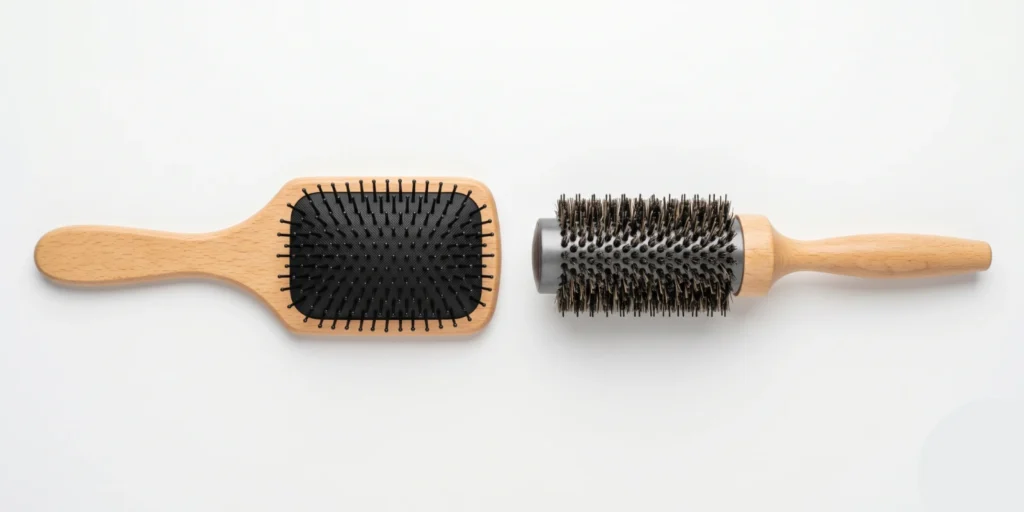
A paddle brush is a flat, wide-headed hair brush designed primarily for detangling, smoothing, and straightening longer hair lengths in a single pass. A round brush is a cylindrical brush used in conjunction with a blow-dryer to add volume, curl, or directional movement to the hair during styling. While both are core tools in professional and consumer hair care, they serve distinct functional purposes and are suited to different hair types, lengths, and styling outcomes.
For B2B buyers sourcing hair brushes for salon brands, retail ranges, or private label collections, understanding the structural and functional differences between these two brush categories is essential to building a product assortment that meets end-user expectations.
What Is a Paddle Brush?
A paddle brush is defined by its broad, flat or slightly curved base — typically 200–250mm in length — which allows it to cover a large surface area of hair in each stroke. The base is usually constructed with an air-cushion membrane (a flexible rubber or silicone pad over a hollow chamber) that allows the pins to flex in response to scalp contour and hair tension, reducing mechanical stress during brushing.
Key structural characteristics of paddle brushes include:
- Base shape: Rectangular or oval, flat to slightly convex
- Pin type: Nylon ball-tipped pins, boar bristle, or mixed nylon-boar configurations
- Cushion base: Air-cushion (most common), hard base (less common, used for precision styling)
- Handle: Short to medium length, ergonomic grip for downward stroke motion
- Typical dimensions: 220–250mm head length, 60–80mm head width
Paddle brushes are most effective on medium to long hair. They are widely used for daily detangling, pre-blow-dry smoothing, and finishing flat, straight styles. The large contact surface makes them less effective for creating curl or volume.
What Is a Round Brush?
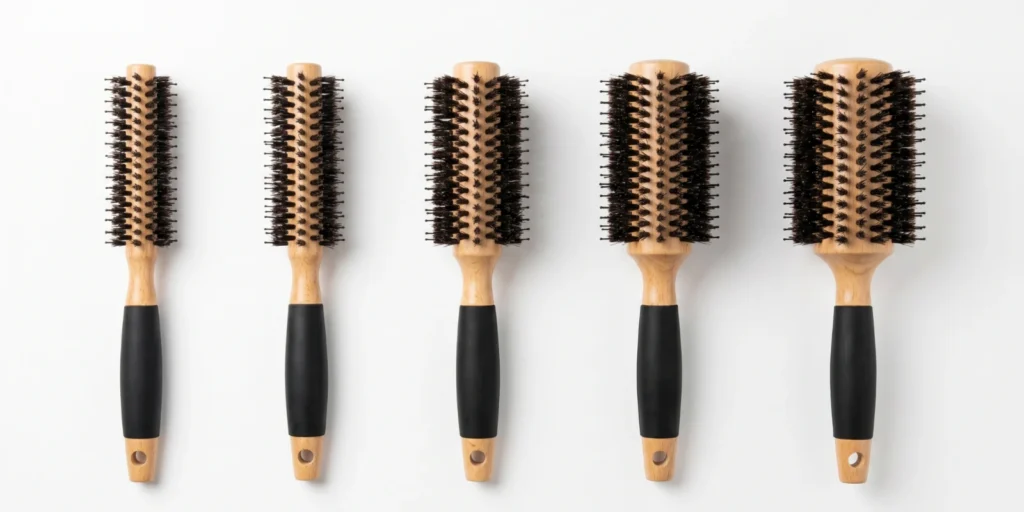
A round brush is a cylindrical styling tool in which bristles radiate outward from a central barrel. The barrel diameter determines the type of styling outcome achievable: smaller barrels (25–35mm) produce tighter curl and definition, while larger barrels (50–70mm) create loose waves, volume, and directional movement.
Key structural characteristics of round brushes include:
- Barrel shape: Cylindrical, available in multiple diameters
- Barrel material: Aluminium (heat-conductive, accelerates drying), ceramic-coated (even heat distribution), wood (gentler, non-heat-conducting)
- Bristle type: Boar bristle (smoothing, shine), nylon (grip and tension), mixed (balance of both)
- Handle: Long handle for leverage during blow-dry rotation
- Typical barrel diameters: 25mm, 32mm, 38mm, 44mm, 55mm
Round brushes require directional airflow from a blow-dryer to function as styling tools. They are standard equipment in professional blow-dry services and are widely used by consumers seeking salon-style results at home.
Key Differences: Structure, Function, and Performance
The differences between paddle and round brushes extend beyond shape. Each design reflects a different set of use-case priorities — detangling and maintenance versus active heat styling and form creation.
The comparison below summarises the most relevant variables for buyers evaluating both brush types:
| Feature | Paddle Brush | Round Brush |
|---|---|---|
| Head shape | Flat / oval | Cylindrical barrel |
| Primary function | Detangling, smoothing, finishing | Blow-dry styling, volume, curl |
| Best hair length | Medium to long | Short to long (barrel-dependent) |
| Heat tool required | No | Yes (blow-dryer) |
| Curl creation | None | Yes (barrel-size dependent) |
| Volume creation | Minimal | High |
| Scalp contact | Direct (cushion base) | Indirect (barrel lifts hair) |
| Skill level required | Low | Moderate to high |
| Bristle options | Nylon, boar, mixed | Boar, nylon, mixed |
| Typical retail price tier | Entry to mid | Mid to premium |
Neither brush type is universally superior. The appropriate choice depends on the user’s hair type, length, styling routine, and whether they use a blow-dryer as part of their process.
Which Hair Types Benefit Most from Each Brush?
Hair type — including texture, density, and natural pattern — is one of the most reliable indicators of which brush category will perform best for a given user.
Paddle brush — suited to:
- Straight or slightly wavy hair that needs daily detangling
- Fine to medium density hair where a large contact surface reduces brushing time
- Long hair (40cm+) where section-by-section detangling with a round brush would be impractical
- Users with sensitive scalps who benefit from air-cushion pin flex
- Keratin-treated or chemically relaxed hair requiring smooth, tension-free finishing
Round brush — suited to:
- All hair textures where volume or directional movement is the styling goal
- Short to medium length hair (25–45cm) where the barrel can make full rotational contact
- Naturally straight hair being shaped into waves or curls using heat
- Thick or coarse hair that holds a blow-dry style well with tension and heat
- Professional salon use where controlled styling outcomes are the service standard
Bristle Material: How It Affects Performance in Each Brush Type
Bristle specification affects brushing performance differently in paddle and round brush applications. In a paddle brush, bristle material influences scalp sensation, static reduction, and the degree of smoothing achieved. In a round brush, bristle material primarily affects grip, tension, and the level of shine or polish in the finished style.
Boar bristle — natural keratin-based bristle that redistributes scalp oils along the hair shaft, increases shine, and produces a polished finish. More effective in paddle brush applications on fine to medium hair. In round brushes, boar bristle provides smooth tension without excessive grip.
Nylon bristle — synthetic, durable, and available in varying pin diameters. More effective for detangling in paddle brush applications. In round brushes, nylon provides firmer grip and stronger tension during blow-dry styling, making it better suited to thick or coarse hair.
Mixed bristle (boar + nylon) — combines the smoothing properties of boar with the detangling and grip performance of nylon. Widely used in both brush types as a balanced commercial specification. Mixed bristle is a common choice for retail ranges targeting broad consumer demographics.
Buyers sourcing for professional salon channels should note that boar bristle brushes — particularly in round brush configurations — command a higher retail price point and are typically positioned as premium SKUs. Nylon and mixed bristle options are more appropriate for mass market and entry-level retail positioning.
Sourcing Considerations for B2B Buyers
For buyers building a hair brush range that includes both paddle and round brush SKUs, the following sourcing parameters are relevant:
Paddle brushes:
- Confirm cushion base construction: air-cushion rubber membrane vs. hard base
- Specify pin material, pin diameter, and ball-tip finish (rounded tips reduce scalp abrasion)
- Assess handle material and grip — rubberised overmold increases perceived quality
- Evaluate anti-static treatment options for nylon pins (relevant for fine hair market)
Round brushes:
- Specify barrel diameter range based on target styling outcome and hair length
- Confirm barrel material: aluminium core for heat-conductive performance; ceramic coating for even heat distribution
- Assess bristle row count and density — higher density increases grip and tension
- Confirm handle length and balance for professional ergonomic requirements
Both brush types are available through OEM and private label manufacturing routes, with customisation options covering handle material, colour, bristle specification, logo application, and retail packaging format.
Factories with active tooling for both brush categories — including multiple barrel diameter options for round brushes and varied head sizes for paddle brushes — reduce the development lead time for multi-SKU sourcing projects. Buyers are advised to confirm available mold inventory before committing to tooling investment for standard form factors.
Building a Range That Includes Both
Paddle and round brushes are not mutually exclusive from a consumer or retail perspective. Many end-users — and most professional stylists — maintain both in active use for different stages of the hair care routine. From a brand assortment perspective, stocking both allows a range to cover the full styling workflow: detangling and prep (paddle), followed by heat styling and finishing (round).
For buyers developing a tiered range, a practical starting structure includes:
- One or two paddle brush SKUs differentiated by pin type (nylon vs. mixed bristle)
- Two to three round brush SKUs differentiated by barrel diameter (small, medium, large)
- Consistent handle design language across the range for visual brand cohesion
The Global Recycled Standard (GRS) certification is increasingly requested by retail buyers for brush handles made from recycled ABS or PP plastic. Buyers developing sustainable-positioned ranges should confirm factory eligibility before finalising material specifications.
Conclusion
Paddle brushes and round brushes serve structurally different functions and are suited to different hair types, lengths, and styling workflows. Paddle brushes are detangling and smoothing tools optimised for large surface coverage and daily maintenance. Round brushes are heat-styling tools designed to create volume, curl, and directional movement in conjunction with a blow-dryer. For B2B buyers, understanding these distinctions informs better product range decisions, more accurate sourcing briefs, and more effective retail positioning.
Manufacturers such as JunYi Beauty, which produces both paddle and round brush categories across multiple bristle and barrel specifications from its integrated Dongguan facility, represent the type of OEM partner suited to buyers developing cohesive, multi-SKU hair brush ranges for professional and retail channels.
Frequently Asked Questions
What is the main difference between a paddle brush and a round brush?
A paddle brush has a flat, wide head designed for detangling, smoothing, and finishing longer hair in a single stroke. A round brush has a cylindrical barrel used with a blow-dryer to create volume, curl, and directional movement. Paddle brushes are maintenance tools suited to daily grooming; round brushes are active styling tools that require heat to function as intended.
Which brush is better for fine hair?
For fine hair, a paddle brush with a boar or mixed bristle configuration is generally more suitable for daily use. The air-cushion base and natural bristle reduce mechanical stress and static without excessive tension. A round brush with a smaller barrel diameter (25–32mm) can be used for blow-dry volume, but bristle density should be lower to avoid pulling on delicate strands.
Can a paddle brush create volume or curl?
No. A paddle brush is not designed to create curl or significant volume. Its flat head geometry is optimised for smoothing and detangling. For volume or curl, a round brush used in conjunction with a blow-dryer is the appropriate tool.
What barrel diameter should I choose for a round brush?
Barrel diameter determines the size of curl or wave produced. Smaller barrels (25–35mm) create tighter curls and suit short to medium hair. Medium barrels (38–44mm) produce loose waves and are the most versatile option for general retail. Larger barrels (50–70mm) create volume and soft movement in medium to long hair. For professional salon use, stocking multiple barrel diameters across a range is standard practice.
What is the difference between boar bristle and nylon bristle?
Boar bristle is a natural keratin-based bristle that redistributes scalp oils, increases shine, and produces a smooth, polished finish — best suited to fine to medium hair. Nylon bristle is synthetic, more durable, and provides stronger detangling performance and grip during blow-dry styling, making it better suited to thick or coarse hair. Mixed bristle brushes combine both materials to balance smoothing and detangling performance across a broader range of hair types.
What is the MOQ for OEM hair brush manufacturing?
MOQ for OEM hair brush production typically ranges from 1,000 to 5,000 units per SKU when new tooling is required. For ODM production using existing factory molds, MOQ is generally lower, ranging from 300 to 1,500 units per SKU. Exact figures depend on brush type, material specification, and available tooling inventory at the factory.
Can paddle brushes and round brushes be ordered together under one private label range?
Yes. Most experienced hair brush manufacturers support multi-SKU private label orders covering both paddle and round brush categories. Buyers developing a coordinated range typically specify a consistent handle design language — matching colour, material, and logo placement — across both brush types to maintain visual brand cohesion at retail.