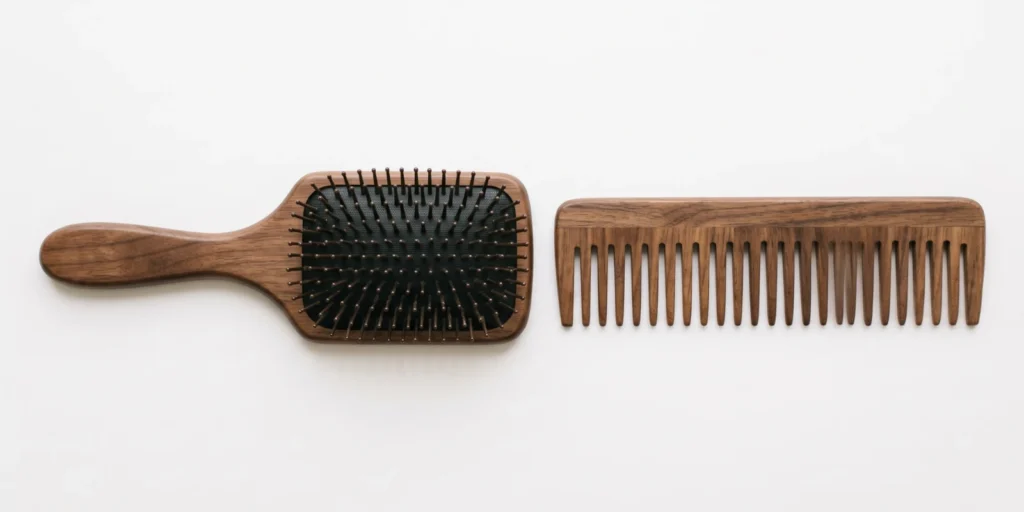
Hair brushes and hair combs are frequently treated as interchangeable tools — two ways of doing the same thing. In practice, they perform different mechanical functions on the hair shaft, are appropriate at different stages of the hair care routine, and produce different outcomes when used on different hair types. Using the wrong tool at the wrong stage is one of the most common sources of preventable breakage, frizz, and styling failure.
This guide covers the structural differences between brushes and combs, the specific functions each performs best, which hair types and conditions favour one over the other, and how the two tools work as complementary parts of a complete hair care routine. For brand developers and importers building hair brush and hair comb ranges, the brush-versus-comb distinction also maps directly onto product segmentation and packaging claim decisions.
How Brushes and Combs Differ Structurally
The fundamental difference between a brush and a comb is contact point density and the way each tool moves through the hair.
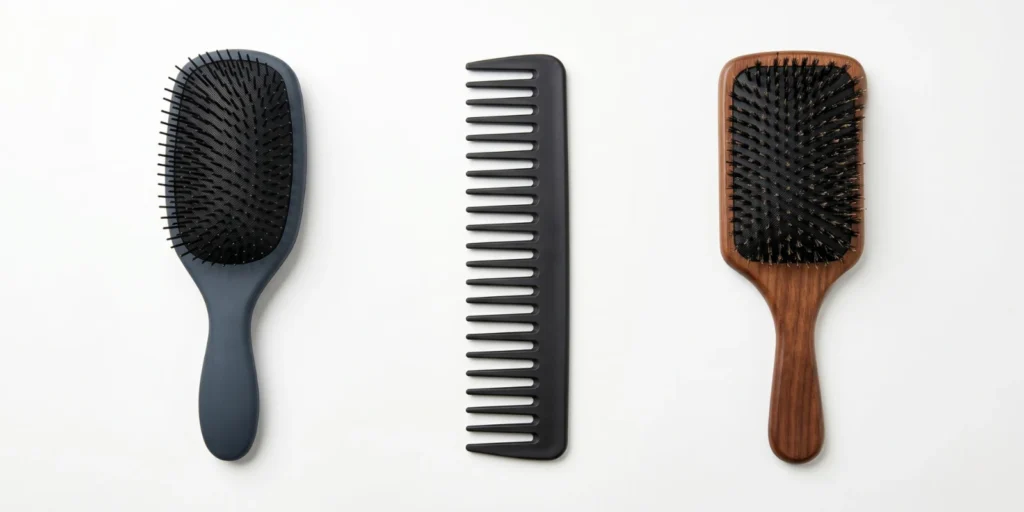
A brush has multiple rows of pins or bristles set into a base, creating a wide surface area of contact points per stroke. The base — whether rigid or air-cushioned — determines how much pressure each pin applies to the scalp and shaft. Brush strokes cover large sections of hair simultaneously and are designed to smooth, distribute, style, or detangle across the full surface of the hair mass.
A comb has a single row of teeth with consistent spacing between them, creating a far lower contact point density per stroke than any brush. The teeth pass through the hair in a line rather than across a surface, which means the force applied per tooth is lower and the path through the hair is more predictable. Combs are precise instruments — they follow a defined line through the hair rather than engaging the full volume.
This structural difference explains why each tool excels at different functions and why neither is a universal substitute for the other.
What a Brush Does Best
Surface Smoothing and Cuticle Finishing
Brushes — particularly boar bristle and mixed bristle paddle brushes — are the appropriate tool for smoothing the cuticle surface across the full length of the hair. The wide base and high bristle density mean that each stroke makes contact with a large number of strands simultaneously, laying the cuticle scales flat and producing the even light reflection associated with shine. A comb cannot replicate this function because its single row of teeth contacts only the strands in the specific line of each stroke.
Sebum Redistribution
As covered in detail in our article on whether boar bristle brushes genuinely reduce frizz, boar bristle brushes redistribute scalp oils from the root zone along the mid-lengths and tips during brushing. This sebum redistribution is a brush-specific function — a comb does not pick up and deposit oil in the same way because the surface contact between comb teeth and individual strands is too limited for meaningful oil transfer.
Volumising and Root Lifting
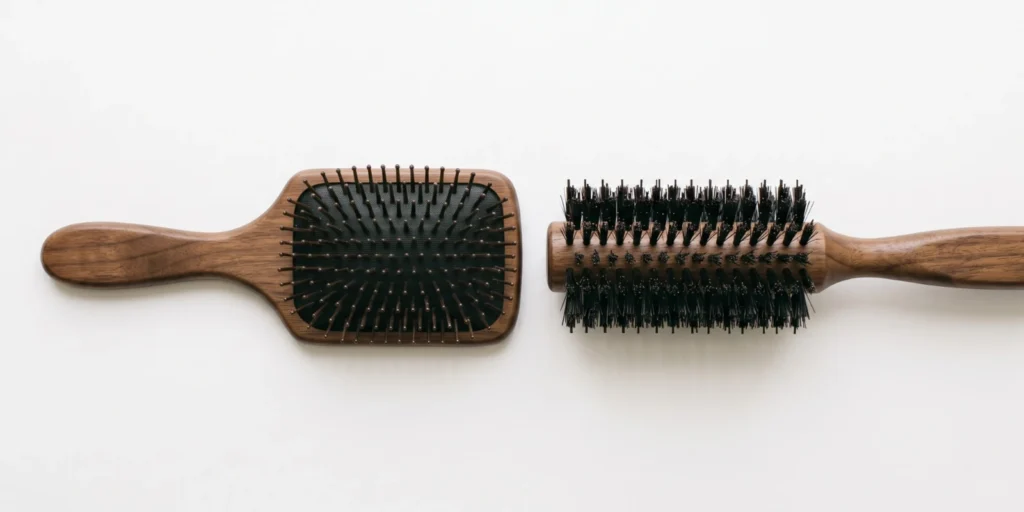
Round brushes and paddle brushes used during blow-drying create tension and lift at the roots that combs cannot provide. The bristle surface grips the hair mass and holds it under tension while heat is applied, creating the volume and directional movement that blow-dry styling requires. A comb used during blow-drying can create directional styling in fine or short hair, but lacks the grip and surface area needed for volume creation in medium to long hair.
Blow-Dry Styling Control
For straightening, wave creation, or curl formation during blow-drying, the round brush barrel diameter and bristle stiffness determine the styling outcome. This is entirely a brush function — no comb replicates the tension, heat distribution, and directional control of a round brush in blow-dry work.
What a Comb Does Best
Precise Sectioning
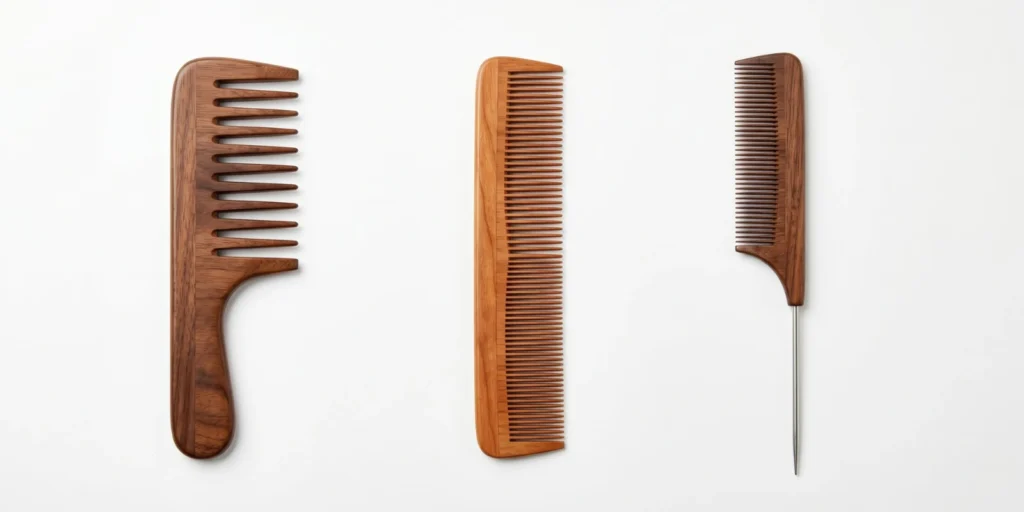
Combs are the standard tool for sectioning hair before cutting, colouring, or styling. The defined tooth spacing creates clean, predictable sections that a brush cannot produce because the wide surface area of a brush engages hair beyond the intended section line. Fine-tooth combs for precise sections, wide-tooth combs for larger sections — this is a comb-specific function.
Wet Hair Detangling
For wet hair, the wide-tooth comb is one of the safest detangling tools available. As discussed in our guide on whether it is bad to brush wet hair, wet hair is structurally vulnerable because water disrupts the hydrogen bonds that give the shaft its rigidity. A wide-tooth comb working through wet, conditioner-coated hair applies force to a smaller number of strands per pass than any brush, reducing the cumulative mechanical load on the swollen, vulnerable shaft.
For curly and coily hair in particular, the wide-tooth comb on wet, product-saturated hair is typically the recommended detangling tool — it works through tangles with minimal disruption to the curl pattern compared to any brush type.
Distribution of Styling Products
Running a comb through product-coated hair distributes cream, gel, or leave-in conditioner more evenly than a brush because the defined tooth spacing creates a consistent application pattern through the hair. For curly hair application of styling product, a wide-tooth comb is more effective than a brush because it distributes the product while minimally disturbing the natural curl formation. A brush would either disrupt the curl or, in the case of a fine-tooth comb equivalent, apply too much friction.
Precision Styling in Short Hair
For short hair, fine-tooth combs offer directional styling control that brushes cannot match at small scales. Creating precise partings, directing individual sections during styling, and working product through short hair are all functions where the comb’s precision outperforms the brush’s surface coverage.
Scalp Parting and Scalp Care Massage
Rat-tail combs — with a fine pointed handle — are the standard tool for creating clean scalp partings. No brush replicates this function. Wider, round-tooth combs used with gentle pressure also provide scalp stimulation during detangling that is different in character from brush scalp contact.
Hair Type Considerations: Brush or Comb?
Fine and Thin Hair
Fine hair benefits from both tools at different stages. For wet detangling, a wide-tooth comb minimises the force applied per strand. For dry finishing, a soft boar bristle brush is the most appropriate tool for smoothing and sebum redistribution. Fine hair consumers brushing with hard nylon pins for daily maintenance — and experiencing frizz and static as a result — are using the wrong tool for the function. A more complete discussion of the correct brush-comb combination for fine hair is available in our guide on the best hair brush for fine and thin hair.
Medium Hair
Medium hair can use a flexible detangling brush for wet work and a mixed bristle or boar bristle paddle brush for dry maintenance with good results. A wide-tooth comb remains appropriate for wet detangling and product distribution, and a fine-tooth comb for sectioning. Medium hair is the most versatile hair type in terms of tool tolerance — both brushes and combs perform well across their respective functions.
Thick and Coarse Hair
Thick hair benefits from a wide-tooth comb for initial wet detangling — the lower contact point density limits the force required to work through dense knot accumulations. A mixed bristle or nylon pin paddle brush is appropriate for dry maintenance once knots have been removed. Attempting to dry-brush thick hair that has not been detangled first is one of the most common causes of breakage in this hair type, regardless of brush specification.
Curly and Coily Hair
For Type 3 and Type 4 hair, the wide-tooth comb on wet, product-saturated hair is the primary detangling tool. Dry brushing curly hair with any brush type disrupts the curl pattern and produces frizz — a point covered in detail in our article on why brushing makes hair frizzy and what to do instead. The comb is not a secondary or budget alternative for curly hair — it is the structurally correct tool for this hair type’s primary care function.
When to Use Each in the Hair Care Routine
The brush and comb are most effective when used at specific stages rather than interchangeably.
Pre-Wash
A wide-tooth comb used on dry hair before washing removes surface knots and distributes any pre-wash treatment product evenly. This reduces the severity of wet detangling after washing because the hair enters the wash step in better initial condition. A paddle brush used pre-wash on dry hair is also effective for removing knots in straight and wavy hair, but the comb is safer for pre-wash detangling in curly or coily hair to avoid pre-disrupting the curl before it becomes fully saturated.
In the Shower or Immediately Post-Wash
Wide-tooth comb or flexible detangling brush on conditioner-saturated wet hair. This is the critical detangling stage, and it should always use a tool designed for wet-hair contact — never a boar bristle or hard nylon pin brush.
Damp to Dry Transition
A boar bristle or mixed bristle paddle brush used as the hair dries from damp to dry performs the sebum redistribution and cuticle smoothing function most effectively at this stage. A comb used at this stage provides less smoothing benefit but is appropriate for re-establishing sections or directional styling.
Fully Dry — Daily Maintenance and Finishing
A boar bristle paddle brush for fine-to-medium hair, mixed bristle for medium-to-thick hair. This is the brush’s primary performance stage. A comb used at this stage is appropriate for sectioning, precision styling, or directing short hair, but does not replicate the surface smoothing and shine-enhancement function of a brush on longer hair.
Styling
The tool selection depends entirely on the style being created. Blow-drying for volume uses a round brush. Blow-drying for smoothness uses a paddle brush. Product distribution uses a wide-tooth comb. Precision partings use a rat-tail comb. Each function maps to a specific tool, and substituting a brush for a comb or vice versa at the styling stage typically produces a worse outcome.
Sourcing Considerations for B2B Buyers
For buyers building hair tool ranges that include both brushes and combs, the functional distinction between the two categories supports clear range architecture decisions.
Product segmentation: Combs and brushes are not competing products within the same category — they perform complementary functions at different stages of the hair care routine. Ranging both and communicating their distinct use cases produces higher average transaction values as consumers understand the need for both tools.
Packaging claims: Brushes should be positioned around their primary performance advantages — smoothing, sebum redistribution, volumising, blow-dry control. Combs should be positioned around precision, detangling, sectioning, and wet-hair safety. Positioning a comb as a budget alternative to a brush, or a brush as a comb substitute, creates expectation mismatches at the consumer level.
Hair type differentiation: Both brushes and combs can be differentiated by hair type within the range — wide-tooth combs positioned for curly and thick hair detangling, fine-tooth combs for straight hair styling and sectioning, rat-tail combs for colouring and precision work. This segmentation mirrors the approach recommended for brush ranges in our broader guide on how to choose the right hair brush for your hair type.
Material and tooth specification: Comb material affects both durability and the friction generated against the hair shaft. Seamless-tooth combs, produced without visible mould seams on the tooth edges, generate less friction and snagging than standard moulded teeth — a specification variable that is directly relevant to wet-hair safety positioning and premium tier differentiation.
Both hair brushes across paddle, round, and detangling formats and hair combs across wide-tooth, fine-tooth, and rat-tail specifications are available through OEM and private label manufacturing routes, with material, tooth specification, and handle design adjustable to range requirements.
Frequently Asked Questions
Is a hair comb better than a hair brush?
Neither is universally better — they perform different functions. Combs are better for wet detangling, sectioning, product distribution, and precision styling. Brushes are better for surface smoothing, sebum redistribution, volumising, and blow-dry styling. The correct approach is to use both tools at the stages of the hair care routine where each performs best.
Can I use a comb instead of a brush for daily hair care?
A comb can detangle and section effectively, but it does not replicate the cuticle-smoothing and sebum redistribution functions of a boar bristle brush on dry hair. For consumers whose primary goals are shine enhancement and frizz reduction in straight or wavy hair, a comb alone is insufficient as a daily maintenance tool. For curly hair consumers whose primary goal is detangling without pattern disruption, a comb may be the more appropriate primary tool.
Which is better for detangling — a brush or a comb?
For wet hair, a wide-tooth comb or flexible detangling brush is most appropriate, with the comb preferred for very dense or curly hair due to lower contact point density. For dry detangling in straight and wavy hair, a flexible detangling brush or wide-tooth comb both work well depending on knot severity. Rigid brushes — boar bristle or hard nylon pin — should not be used as detangling tools on heavily knotted or wet hair.
What type of comb is best for curly hair?
A wide-tooth comb used on wet, conditioner-saturated hair is the standard recommendation for curly hair detangling. The wide spacing between teeth limits friction per pass and avoids the curl disruption that any brush causes when used dry. For coily hair with very tight curl patterns, finger detangling before comb use reduces the mechanical force required at the comb stage.
Should I brush or comb my hair first?
For dry straight or wavy hair, a brush is generally used first for detangling and smoothing, followed by a comb if sectioning or precision styling is needed. For wet or damp hair, a comb or flexible detangling brush should be used first to work through knots before any brush contact. For curly hair, wet combing first — followed by product application and no further brushing — is the standard approach.
Does a comb cause less breakage than a brush?
On wet hair, a wide-tooth comb causes less breakage than most brushes because the lower contact point density reduces the cumulative mechanical load per stroke. On dry hair with no knots, a correctly specified brush (boar bristle, air-cushion base) causes no more breakage than a comb and produces additional smoothing benefits that a comb does not. Breakage risk is primarily determined by tool appropriateness for the hair’s current condition, not by brush versus comb as a category.
Conclusion
Hair brushes and hair combs serve distinct mechanical functions that complement rather than replace each other. Brushes excel at surface smoothing, sebum redistribution, volumising, and blow-dry styling — functions that depend on high contact point density and surface coverage. Combs excel at wet detangling, sectioning, product distribution, and precision styling — functions that depend on defined tooth spacing and low friction per pass. The most effective hair care routines use both tools at the stages where each performs best, rather than defaulting to one at the expense of the other.
For brand developers building hair tool ranges, the complementary positioning of brushes and combs — each with clearly differentiated functions, hair-type recommendations, and use-stage guidance on packaging — supports both stronger consumer outcomes and higher average range transaction values. Manufacturers such as JunYi Beauty, which produces hair brushes across paddle, round, and detangling formats alongside hair combs across wide-tooth, fine-tooth, and styling specifications from its Dongguan facility, represent the type of OEM partner suited to brands building complete, function-differentiated hair tool ranges.