Brushing wet hair is one of the most common hair care practices and one of the most consistently misunderstood. The short answer is that wet hair is more vulnerable to mechanical damage than dry hair — but the full picture is more nuanced than a simple yes or no. The risk of brushing wet hair depends on the tool used, the technique applied, the hair type involved, and what the brushing is intended to achieve.
For consumers, this matters because the wrong approach to wet-hair brushing is a primary cause of breakage, split ends, and cuticle damage that compounds over time. For brand developers and importers sourcing hair brush ranges, it is also directly relevant to product positioning: the brushes appropriate for wet hair and the brushes appropriate for dry hair are structurally different products, and positioning them correctly reduces consumer mismatches and the breakage complaints that follow.
Why Wet Hair Is More Vulnerable Than Dry Hair
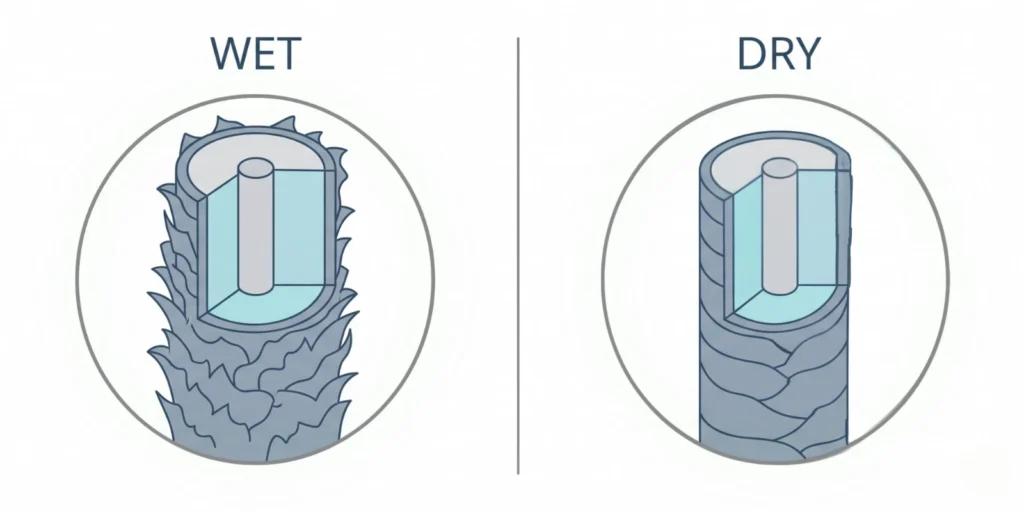
The hair shaft is composed primarily of keratin protein arranged in a cortex surrounded by an outer cuticle layer. When hair is wet, water molecules penetrate the cortex and disrupt the hydrogen bonds that give the shaft its structural rigidity. The result is a strand that is significantly more elastic and more vulnerable to mechanical stress than the same strand in its dry state.
Wet hair can stretch to approximately 30 percent of its original length before breaking under tension, compared to approximately 20 percent when dry. This sounds like an advantage, but the problem is that stretching beyond the elastic limit of the hair causes permanent deformation — the bonds that were disrupted by water do not reform correctly under tension, and the strand does not return to its original structure when it dries. Repeated mechanical stress on wet hair accumulates as breakage, thinning, and split ends over time.
The cuticle layer is also more vulnerable when wet. The cuticle scales — which lie flat when the hair is healthy and dry — swell and lift slightly in the presence of water, making them easier to snag, chip, and remove during brushing. Each pass of a rigid brush through wet, knotted hair removes or damages cuticle material that cannot be restored.
This is the biological basis of the advice to avoid brushing wet hair. But it does not mean wet-hair brushing should never occur — it means it requires the right tool and technique.
The Difference Between Brushing and Detangling
A distinction that is frequently collapsed in consumer hair care advice is the difference between brushing and detangling. They are not the same action, and they are not served by the same tools.
Brushing
Brushing refers to running a brush through hair that is already free of knots — for smoothing, distributing oils, adding shine, or styling. This is primarily a dry-hair activity. Brushing wet hair that is already smooth and unknotted carries relatively low breakage risk if done gently with an appropriate brush, but it offers little functional benefit over detangling and introduces unnecessary mechanical contact at a point when the hair is most vulnerable.
Detangling
Detangling refers to working through knots and matted sections in hair that has not been combed since washing or since becoming tangled. This is where the highest breakage risk occurs — whether the hair is wet or dry — because knots create concentration points of mechanical force during brushing. The question of whether to detangle wet or dry is the more practically relevant question for most consumers.
Wet Detangling vs. Dry Detangling: Which Causes Less Damage
The answer depends on hair type, and it is not uniform across all categories.
For Straight and Lightly Wavy Hair
Straight and lightly wavy hair (Type 1 and 2) can generally be detangled either wet or dry, with dry detangling carrying slightly lower structural risk because the shaft is in its most rigid state. However, dry detangling on hair with significant knot accumulation — such as after sleeping or exercise — can cause high-friction breakage when rigid brush pins pull through tangled sections. In practice, most straight-hair consumers detangle in the shower with conditioner applied, which significantly reduces friction during the process and is an acceptable approach provided a suitable brush is used.
For Curly and Coily Hair
For curly and coily hair (Type 3 and 4), wet detangling with conditioner is strongly preferable to dry detangling. The curl pattern creates significantly more knot accumulation than straight hair, and dry detangling of this hair type causes extensive breakage regardless of brush type. Wet detangling with a flexible detangling brush or wide-tooth comb on conditioner-saturated hair is the approach that produces the lowest mechanical damage for these hair types.
This intersection of wet brushing, hair type, and frizz is also discussed in our guide on why brushing makes hair frizzy and what to do instead, which covers the cuticle mechanics in more detail.
For Damaged and Colour-Treated Hair
Chemically processed hair has elevated porosity and a compromised cuticle, which means it absorbs water more rapidly and retains it longer than healthy hair. In wet conditions, damaged hair is disproportionately vulnerable to mechanical stress. For this hair type, wet detangling with a flexible brush and generous conditioner application is necessary, but should be done with particular care — using minimal passes, starting from the ends, and working upward in sections rather than pulling through from root to tip.
The Right Tool for Wet Hair
The most important factor in reducing breakage during wet-hair brushing is the tool used. Rigid brushes designed for dry-hair use are the primary source of wet-hair breakage, not the act of wet brushing itself.
Flexible Nylon Detangling Brushes
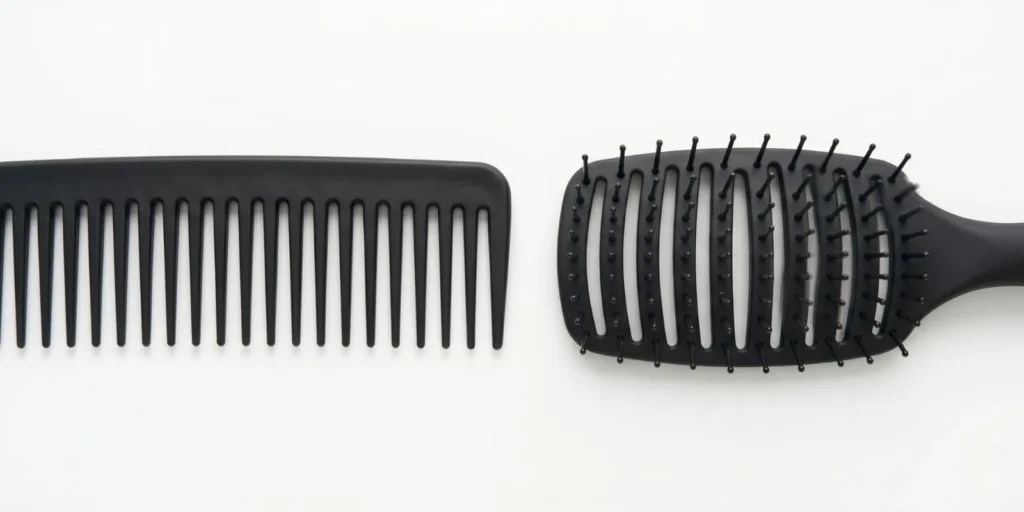
Flexible nylon detangling brushes have a cushioned base and widely spaced, tapered pins engineered to flex under tension. When a pin encounters a knot, it bends rather than pulling through the tangle with the full force of the brushing stroke. This flex-under-tension mechanism dramatically reduces the mechanical force applied to knotted strands and is the principal reason detangling brushes produce less breakage than rigid alternatives on wet hair.
For wet-hair use across most hair types, a flexible nylon detangling brush is the appropriate tool. It is not effective for finishing or styling, but for the specific function of working through knots on wet or damp hair, it is the lowest-breakage option available.
Wide-Tooth Combs
Wide-tooth combs are the other widely recommended tool for wet-hair detangling. The widely spaced teeth pass through hair with fewer contact points per pass than any brush, reducing the accumulation of friction across the full stroke. For very dense or tightly coiled hair, a wide-tooth comb used on wet, conditioner-saturated hair is often preferable to even a flexible detangling brush, as the reduced contact point density minimises the friction load on each individual strand.
What Not to Use on Wet Hair
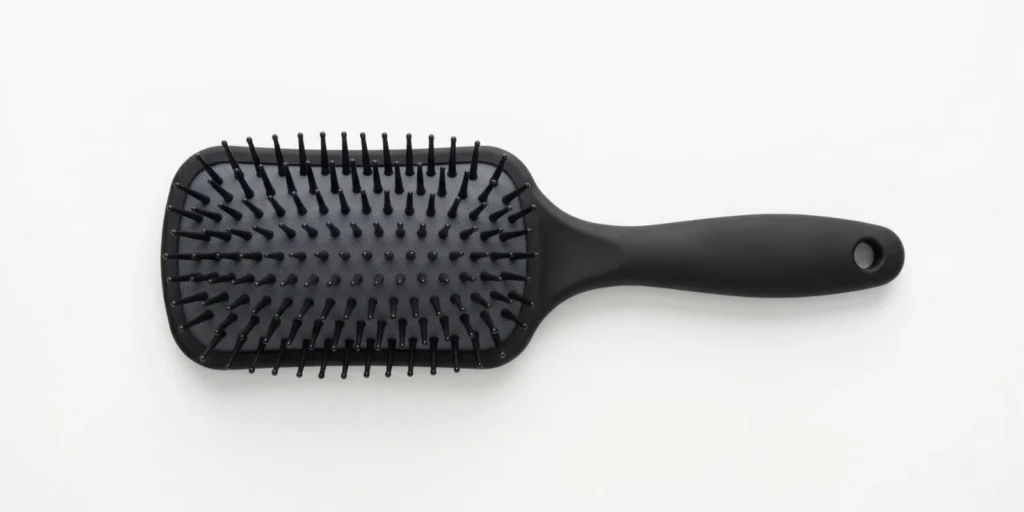
Boar bristle brushes, mixed bristle brushes, and hard nylon pin brushes are not appropriate for wet-hair detangling. Boar bristle lacks the stiffness to work through knots without applying sustained tension to knotted strands, and the natural keratin of the bristle absorbs moisture during wet use, accelerating bristle degradation over time. Hard nylon pins on wet hair combine the vulnerability of the swollen shaft with the high-friction mechanical force of rigid pins — the worst possible combination for breakage risk.
This distinction between wet-hair and dry-hair tools is also central to the brush selection framework in our guide on how to choose the right hair brush for your hair type.
Technique Matters as Much as Tool
Even with the right brush, wet-hair detangling technique significantly affects breakage outcome. The following principles apply regardless of hair type.
Start from the Ends
Working through knots from the ends upward — removing tangles at the tips before moving to mid-lengths, and then roots — distributes the mechanical force of detangling across short sections of hair rather than applying it to the full shaft length simultaneously. Starting from the root and brushing downward forces the brush through the full length of the knot, concentrating tension at each obstruction point and dramatically increasing breakage risk.
Work in Sections
Dividing the hair into sections before detangling reduces the volume of hair the brush must penetrate per pass. For thick and curly hair in particular, working through unsectioned hair means the brush is attempting to detangle many strands simultaneously, with the knots in each strand creating cumulative resistance. Sectioning allows each pass to address a manageable number of strands.
Apply Slip
Conditioner, detangling spray, or leave-in product applied before brushing wet hair coats the hair shaft and reduces the coefficient of friction between strands and between the brush and the hair. The slip provided by product application is one of the most effective single interventions for reducing breakage during wet detangling. For curly and coily hair, detangling without slip is strongly inadvisable regardless of tool or technique.
Avoid Immediate Post-Wash Brushing
Hair is at its most vulnerable in the first few minutes after wetting — the cortex has fully absorbed water and hydrogen bonds are at their most disrupted. Allowing hair to drain and beginning to return to a damp rather than soaking-wet state before brushing reduces peak vulnerability. The difference between soaking wet and damp is meaningful for breakage risk, particularly in fine and damaged hair.
What Happens If You Brush Wet Hair Daily with the Wrong Tool
The consequences of regular wet brushing with inappropriate tools accumulate gradually and are often attributed to other factors. The progression typically follows this pattern:
Initially, consumers notice increased hair in the brush and a perception of thinning at the ends. At this stage, breakage is occurring primarily at the mid-length to tip section where knots concentrate force. Over weeks and months, split ends proliferate as the cuticle is repeatedly stripped from the ends during detangling. The hair begins to feel rough and dull — the cuticle surface has been sufficiently damaged that light no longer reflects evenly from the shaft. At more advanced stages, fine hair in particular may show visible reduction in density as breakage accumulates faster than the growth rate compensates.
None of these outcomes are inevitable. They are the product of tool mismatch — using a rigid dry-hair brush on wet hair — combined with technique errors such as root-to-tip brushing direction and detangling without slip.
Damp Hair: The Middle Ground
For most hair types, damp hair — after towel-drying to remove excess moisture but before the hair has fully dried — represents a useful compromise between the vulnerability of soaking-wet hair and the brittleness of fully dry hair. Hair at the damp stage has returned some of its elasticity while retaining enough moisture to allow the cuticle to lie flat after brushing.
For straight and wavy hair types that are using a boar bristle or mixed bristle paddle brush for daily maintenance, brushing at the damp stage rather than either wet or completely dry produces the most favourable combination of cuticle condition and breakage risk. The sebum redistribution effect of boar bristle works on damp hair, and the cuticle disturbance caused by static — more pronounced on fully dry hair in low-humidity environments — is reduced.
This timing consideration is particularly relevant for the frizz outcomes covered in our article on whether boar bristle brushes genuinely reduce frizz.
Sourcing Considerations for B2B Buyers
For buyers developing hair brush ranges, the wet-hair versus dry-hair distinction is a critical product positioning variable that is frequently under-communicated at the retail level.
Dedicated wet-hair tools — flexible nylon detangling brushes and wide-tooth combs — should be positioned explicitly for wet and damp-hair use, with packaging that communicates the hair-type range, the appropriate moisture state, and the technique (ends-to-roots, with slip product). These are not budget alternatives to standard brushes; they are specialist tools for a specific function.
Dry-hair tools — boar bristle, mixed bristle, and hard nylon pin brushes — should carry clear guidance that they are not designed for wet-hair detangling. Including this guidance on packaging reduces the product misuse that generates breakage complaints and negative reviews.
Range architecture that separates wet-hair and dry-hair tools into distinct product categories — rather than marketing a single brush as suitable for all conditions — produces better consumer outcomes and supports higher average transaction values by creating a legitimate need for two complementary tools.
Anti-breakage positioning for flexible detangling brushes is a packaging claim that is well supported by the mechanism: flexible pins genuinely do reduce mechanical force on knotted wet hair compared to rigid alternatives. This is a claim that can be made with material confidence and that resonates with consumers in markets where breakage and hair health are primary purchase drivers.
Both flexible nylon detangling brushes and the full range of dry-hair brush formats are available through OEM and private label manufacturing routes, with pin flexibility, cushion base specification, and handle design adjustable to range positioning requirements.
Frequently Asked Questions
Is it always bad to brush wet hair?
Not always — it depends on the tool and technique. Brushing wet hair with a rigid boar bristle or hard nylon pin brush causes significant breakage because the swollen, vulnerable shaft is subjected to high-friction, high-force mechanical contact. Using a flexible nylon detangling brush or wide-tooth comb, starting from the ends, and applying conditioner or detangling spray before brushing makes wet-hair detangling safe for most hair types.
What is the safest brush to use on wet hair?
A flexible nylon detangling brush with a cushioned base and tapered, widely spaced pins is the safest option for most hair types. The flexible pins bend under tension rather than pulling through knots, which significantly reduces the mechanical force applied to vulnerable wet strands. Wide-tooth combs are also appropriate, particularly for dense curly and coily hair.
Can brushing wet hair cause permanent damage?
Repeated wet brushing with inappropriate tools can cause cumulative cuticle damage that produces permanently rough, dull hair over time. Split ends caused by wet brushing cannot be repaired — they can only be removed by cutting. Breakage that occurs below the scalp does not grow back as the same strand; the follicle must produce an entirely new hair. Consistent wet brushing with the right tool and technique does not cause permanent damage.
Is it better to detangle hair wet or dry?
For straight and lightly wavy hair, either approach works with the right tool, though damp brushing with a flexible brush or wide-tooth comb is lower risk than dry detangling for heavily knotted hair. For curly and coily hair, wet detangling on conditioner-saturated hair is clearly preferable to dry detangling, which disrupts the curl pattern and causes significantly more breakage.
Does using conditioner before brushing wet hair actually help?
Yes, significantly. Conditioner and detangling products coat the hair shaft and reduce the coefficient of friction between strands and between the brush and the hair. This slip reduction lowers the force required to work through knots and directly reduces breakage during wet detangling. For curly and coily hair, detangling without slip product is one of the most common causes of preventable breakage.
How should I brush wet hair to minimise breakage?
Use a flexible nylon detangling brush or wide-tooth comb. Apply conditioner or detangling product before brushing. Allow the hair to move from soaking wet to damp before beginning. Start at the ends and work upward in sections. Avoid root-to-tip brushing direction on knotted hair. Do not rush — wet detangling should be slower and more deliberate than dry brushing.
Conclusion
Wet hair is structurally more vulnerable than dry hair because water disruption of hydrogen bonds reduces shaft rigidity and lifts the cuticle scales. Brushing wet hair with rigid tools designed for dry-hair use causes cuticle damage and breakage that accumulates over time. However, wet detangling with appropriate tools — flexible nylon detangling brushes and wide-tooth combs, used with slip product and an ends-to-roots technique — is safe and in some hair types preferable to dry detangling. The critical variable is not whether hair is wet but whether the tool and technique match the vulnerability state of the hair at that moment.
For brands and buyers, this distinction creates a clear product category: wet-hair tools are not a budget alternative to standard brushes but a specialist segment with a specific mechanism, specific performance claim, and specific consumer need. Manufacturers such as JunYi Beauty, which produces flexible nylon detangling brushes alongside the full range of dry-hair paddle, round, and boar bristle formats from its Dongguan facility, represent the type of OEM partner suited to brands building ranges that address both wet-hair and dry-hair brushing needs with appropriately specified tools.