Packaging is the last specification decision most buyers make and the first thing a consumer interacts with. For custom hair brush orders, packaging choices affect unit cost, retail shelf appeal, e-commerce fulfilment compatibility, sustainability positioning, and the minimum order quantities required to make custom print runs economically viable. Getting packaging decisions wrong — either by under-specifying or by selecting formats incompatible with the target retail channel — generates costs that are difficult to recover after production.
This guide covers the primary packaging material options for custom hair brush products, the format decisions that affect retail and e-commerce performance, print and branding specifications, sustainable packaging considerations, and the MOQ realities that determine which options are accessible at different order volumes. For buyers working through the full pre-order process, this article complements the checklist covered in our guide on 10 things to check before placing a custom hair brush order.
Why Packaging Specification Matters More Than Most Buyers Expect
Hair brush packaging serves four distinct functions, each of which places different requirements on the format and material choices:
Retail presentation requires that the packaging communicates product positioning — bristle type, hair-type suitability, brand identity — quickly and legibly at shelf level, and that the format is compatible with the retail environment (hanging, shelf-standing, or shelf-ready display).
Consumer communication requires that the packaging carries the hair-type and use-case information consumers need to make a correct purchase decision. Packaging that fails to communicate this clearly drives returns and negative reviews regardless of how well the product itself performs.
Product protection requires that the packaging survives the supply chain — warehouse storage, shipping, retail handling, and in the case of e-commerce fulfilment, the additional stress of parcel delivery — without damage to either the packaging or the brush.
Channel compatibility requires that the packaging format, dimensions, and labelling comply with the specific requirements of the retail or fulfilment channel: hanging pegboard display for pharmacy, shelf-stand for salon retail, Amazon-compliant polybag and label placement for FBA, or retailer-specific shelf-ready configurations for supermarket chains.
Packaging that satisfies one of these functions while failing another creates operational problems that are typically discovered after production is complete.
Primary Packaging Material Options
Paperboard and Cardboard
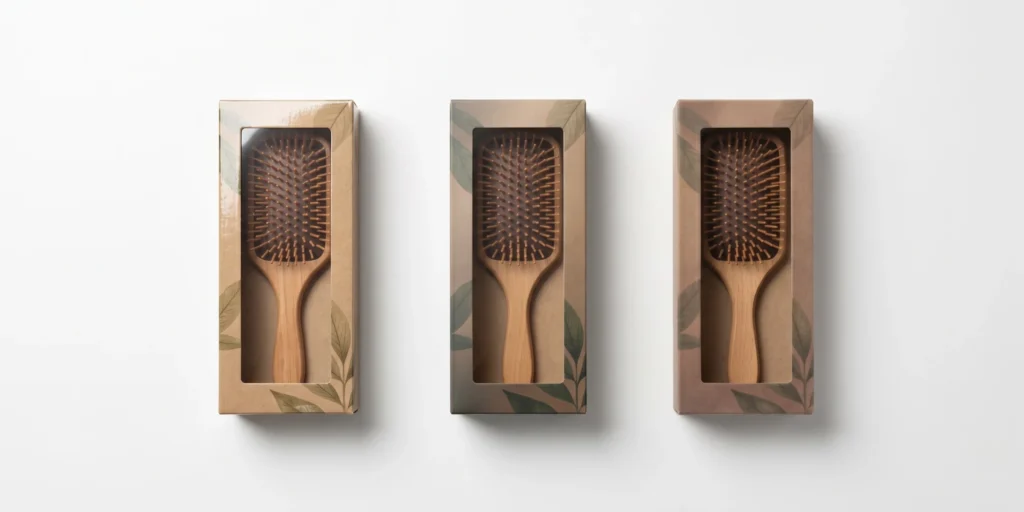
Paperboard is the most widely used packaging material for retail hair brushes. It offers high printability, structural rigidity, and cost efficiency at moderate to high volumes. Within the paperboard category, the relevant variables are board weight (typically 300gsm to 400gsm for hair brush packaging), surface treatment (coated for print quality, uncoated for a natural or craft aesthetic), and finish options (gloss lamination, matte lamination, soft-touch lamination, or UV spot varnish).
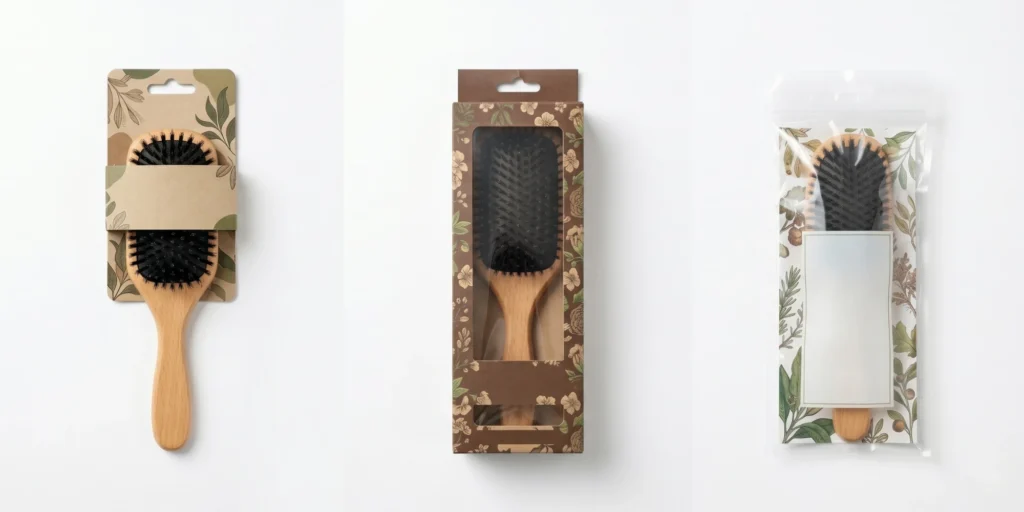
Paperboard packaging for hair brushes most commonly takes the form of a header card attached to the brush handle with a hang hole for pegboard display, a wrap-around card sleeve that encases part of the brush while leaving the bristle visible, or a fully enclosed box with a window cut-out.
The print quality achievable on coated paperboard is high, making it the most appropriate format for brands where shelf visual impact is a primary purchase driver. The limitation is that paperboard is not waterproof, making it unsuitable for products stored or displayed in wet environments such as shower retail sections.
Polybag with Insert Card
A clear polybag with a printed insert card is the most common format for e-commerce and Amazon FBA fulfilment. It provides product protection during parcel delivery, allows the product to be visible to the consumer, and accommodates the FNSKU label and suffocation warning text required for Amazon FBA compliance without additional labelling steps at the fulfilment centre.
The polybag format has a lower minimum order quantity for custom print than rigid paperboard packaging, because the insert card can be printed at smaller volumes than a custom-printed box. For brands testing a new SKU at low volumes before committing to full retail packaging, a polybag with printed insert card is the lowest-cost entry point for a branded presentation.
The limitation of polybag packaging is that it does not present well in physical retail environments — the format signals e-commerce rather than retail, and it does not carry the same shelf presence as a structured paperboard format.
Window Box
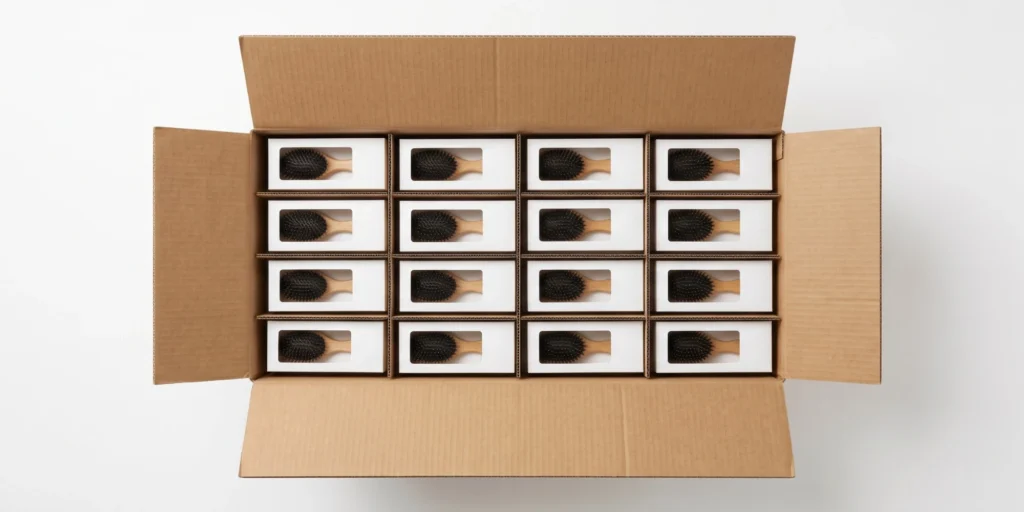
A fully enclosed box with a die-cut window allows the consumer to see the brush — specifically the bristle type and texture — without opening the packaging. This format provides strong retail shelf presence, a premium presentation, and full surface area for brand communication and hair-type messaging. It is the most appropriate format for premium-positioned brushes where both the product quality and the brand positioning need to be communicated at the point of sale.
Window boxes require a higher minimum print run than header cards or insert cards, and the die-cut window adds tooling cost to the packaging production. For buyers placing their first custom order at lower volumes, the window box format may not be economically viable without accepting a higher per-unit packaging cost.
Blister Card
A blister card — a printed card with a thermoformed plastic blister that holds the brush — is used primarily in mass-market retail and pharmacy channels. It offers full product visibility, tamper evidence, and pegboard compatibility. The blister thermoform requires a mould specific to the brush dimensions, which adds tooling cost on top of print costs. For mass-market retailers that require this format, the tooling cost is typically amortised across large volumes, making it viable at scale but not at low test volumes.
Format and Configuration Decisions
Hang Hole Positioning
For any packaging format intended for pegboard display, the hang hole position must be compatible with the retailer’s peg spacing and the overall weight of the packaged unit. A brush displayed from a hang hole that cannot support its weight will result in damaged packaging at the retail fixture — a common source of retailer complaints on hair brush products. Before finalising packaging design, confirm the pegboard specification of the target retailer.
Shelf-Stand Capability
Some header card and box formats are designed to stand on a flat shelf surface as well as hang from a pegboard — a dual-function configuration that expands placement flexibility. This is a structural consideration that should be addressed in the packaging design stage, not retrofitted after the print artwork is finalised.
Inner Carton and Master Carton Configuration
The number of units per inner carton and per master carton determines the dimensional weight of the shipping unit, the stacking efficiency in the warehouse, and the compliance with retailer delivery specifications. Many retailers specify exact inner carton quantities and master carton dimensions as a condition of delivery. Confirming these requirements before finalising packaging dimensions prevents the need for repackaging on arrival.
For Amazon FBA, the maximum carton weight (typically 23kg) and the FNSKU label placement on individual units are non-negotiable compliance requirements. Building these into the packaging specification before production prevents FBA compliance failures at the point of check-in.
Print and Branding Specifications
Print Method
The most common print methods for hair brush retail packaging are offset lithography (high quality, appropriate for large runs), digital printing (suitable for short runs and variable data, lower per-unit cost at small quantities but higher per-unit cost at scale), and flexographic printing (lower quality than offset but cost-effective for simple designs at high volumes).
For most custom hair brush packaging at the volumes relevant to brand developers — typically 500 to 5,000 units per SKU — offset or digital printing are the relevant options. Digital printing is increasingly accessible and economical for runs under 1,000 units.
Finish Options
Surface finish affects both the perceived quality of the packaging and its durability in the supply chain. The standard options are:
Gloss lamination — high sheen, strong colour saturation, fingerprint-visible. Appropriate for premium and mass-market retail where visual impact is the priority.
Matte lamination — soft, flat finish, fingerprint-resistant. Appropriate for brands positioning in the natural, clean beauty, or professional segments where the matte aesthetic communicates quality.
Soft-touch lamination — a tactile finish that creates a velvet-like surface feel on the packaging. A genuine differentiation feature at the retail fixture for premium-positioned brushes, but adds cost per unit.
UV spot varnish — gloss varnish applied selectively to specific design elements (logo, product name) over a matte base, creating a contrast finish that highlights key brand elements.
Colour Matching
Pantone colour matching should be specified for any brand colour that is critical to brand identity consistency across SKUs and across production runs. Relying on CMYK approximations of brand colours produces variation between print runs that is visible when products are displayed together on shelf. Pantone specification is a standard part of any print brief for a brand with established colour guidelines.
Sustainable Packaging Options
Sustainability in hair brush packaging is an increasingly relevant positioning variable in European and North American markets. The primary options available at realistic MOQs are:
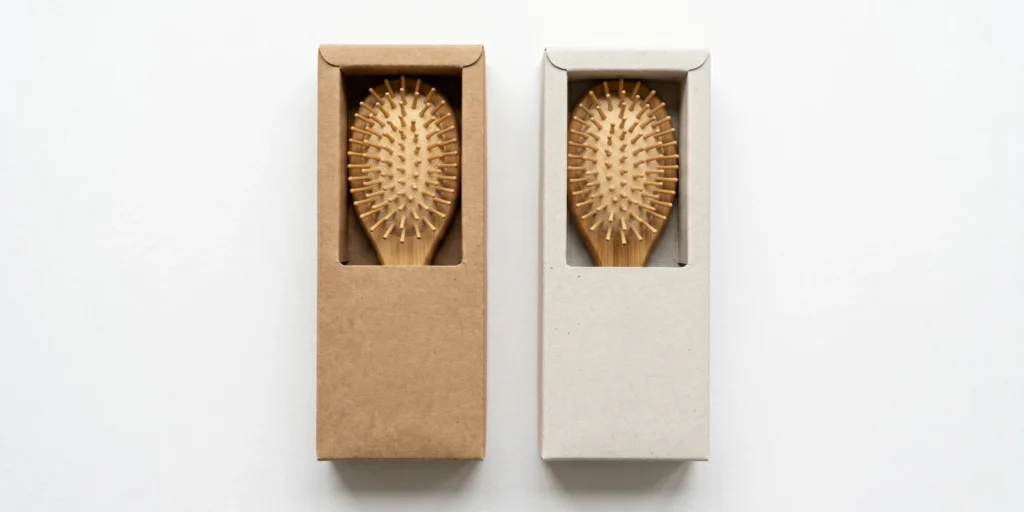
FSC-certified paperboard — paperboard sourced from forests certified by the Forest Stewardship Council. FSC certification is the most widely recognised and credibly substantiated sustainable packaging claim for paper-based materials, and it carries a logo that consumers recognise. FSC-certified board is available at most standard print volumes without significant cost premium.
Recycled content paperboard — packaging produced from post-consumer recycled content, reducing virgin fibre use. The recycled content percentage should be specified and substantiated if used as a packaging claim, as unsubstantiated recycled content claims are subject to increasing regulatory scrutiny in both the EU and US markets.
Soy-based or water-based inks — an alternative to petroleum-based printing inks that reduces VOC emissions during the print process. This claim is verifiable and relatively straightforward to implement at most print suppliers.
Plastic-free packaging — formats that eliminate the plastic blister, polybag, or lamination film from the packaging construction. This typically means unlaminated paperboard or kraft paper packaging with water-based inks. The tradeoff is reduced print quality and lower surface durability compared to laminated alternatives.
Sustainable packaging claims require substantiation documentation — FSC chain of custody certificates, recycled content test reports, or ink specification sheets — to be defensible at retail. Confirming documentation availability before placing the order prevents the situation where the claim is made on packaging but cannot be supported if challenged by a retailer or regulator.
MOQ Realities for Custom Packaging
The minimum order quantities for custom hair brush packaging vary significantly by format and print method. The following ranges are indicative for buyers working with Chinese OEM manufacturers:
| Packaging Format | Typical MOQ | Notes |
|---|---|---|
| Printed insert card (digital) | 200–500 units | Lowest entry point for branded presentation |
| Header card (offset print) | 1,000–2,000 units | Standard retail entry MOQ |
| Window box (offset print) | 1,000–3,000 units | Higher due to die-cut tooling |
| Blister card | 3,000–5,000 units | Blister mould tooling adds cost |
| Polybag (plain) | 500–1,000 units | Lower with unprinted poly |
| FSC-certified paperboard | Same as standard | No MOQ penalty at most suppliers |
For buyers placing initial test orders at low volumes, the most practical approach is a polybag with digital-printed insert card, transitioning to full retail packaging (header card or window box) once the SKU has been validated at market. The packaging transition should be planned before the initial order is placed, so the brush specification and hang hole positioning are designed to accommodate both packaging formats without redesign.
The MOQ decisions around packaging interact directly with brush MOQ and the broader pre-order checklist covered in our guide on how to choose a reliable hair brush factory, and the manufacturing model choices discussed in our article on OEM versus ODM for hair care brands.
Sourcing Considerations for B2B Buyers
For buyers sourcing custom hair brush products through OEM and private label manufacturing routes, the most efficient approach to packaging is to finalise the packaging brief in parallel with — not after — the product specification. The brush dimensions, hang hole requirements, and product claim content are all inputs into the packaging design, and revising any of them after packaging artwork has been completed generates additional design and print costs.
Key decisions to make before briefing packaging production include: target retail channel and its specific format requirements, volume per SKU and the print method this supports, sustainable packaging claims and their substantiation requirements, multilingual label requirements for multi-market distribution, and whether a transitional packaging format (polybag for initial test, retail packaging for scale) is part of the launch plan.
Manufacturers that offer integrated packaging support — including packaging design guidance, print supplier coordination, and compliance checking for target market requirements — reduce the coordination burden on the buyer and limit the risk of specification gaps between the product and its packaging.
Frequently Asked Questions
What is the most cost-effective custom packaging option for a first hair brush order?
A polybag with a digitally printed insert card is the lowest-cost entry point for a branded custom presentation. It has the lowest MOQ of any format, requires no tooling beyond the insert card artwork, and is compatible with e-commerce and Amazon FBA fulfilment. For physical retail, a printed header card at offset MOQ (typically 1,000 to 2,000 units) is the most cost-effective format.
What information must appear on hair brush retail packaging?
At minimum: product name, brand name, hair-type suitability, country of origin, and any legally required warnings for the target market (such as California Proposition 65 warnings for the US market). Barcodes, FNSKU labels for Amazon FBA, and multilingual text requirements depend on the specific retail channel and market.
Can I use FSC-certified packaging at low order volumes?
Yes. FSC-certified paperboard is available at standard retail packaging MOQs without significant cost premium at most print suppliers. The main requirement is that the print supplier holds FSC chain of custody certification, which allows them to pass the FSC claim through to the finished packaging. Confirm this before placing the print order.
What finish makes hair brush packaging look most premium?
Soft-touch matte lamination with UV spot varnish on key design elements — logo and product name — is the combination that most consistently produces a premium tactile and visual experience at the retail fixture. Matte lamination alone is a significant step up from gloss for premium positioning. The addition of soft-touch is the highest-differentiation option within standard print finishing.
How do I ensure packaging is compatible with Amazon FBA?
Each unit must have an FNSKU label visible on the exterior of the packaging, a suffocation warning label on any polybag, and dimensions and weight within Amazon’s FBA carton limits. If the retail packaging does not accommodate an FNSKU label on its exterior, a polybag over the retail packaging is required. Building FBA compliance into the packaging design from the outset avoids the cost of additional labelling or repackaging at the fulfilment centre.
Conclusion
Custom hair brush packaging decisions — material, format, finish, sustainable content, and channel compliance — need to be made with the same specificity as the product specification itself. Packaging that is under-specified, channel-incompatible, or misaligned with the product’s positioning generates costs and operational problems that are preventable with a systematic briefing process. The most practical approach for buyers entering a new SKU is a scalable packaging strategy: a low-MOQ polybag or insert card format for initial market testing, transitioning to full retail packaging as the volume justifies the print run.
For brands sourcing custom hair brush products with integrated packaging support, manufacturers such as JunYi Beauty — which coordinates product specification, packaging design guidance, and compliance requirements from its Dongguan facility — represent the type of OEM partner that reduces the coordination complexity of launching a packaged retail-ready product from a single production source.