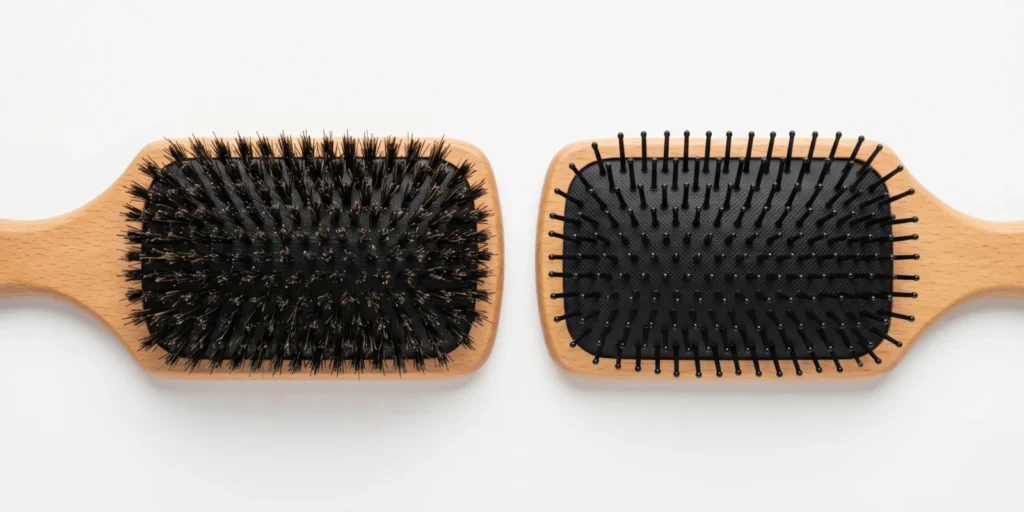
The choice between a boar bristle brush and a synthetic brush is not a question with a single correct answer — it depends on hair type, intended use, and what the brush is expected to do during each session. Both bristle types have legitimate performance advantages, and both have conditions under which they underperform. The framing of boar bristle as universally superior and synthetic as universally inferior is a retail simplification that does not reflect how either material actually behaves against the hair shaft.
For brand developers and importers building hair brush ranges, this comparison is a product segmentation question: which brush belongs in which part of the range, positioned for which consumer, with which performance claim on the packaging.
How Each Bristle Type Interacts with Hair
Before comparing performance outcomes, it is useful to establish what each bristle material actually does at the point of contact with the hair shaft.
Boar Bristle
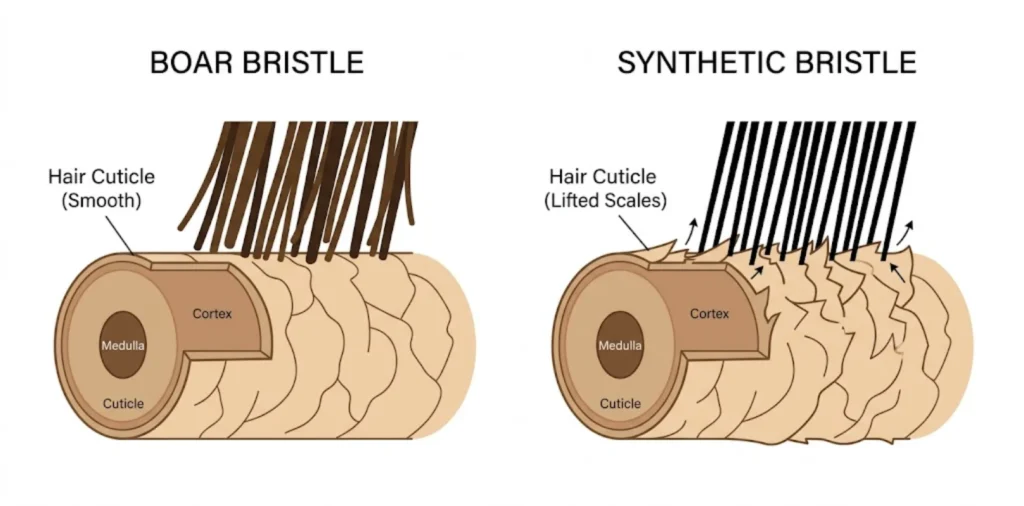
Boar bristle is a natural keratin fibre with a molecular composition structurally similar to human hair. This similarity produces three effects during brushing: it creates less surface friction than synthetic materials, it picks up and redistributes scalp sebum along the shaft, and it generates significantly less static charge than nylon or synthetic alternatives. The net result for appropriate hair types is cuticle smoothing, improved shine, and reduced flyaways.
Boar bristle is soft enough that it does not penetrate deeply into thick or dense hair. It functions primarily as a surface-smoothing and finishing tool rather than a detangling or volumising instrument. For a detailed examination of the specific mechanisms behind boar bristle’s frizz-reduction performance — including where those claims hold up and where they break down — see our article on whether boar bristle brushes really reduce frizz.
Synthetic Bristle
Synthetic bristle — most commonly nylon — is manufactured to a consistent diameter and stiffness across the full length of each pin. This consistency makes it effective for penetrating thick hair, working through knots, and maintaining shape during heat styling. Nylon pins generate more friction and static than boar bristle, which makes them more likely to disturb the cuticle during brushing. However, this friction also gives them the grip and stiffness needed for volumising, root lifting, and sectioning during blow-dry work.
Flexible nylon — used in detangling brushes — is engineered to bend under tension rather than pull through knots, which reduces mechanical stress on the hair shaft and makes it suitable for wet-hair detangling.
Performance Comparison by Hair Type
Fine and Thin Hair
For fine hair, boar bristle is generally the more appropriate choice for dry brushing and finishing. The lower friction reduces cuticle disturbance, and the sebum redistribution adds a light surface coating that improves shine without weighing the strands down — provided brushing frequency is appropriate. Fine hair with low oil production may not generate enough sebum for redistribution to be meaningful, in which case the anti-static benefit alone remains relevant.
Hard nylon pins on fine dry hair generate static charge that causes individual strands to repel each other, producing volume that looks frizzy rather than full. For consumers with fine hair who are brushing for smoothness, synthetic bristle is the less appropriate choice.
Medium Hair
Medium hair is where both bristle types perform competently, and where the use-case distinction becomes the deciding factor. Boar bristle is better for daily maintenance brushing, shine enhancement, and finishing after styling. Synthetic bristle is better for blow-dry work, volumising, and detangling when the hair is damp or knotted. Mixed bristle — combining boar and nylon — is often the most practical single-brush solution for medium hair, as it delivers reasonable performance across both use cases.
Thick and Coarse Hair
Thick hair is where boar bristle has the clearest performance limitation. Pure boar bristle typically lacks the stiffness to penetrate through the lower layers of dense hair, smoothing only the surface while leaving the underlying texture unaddressed. Synthetic nylon pins, with their consistent stiffness and longer penetration depth, are more effective for detangling and blow-dry styling in thick hair. Mixed bristle addresses both needs by combining nylon penetration with boar smoothing.
For thick-hair consumers, a pure boar bristle brush is most useful as a finishing brush used after initial styling rather than as the primary brushing tool.
Curly and Coily Hair
Neither pure boar bristle nor hard synthetic pins are well suited to dry brushing curly and coily hair. Dry brushing of any kind tends to disrupt the curl pattern, separate the strands, and produce frizz rather than smoothness. For Type 3 and 4 hair, flexible nylon detangling brushes used on damp, product-coated hair are the appropriate tool. The boar versus synthetic debate is largely secondary to the wet-versus-dry brushing question for this hair category.
Colour-Treated and Chemically Processed Hair
Damaged, bleached, or chemically processed hair has a compromised cuticle with elevated porosity. Boar bristle is the lower-risk choice for this hair type during dry brushing because the reduced friction and static minimise additional mechanical stress on an already weakened structure. Hard synthetic pins on damaged dry hair compound existing cuticle damage through each stroke. Flexible nylon detangling brushes remain the appropriate choice for wet application on this hair type.
Performance Comparison by Use Case
Daily Maintenance Brushing
For daily maintenance on dry straight and wavy hair, boar bristle outperforms synthetic. The sebum redistribution keeps the cuticle coated and flat between washes, the friction reduction minimises daily cuticle wear, and the anti-static effect keeps strands lying smooth. This is the use case for which boar bristle was historically developed and where its advantages are most consistently demonstrated.
Detangling
For detangling — whether on wet or dry hair — synthetic bristle or flexible nylon is more appropriate than boar. Boar bristle lacks the penetration and stiffness to work through knots effectively without applying repeated mechanical pressure that can cause breakage. Flexible nylon detangling brushes, with their tapered pins that flex under tension, are the most effective and lowest-damage tool for knot removal in most hair types.
Blow-Dry Styling
For blow-dry work, synthetic bristle is the functional choice. Round brushes used for blow-drying require stiff, heat-tolerant bristle that grips the hair and holds tension under heat. Boar bristle round brushes are used in professional blow-dry styling, but typically in mixed bristle configurations where the nylon provides grip and the boar provides the smoothing effect. Pure boar bristle does not hold sufficient tension for most blow-dry applications in medium to thick hair.
Heat Styling and Tool Use
Synthetic nylon bristle is more heat-resistant than natural boar bristle. Brushes used with high heat or in close contact with heated styling tools should have nylon or heat-resistant synthetic bristle. Boar bristle used near direct heat risks singeing and bristle degradation.
Finishing and Shine Enhancement
This is boar bristle’s most distinct performance advantage over synthetic. A light pass with a boar bristle brush over already-styled, smooth hair picks up any remaining surface oils, lays the outermost cuticle scales flat, and produces a visible shine improvement that synthetic bristle cannot replicate. Synthetic bristle used as a finishing brush generates static and may disturb the styled surface rather than enhancing it.
The Mixed Bristle Middle Ground
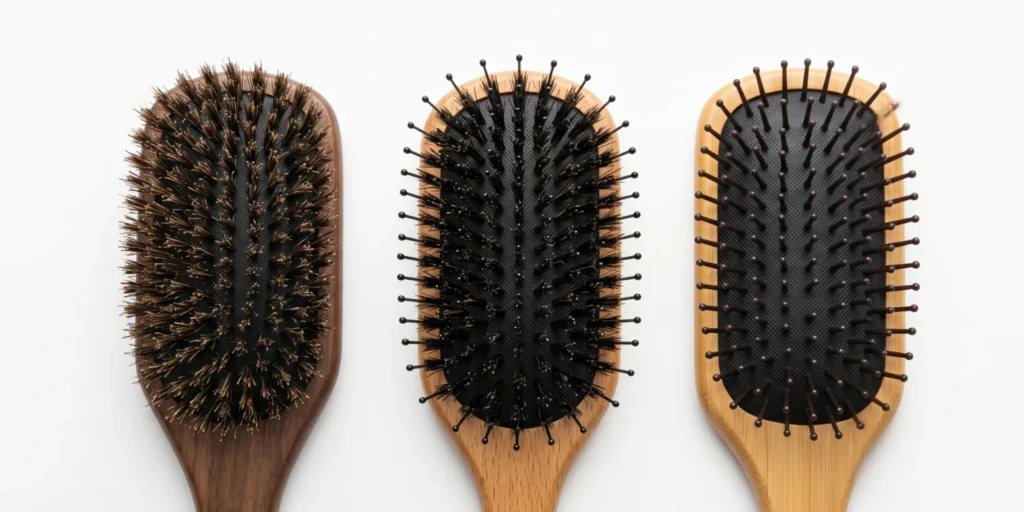
Mixed bristle brushes — combining boar bristle and nylon pins in a single brush — were developed specifically to address the performance gap between the two materials. The nylon pins provide penetration depth and detangling capability; the boar bristles positioned between them deliver smoothing, sebum redistribution, and static reduction on the strands that have already been separated by the nylon.
For a single-brush solution across medium hair types, mixed bristle is often the most practical specification. It does not fully match the finishing performance of pure boar on fine hair, nor the detangling performance of flexible nylon on knotted or wet hair, but it delivers acceptable results across a wider range of use cases than either pure bristle type alone.
In a retail range context, offering pure boar for fine hair finishing, mixed bristle for medium hair daily use, and flexible nylon detangling for wet-hair application covers the main consumer need states without requiring excessive SKU proliferation.
Durability and Maintenance Considerations
Boar bristle requires more careful maintenance than synthetic. Natural bristle absorbs product residue, sebum, and moisture during use, and requires regular cleaning to prevent bristle degradation and odour. Poorly maintained boar bristle brushes lose their smoothing effectiveness as the bristle becomes coated with product build-up.
Synthetic nylon pins are more durable under repeated washing and are unaffected by moisture. They maintain consistent stiffness and shape over time more reliably than natural bristle. For professional environments where brushes are cleaned frequently and shared between clients, synthetic or mixed bristle is more practical than pure boar.
The lifespan of a well-maintained boar bristle brush is typically longer than that of a synthetic brush in daily personal use, but the maintenance requirement is higher. This is a relevant factor for consumer messaging at the retail level and for professional-channel product positioning.
Sourcing Considerations for B2B Buyers
For buyers developing hair brush ranges that include both boar and synthetic products, the bristle type decision is a positioning and segmentation decision as much as a performance decision.
Category structure: A well-structured range positions boar bristle for fine-to-medium hair finishing and daily maintenance, mixed bristle for medium-to-thick hair daily use, and flexible nylon for wet-hair and detangling applications. Hard nylon pin brushes sit in the styling and blow-dry segment. Each category carries a distinct performance claim and hair-type recommendation.
Packaging claims: Boar bristle claims should reference smoothing, shine, and sebum redistribution. Synthetic claims should reference detangling, volumising, and styling control. Overstating boar bristle as a universal frizz solution, or underselling synthetic as purely a budget alternative, creates the expectation mismatches that drive returns and negative reviews.
Price architecture: Boar bristle and mixed bristle command higher retail price points than synthetic due to raw material cost. This supports clear good-better-best range architecture, provided each tier is clearly differentiated by hair type and use case rather than simply by price.
Bristle grade: Within boar bristle, bristle grade and density are the primary quality differentiators. Fine, densely packed bristle for fine hair finishing; firmer, longer bristle for medium hair; mixed with longer nylon pins for thick hair. These are specification variables adjustable in OEM production.
Both boar bristle and synthetic nylon brushes across paddle, round, and detangling formats are available through OEM and private label manufacturing routes, with bristle specification, cushion base, handle material, and finish adjustable to range positioning requirements.
Frequently Asked Questions
Is boar bristle better than synthetic bristle for all hair types?
No. Boar bristle outperforms synthetic for fine-to-medium straight and wavy hair in daily maintenance and finishing applications. For thick hair, curly hair, detangling, and blow-dry styling, synthetic or mixed bristle is more appropriate. The right choice depends on hair type and how the brush is being used.
Can a synthetic brush cause frizz?
Hard nylon pins on dry hair generate static charge and create more cuticle friction than natural bristle, both of which contribute to frizz. For consumers with fine, dry, or frizz-prone hair who brush dry, synthetic pins are more likely to worsen frizz than reduce it. Flexible nylon detangling brushes, used on damp hair, produce significantly less frizz than rigid nylon pin brushes.
What is the difference between a boar bristle brush and a mixed bristle brush?
A pure boar bristle brush contains only natural boar bristle and performs best as a finishing and smoothing tool for fine to medium hair. A mixed bristle brush combines boar bristle with nylon pins — the nylon penetrates deeper for detangling and the boar smooths between strokes. Mixed bristle is more effective for medium to thick hair that needs both functions in one brush.
How often should I replace a boar bristle brush?
A well-maintained boar bristle brush used daily should last two to four years. Signs of replacement include bristle that no longer springs back after brushing, visible splitting or fraying of individual bristles, or a persistent odour despite cleaning. Synthetic brushes used daily typically last one to two years before pin flexibility or density degrades noticeably.
Do synthetic brushes damage hair more than boar bristle?
Rigid nylon pins generate more friction and static than boar bristle during dry brushing, which means more cuticle disturbance per stroke. However, flexible nylon detangling brushes are specifically engineered to reduce mechanical stress during wet detangling, and in that application they cause less breakage than any bristle type used incorrectly.
Conclusion
Boar bristle and synthetic bristle serve different functions, and both have hair types and use cases for which they are the better tool. Boar bristle delivers measurable advantages in surface smoothing, sebum redistribution, and static reduction for straight and lightly wavy hair during dry maintenance brushing. Synthetic bristle delivers advantages in penetration depth, detangling capability, heat resistance, and blow-dry grip for thick, curly, or wet hair. Mixed bristle spans the middle ground for medium hair consumers who need a single brush to handle both functions adequately.
For brand and retail buyers, the practical implication is that a range built around bristle type rather than hair type will produce mismatched consumer outcomes. Positioning by hair type and use case — with boar, mixed, and synthetic each serving clearly defined consumer need states — is the more effective approach to both range architecture and consumer satisfaction. Manufacturers such as JunYi Beauty, which produces brushes across all three bristle categories with adjustable specification from its Dongguan facility, represent the type of OEM partner suited to brands developing differentiated, hair-type-specific ranges.