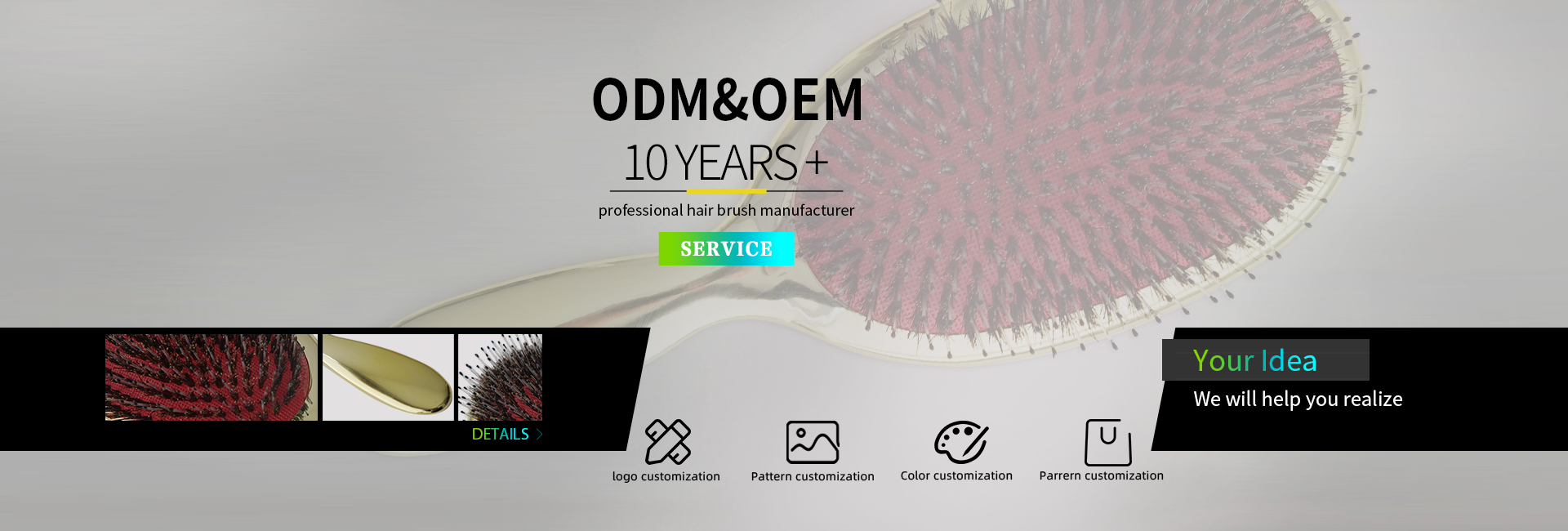
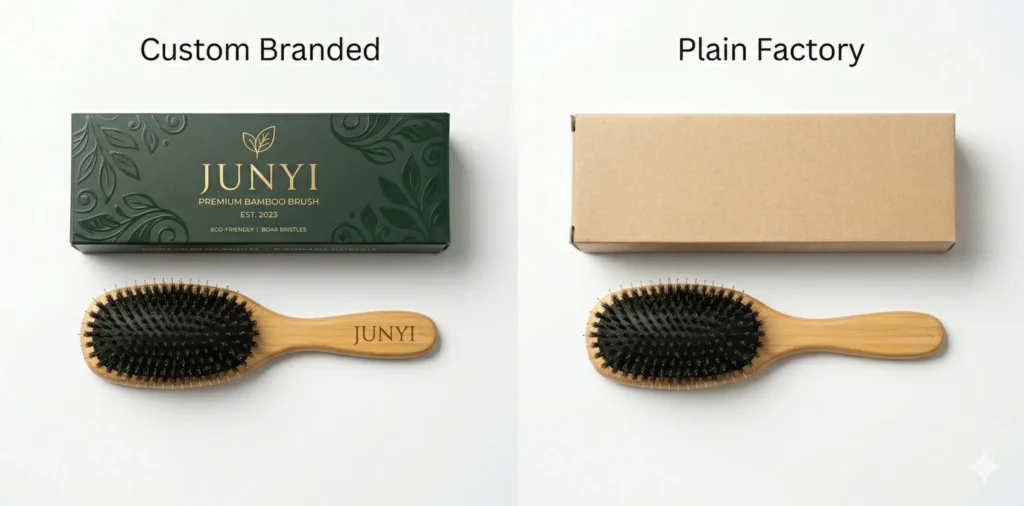
OEM (Original Equipment Manufacturing) and ODM (Original Design Manufacturing) are two distinct production models used in the hair care industry to bring branded products to market. While both involve working with a third-party factory, they differ fundamentally in who controls the product design, how intellectual property is allocated, and what level of brand differentiation is achievable.
Understanding the operational differences between these two models is essential for brand owners, importers, and private label buyers evaluating manufacturing partnerships for hair brushes, combs, and related accessories.
What Is OEM Manufacturing in Hair Care?
OEM manufacturing is a production model in which the buyer provides the product design — including specifications for materials, dimensions, construction, and branding — and the factory produces to those exact requirements. The buyer retains full ownership of the design intellectual property.
In the hair care context, an OEM arrangement typically involves:
- Buyer-supplied technical drawings or 3D CAD files for brush handles, comb profiles, or clip geometry
- Buyer-specified bristle type, pin length, cushion base hardness, and colour
- Factory-produced samples submitted for approval before mass production begins
- Finished goods branded and packaged to the buyer’s specifications
OEM is the standard model for established brands that have completed product development in-house and need a manufacturing partner to execute production at scale. It offers the highest degree of product differentiation but requires the buyer to invest in design development prior to engaging the factory.
What Is ODM Manufacturing in Hair Care?
ODM (Original Design Manufacturing) is a model in which the factory provides an existing, ready-to-produce design that the buyer licences, selects, or adapts for their own brand. The factory owns the underlying tooling and design; the buyer typically applies their brand name, packaging, and in some cases surface-level customisation such as colour or finish.
In practice, ODM arrangements in the hair accessories industry involve:
- Buyer selects from a factory’s existing product catalogue or mold library
- Private label branding (logo embossing, hot stamping, custom hang tag) applied to an existing product form
- Limited structural customisation — colour, material grade, or packaging are adjusted; the core product geometry remains fixed
- Faster time to market, as no new tooling development is required
ODM is the preferred model for brands launching new product categories quickly, e-commerce operators building initial SKU ranges, or buyers entering a new market segment without committing to full custom development.
Key Differences Between OEM and ODM
The structural differences between OEM and ODM affect every stage of a sourcing project — from initial development cost to long-term brand ownership. The comparison below outlines the most relevant variables for hair care brand buyers.
| Factor | OEM | ODM |
|---|---|---|
| Design ownership | Buyer | Factory |
| Tooling cost | Buyer-funded (new molds) | Factory-owned (existing molds) |
| Product uniqueness | High | Moderate to low |
| Time to market | Longer (design + sampling) | Shorter (catalogue selection) |
| MOQ flexibility | Varies; often higher | Often lower for standard designs |
| Customisation depth | Full (material, structure, form) | Surface level (colour, logo, packaging) |
| IP protection | Buyer retains design IP | Factory retains core design IP |
| Typical buyer profile | Established brands, retail chains | New brands, e-commerce operators |
The right model depends on where a brand sits in its development cycle and how much product differentiation it requires to compete in its target market.
When OEM Is the More Suitable Model
OEM manufacturing is appropriate when product differentiation is a commercial priority and the buyer has the internal capability — or has engaged a product development studio — to produce detailed specifications before approaching a factory.
Scenarios where OEM is typically the better fit:
- Retail chain buyers developing exclusive product ranges that cannot be sourced by competitors from the same factory catalogue
- Professional salon brands requiring specific bristle configurations or ergonomic handle geometry not available in standard ODM offerings
- Premium private label operators building brand equity around product design that justifies IP protection
- Brands with existing product lines seeking to replicate or extend a proven form factor in new materials
The main commercial risk in OEM is front-loaded: tooling investment, sampling costs, and a longer development timeline before the first saleable unit is produced. Buyers should build these into project budgets and timelines.
When ODM Is the More Suitable Model
ODM manufacturing is appropriate when speed to market, lower upfront capital commitment, and access to proven product designs are the primary sourcing objectives.
Scenarios where ODM is typically the better fit:
- New brand launches where product validation is more important than product exclusivity at the initial stage
- Amazon and Shopify operators building broad hair accessory ranges and requiring fast replenishment cycles
- Importers and distributors sourcing for regional markets where branded product differentiation is less critical than price competitiveness and availability
- Brands in early-stage market testing who need to assess consumer response before committing to custom tooling investment
One important consideration in ODM sourcing: because the factory owns the tooling and design, the same product form may be available to multiple brands simultaneously. Buyers should verify exclusivity arrangements — if any — before relying on an ODM product as a brand differentiator.
Can OEM and ODM Be Combined?
In practice, many manufacturers in the hair care accessories sector offer hybrid approaches that combine elements of both models. A common example involves a buyer selecting an existing ODM handle form from the factory’s mold library — eliminating tooling cost — while specifying a custom bristle configuration, cushion base, and branding execution that are unique to their product.
This hybrid approach allows buyers to:
- Reduce or eliminate tooling investment for the structural components
- Achieve meaningful product differentiation through material and finish specification
- Maintain faster timelines than a fully custom OEM project
- Retain partial design control without bearing the full cost of new mold development
Factories with large existing mold libraries — particularly those with 1,000 or more active production molds — are better positioned to support this hybrid model, as the range of available base geometries is broader. Buyers interested in exploring this approach can review available OEM and ODM service options before opening a sourcing discussion.
Intellectual Property and Exclusivity Considerations
IP ownership is one of the most commercially significant differences between OEM and ODM, and one that buyers frequently underestimate during initial sourcing discussions.
Under a standard OEM arrangement:
- The buyer funds mold development
- The mold is registered to the buyer (confirmed in the manufacturing agreement)
- The factory is contractually prohibited from producing the same form for other clients
Under a standard ODM arrangement:
- The factory owns the mold
- The buyer has no exclusivity over the product geometry
- Branding elements (logo, packaging) remain the buyer’s property, but the product form does not
Buyers seeking to protect their product design under ODM terms should negotiate limited exclusivity agreements — either by territory, channel, or time period — and have these reviewed by a commercial attorney before signing. Not all factories will agree to exclusivity on standard ODM catalogue items, particularly high-volume SKUs. For a broader overview of how amfori BSCI social compliance audits relate to factory accountability, the amfori documentation provides useful reference material.
MOQ and Lead Time: A Practical Comparison
MOQ and lead time differ between the two models and should be factored into sourcing decisions alongside development costs. Buyers new to ISO 9001:2015 certified production environments may also find that quality management documentation requirements add a short administrative step to initial sample approval cycles.
For hair brush and hair accessory production, typical parameters are:
OEM projects:
- MOQ: 1,000–5,000 units per SKU (higher when new tooling is involved)
- Sample lead time: 15–25 business days post design approval
- Mass production lead time: 45–70 days post sample sign-off
ODM projects:
- MOQ: 300–1,500 units per SKU (lower, as tooling already exists)
- Sample lead time: 7–12 business days (standard mold, colour or logo change only)
- Mass production lead time: 25–45 days
These figures vary by factory capacity, order complexity, and seasonal demand cycles. Buyers placing first orders are advised to build buffer time into launch schedules, particularly around Chinese New Year and Golden Week periods. Brands requiring recycled material content should also confirm factory eligibility under the Global Recycled Standard (GRS 4.0) before finalising material specifications.
Conclusion
OEM and ODM are not competing options — they are complementary models suited to different stages of brand development and different commercial priorities. OEM delivers full design ownership and maximum product differentiation at the cost of higher upfront investment and longer timelines. ODM delivers speed, lower entry cost, and access to proven designs at the cost of reduced exclusivity and limited structural customisation.
Manufacturers such as JunYi Beauty, which maintains an integrated mold library and full-range OEM and ODM production capability across hair brushes, combs, and hair accessories from its Dongguan facility, represent the type of factory-direct partner suited to brands at different stages of their product development — from initial market entry through to scaled private label production.