Choosing the wrong hair brush is one of the most common and least discussed causes of hair damage, frizz, and breakage. Most consumers select brushes based on aesthetics, price, or brand familiarity — not on whether the bristle type, pin configuration, and cushion base are actually matched to their hair type. The result is brushes that work against the hair rather than with it, producing outcomes that get attributed to the hair itself rather than the tool being used on it.
This guide covers the key variables in hair brush specification — bristle type, pin stiffness, cushion base, and brush shape — and maps each to the hair types and use cases for which they are appropriate. For brand developers and importers sourcing hair brush ranges, it also provides a framework for building ranges that are differentiated by hair type rather than by price tier alone.
Why Hair Type Is the Starting Point
Hair type determines how the cuticle responds to mechanical contact, how much oil the scalp produces and how far it travels down the shaft, how much static the hair generates in dry conditions, and how much tension individual strands can absorb before breaking. A brush specification that works well for one hair type can actively damage another.
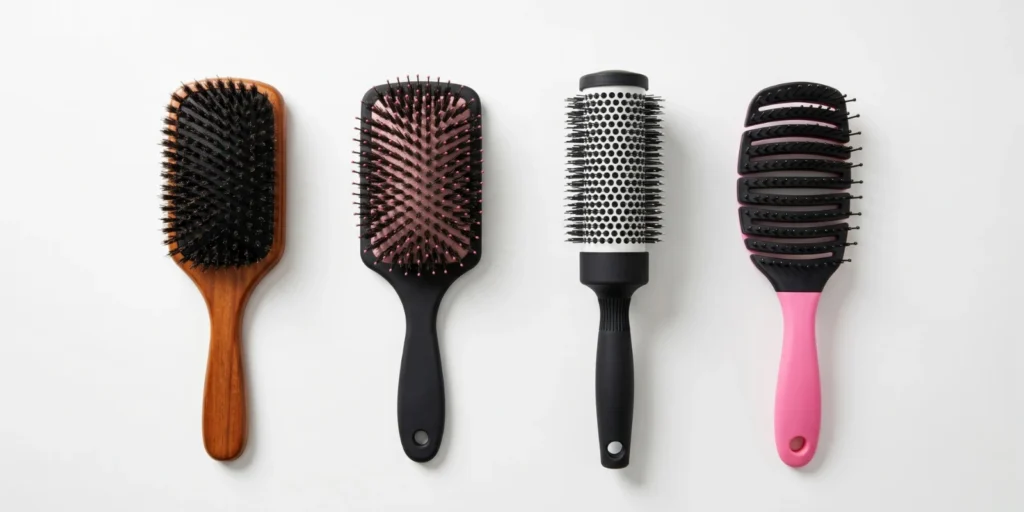
The four variables that matter most in brush selection are bristle material, pin stiffness and tip type, cushion base construction, and brush shape. Each interacts with hair type differently, and the optimal combination shifts depending on whether the brush is being used for detangling, daily maintenance, blow-drying, or finishing.
Bristle Type: The Most Important Variable
Boar Bristle
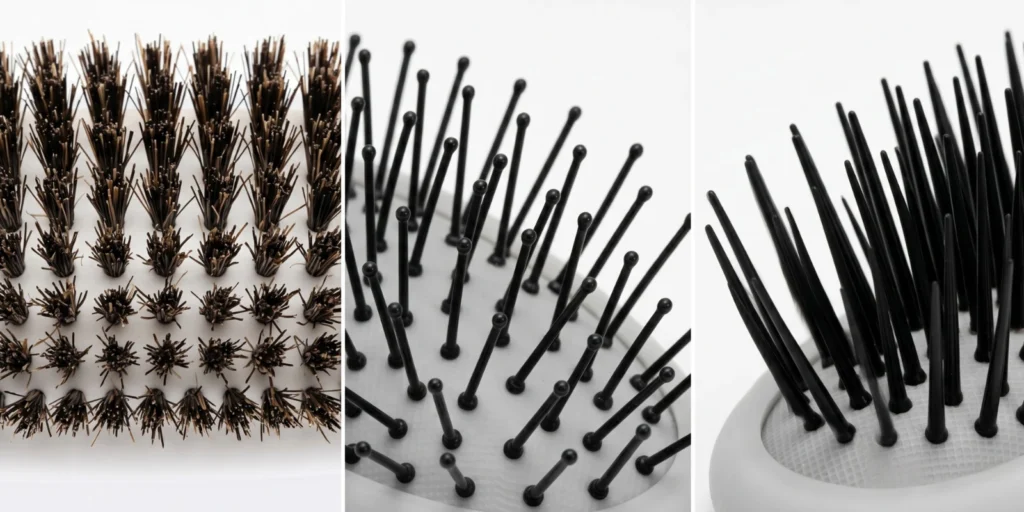
Natural boar bristle has a keratin composition structurally similar to human hair. This produces lower friction against the hair shaft than synthetic materials, redistributes scalp sebum from root to tip during brushing, and generates significantly less static charge than nylon. The practical effect is cuticle smoothing, improved shine, and reduced flyaways in appropriate hair types.
Boar bristle is best suited to fine and medium straight and wavy hair for daily maintenance and finishing. It lacks the stiffness to penetrate thick or dense hair effectively, and it is not appropriate for wet-hair detangling. For curly and coily hair, dry boar bristle brushing tends to disrupt the curl pattern and increase frizz rather than reduce it — a limitation covered in detail in our article on whether boar bristle brushes genuinely reduce frizz.
Mixed Bristle
Mixed bristle brushes combine natural boar bristle with synthetic nylon pins. The nylon pins penetrate deeper into the hair mass and work through knots, while the boar bristles between them smooth the cuticle on strands that have already been separated. For medium to thick straight and wavy hair, mixed bristle delivers better overall outcomes than pure boar because the full depth of the hair is being addressed, not just the surface.
Mixed bristle is the most practical single-brush specification for consumers with medium hair who need both detangling and smoothing performance from one tool.
Flexible Nylon
Flexible nylon detangling brushes have tapered pins engineered to flex under tension rather than drag through knots. This significantly reduces the mechanical stress placed on individual strands during detangling, making them the appropriate choice for wet-hair use across most hair types. They are the recommended tool for curly and coily hair detangled with conditioner, for colour-treated hair being managed wet, and for any hair type that is prone to breakage during detangling.
Hard Nylon Pins
Hard nylon pins with ball tips provide the stiffness and grip needed for blow-dry styling, root lifting, and volumising. They penetrate thick hair effectively and hold tension under heat. The tradeoff is higher friction and static generation compared to natural bristle, which makes them less appropriate for dry brushing fine or frizz-prone hair. Their primary use cases are styling applications rather than maintenance or finishing.
Matching Brush Type to Hair Type
Fine and Thin Hair
Fine hair has a smaller shaft diameter, less cuticle coverage, and generates static more readily than other hair types. The priority for fine hair is minimising mechanical stress and static per brushing session.
Recommended: Soft boar bristle paddle brush for daily dry brushing and finishing. Air-cushion base to reduce pin pressure. Avoid hard nylon pins for dry brushing — the static generated causes strands to repel each other and produces volume that reads as frizz rather than fullness.
For detangling: Wide-tooth comb or flexible nylon detangling brush used on damp hair with conditioner.
Medium Hair
Medium hair tolerates a wider range of brush specifications than fine or thick hair. The key distinction is use case — daily maintenance versus blow-dry styling requires different tools.
Recommended: Mixed bristle paddle brush for daily maintenance. Nylon pin round brush for blow-dry styling. Flexible nylon detangling brush for wet-hair use.
A mixed bristle brush is the most practical primary brush for medium hair consumers who prefer one tool for most sessions.
Thick and Coarse Hair
Thick hair requires a brush with sufficient pin stiffness and density to penetrate through the full depth of the hair mass. Pure boar bristle does not meet this requirement — it smooths the surface but leaves the underlying layers unaddressed.
Recommended: Mixed bristle or hard nylon pin paddle brush for daily brushing and detangling. Nylon pin round or paddle brush for blow-dry styling. Mixed bristle with longer nylon pins for effective depth penetration.
Pure boar bristle brushes are useful for thick hair only as finishing tools — used after the hair has been fully styled and detangled to add surface shine.
Curly and Coily Hair (Type 3 and 4)
Dry brushing curly and coily hair with any bristle type disrupts the curl pattern and produces frizz. The appropriate approach for this hair category is wet detangling only, combined with finger styling or diffusing rather than brushing once dry.
Recommended: Flexible nylon detangling brush used on soaking wet, conditioner-coated hair. Wide-tooth comb for less dense curl patterns. Avoid all dry brushing with paddle or round brushes regardless of bristle type.
A more detailed breakdown of how brushing technique affects frizz outcomes in different curl types is available in our article on why brushing makes hair frizzy and what to do instead.
Colour-Treated and Chemically Processed Hair
Chemically processed hair has elevated porosity and a weakened cuticle. The priority is minimising additional mechanical damage during each brushing session.
Recommended: Soft boar bristle for dry finishing on straight or wavy processed hair — the lower friction reduces cuticle stress per stroke. Flexible nylon detangling brush for wet use. Avoid hard nylon pins on dry damaged hair.
Brushing frequency matters for this hair type. Daily hard brushing compounds cumulative cuticle damage. Reducing sessions or switching to finger detangling between brush applications reduces long-term mechanical wear.
Brush Shape and Its Effect on Outcome
Paddle Brush
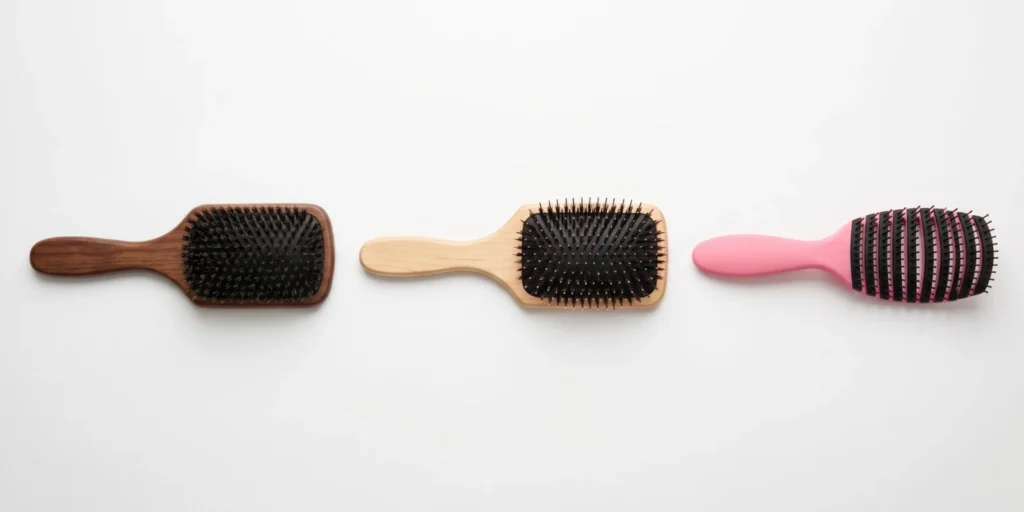
The paddle brush has a wide, flat base that covers large surface areas per stroke. It is most effective for straightening, smoothing, and detangling medium to long hair. The wide base reduces the number of strokes needed to brush through the full length, which limits cumulative mechanical contact. Paddle brushes with air-cushion bases are the standard recommendation for fine and frizz-prone hair in daily maintenance use.
Round Brush
Round brushes are designed for blow-dry styling. The cylindrical barrel creates tension and curl during heat application, and the barrel diameter determines the degree of curl or wave produced — smaller barrels for tighter curls, larger barrels for loose waves or straightening. Round brushes are not appropriate for detangling or general dry brushing.
Detangling Brush
Detangling brushes have a flexible base and widely spaced, tapered pins designed to work through knots without pulling through them. They are the appropriate tool for wet-hair use across hair types and the recommended brush for curly and coily hair detangling. They are not finishing tools and are not suited to styling applications.
Cushion Paddle Brush
The cushion base — an air-filled rubber pad beneath the pin rows — allows the bristles to flex as they move across the contours of the scalp and hair. This reduces the pressure applied per pin during each stroke, lowering friction and making the brush more appropriate for fine, sensitive, or damaged hair. For most daily maintenance applications, a cushion-base paddle brush is preferable to a hard-base equivalent.
Quick Reference: Brush Selection by Hair Type
| Hair Type | Daily Maintenance | Wet Detangling | Blow-Dry Styling | Finishing |
|---|---|---|---|---|
| Fine / thin | Soft boar bristle paddle | Flexible nylon / wide-tooth comb | Soft nylon round (small barrel) | Boar bristle paddle |
| Medium | Mixed bristle paddle | Flexible nylon detangling | Nylon round brush | Mixed or boar bristle paddle |
| Thick / coarse | Mixed bristle paddle | Flexible nylon detangling | Hard nylon round or paddle | Mixed bristle paddle |
| Curly / coily | Not recommended dry | Flexible nylon (wet only) | Diffuser (no brush) | Not recommended dry |
| Colour-treated | Soft boar bristle paddle | Flexible nylon detangling | Soft nylon round | Boar bristle paddle |
Sourcing Considerations for B2B Buyers
For buyers building hair brush ranges, the hair-type framework above provides a more effective range architecture than organising by price tier alone. A range structured around hair type — with each brush carrying a clear hair-type recommendation, use-case positioning, and bristle specification matched to that position — reduces consumer mismatches, limits returns, and supports premium price positioning at the upper end of the range.
Key decisions in range building include whether to carry pure boar, mixed bristle, and flexible nylon as separate SKUs or to consolidate mid-range positions with mixed bristle; how to differentiate cushion-base from hard-base models within a paddle brush line; and whether the range includes dedicated wet-hair and dry-hair tools or attempts to cover both with single multi-use specifications.
Both specification depth and range architecture decisions are adjustable in OEM production, where bristle grade, pin stiffness, cushion base construction, and handle specification can be varied across a coordinated range. Both boar bristle and synthetic brush categories across paddle, round, and detangling formats are available through OEM and private label manufacturing routes with full specification control.
Frequently Asked Questions
How do I know which hair brush is right for my hair type?
Start with hair thickness and texture. Fine, straight hair benefits from soft boar bristle paddle brushes for daily use. Medium hair works well with mixed bristle. Thick hair needs mixed bristle or nylon pin brushes with sufficient stiffness to penetrate the full depth. Curly and coily hair should avoid dry brushing entirely and use flexible nylon detangling brushes on wet hair only.
Does the cushion base of a brush make a difference?
Yes. An air-cushion base allows the pin rows to flex during each stroke, reducing the pressure applied to individual strands. For fine, frizz-prone, or damaged hair, the cushion base meaningfully reduces mechanical stress compared to a hard-base equivalent with the same bristle type.
Can I use the same brush for wet and dry hair?
Most brushes are designed for either wet or dry use, not both. Flexible nylon detangling brushes are designed for wet use. Boar bristle and mixed bristle paddle brushes are designed for dry use. Using a boar bristle brush on wet hair stretches the shaft under tension and can cause cuticle damage. Using a hard nylon brush on wet hair compounds this with additional friction.
How often should I clean my hair brush?
Boar bristle brushes should be cleaned every one to two weeks to remove product residue and sebum build-up that reduces their smoothing effectiveness. Synthetic brushes can be cleaned less frequently but benefit from monthly washing to maintain pin performance. Remove trapped hair from any brush after each use.
Is an expensive brush always better than a budget option?
Price in hair brushes generally reflects bristle grade, pin quality, and cushion base construction. Higher-grade boar bristle is finer, more densely packed, and delivers more consistent sebum redistribution and cuticle smoothing than low-grade equivalents. However, a well-specified mid-range mixed bristle brush often outperforms an expensive pure boar brush for thick hair, because bristle grade is less important than whether the specification matches the hair type.
Conclusion
Choosing the right hair brush begins with hair type, not with brand preference or price. Bristle material, pin stiffness, cushion base, and brush shape each interact with hair type in specific ways that determine whether a brush smooths, damages, detangles, or styles effectively. The clearest decision framework is to match boar bristle to fine and medium straight and wavy hair for daily maintenance, mixed bristle to medium and thick hair for combined detangling and smoothing, flexible nylon to wet-hair applications across all hair types, and hard nylon pins to heat styling and volumising work.
For brand developers building ranges with clear hair-type differentiation and specification integrity at each tier, manufacturers such as JunYi Beauty — producing paddle, round, and detangling brushes across boar, mixed, and synthetic bristle categories from its Dongguan facility — represent the type of OEM partner that can support range-level specification decisions rather than single-product sourcing.