Fine hair is the hair type most affected by brush choice. The smaller shaft diameter, reduced cortex volume, and lower structural mass of each strand mean that fine hair generates more static, absorbs more friction per stroke, and breaks more readily under mechanical tension than medium or thick hair. A brush that works acceptably on medium hair can cause measurable damage to fine hair — and a brush that is correctly specified for fine hair produces noticeably better outcomes in texture, shine, and long-term density retention.
This guide covers what fine and thin hair actually needs from a brush, which specifications deliver those outcomes, which common brush types cause the most harm, and how technique interacts with tool selection to determine the result. For brand developers and importers building hair brush ranges, the fine hair segment also represents a distinct positioning opportunity — it is underserved by ranges that default to general-purpose specifications without distinguishing between hair types.
Understanding What Fine Hair Needs from a Brush
Fine hair is defined by shaft diameter, not by the volume of hair on the scalp. A person can have high hair density — many individual strands — with fine individual strands, or low density with fine strands, which is what is commonly described as thin hair. The brush specification considerations for fine strands apply regardless of overall density, though low-density fine hair carries additional vulnerability because each strand has fewer neighbouring strands to distribute mechanical load across during brushing.
The primary requirements for a brush suited to fine hair are:
Low friction per stroke. Fine hair has proportionally less cuticle coverage than coarser hair, making it easier to disturb the cuticle surface. A brush that generates high friction lifts and chips cuticle scales more rapidly than one with lower contact friction, producing rough texture and dullness over time.
Minimal static generation. Fine hair generates static charge more readily than coarser hair because the smaller shaft diameter means more air contact per strand and less mass to dissipate the charge. Static causes strands to repel each other, producing flyaways and the appearance of frizz that fine-hair consumers commonly report.
Reduced pin pressure. The cushion base of a brush determines how much pressure each pin applies to the scalp and shaft during each stroke. For fine hair, a softer air-cushion base that flexes during contact reduces the force applied per pin and limits the cumulative mechanical stress of daily brushing.
Appropriate penetration depth. Fine hair does not require a brush with high penetration stiffness. A brush with stiff, closely spaced nylon pins designed for thick hair will over-penetrate fine hair, creating unnecessary friction at every layer of the hair mass rather than smoothing the surface.
The Best Brush Types for Fine and Thin Hair
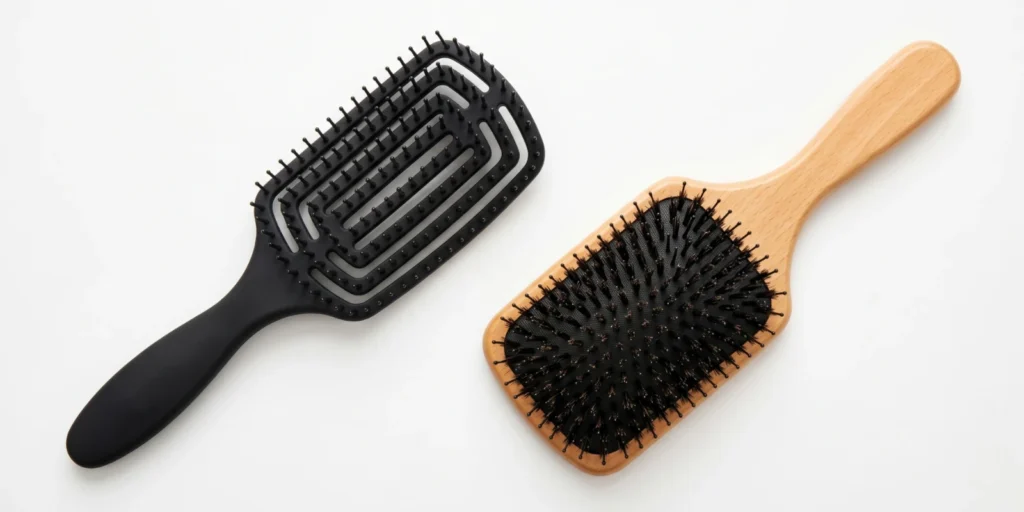
Soft Boar Bristle Paddle Brush
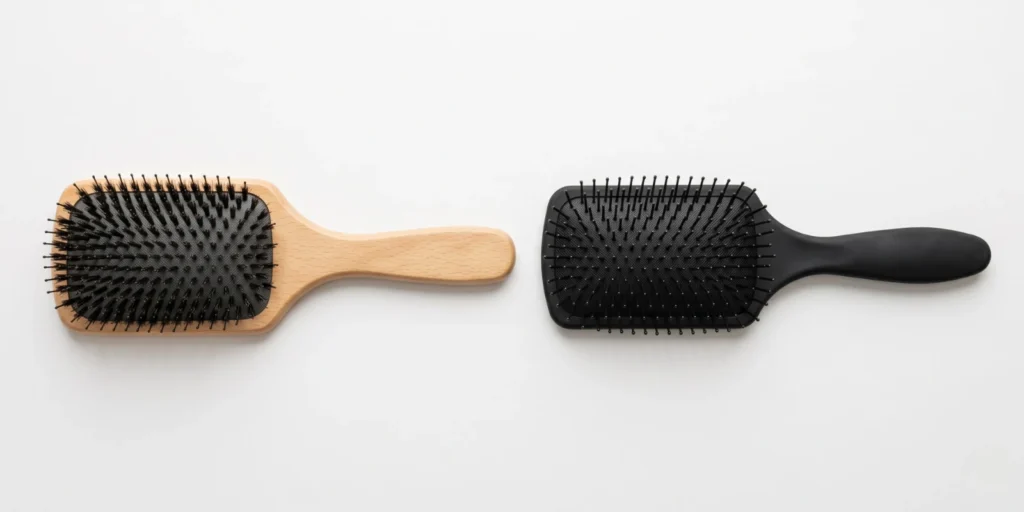
For daily dry brushing and finishing, a soft boar bristle paddle brush with an air-cushion base is the most appropriate tool for fine hair across most use cases. The natural keratin composition of boar bristle reduces cuticle friction compared to nylon, the sebum redistribution mechanism coats the shaft with a light oil layer that holds cuticle scales flat, and the low static generation keeps fine strands lying smooth rather than repelling each other.
The key specification variable within this category is bristle softness and density. Fine hair benefits from finer, more densely packed boar bristle that makes consistent contact across the full shaft surface without applying excessive pressure at individual contact points. Coarser, more widely spaced boar bristle — appropriate for medium hair — may scratch the scalp and cause uneven friction distribution on fine hair.
A detailed examination of what boar bristle actually does to the hair shaft and where its performance claims hold up is available in our article on whether boar bristle brushes genuinely reduce frizz.
Air-Cushion Paddle Brush with Soft Pins
For fine hair consumers who also need some detangling capability from their daily brush — rather than maintaining separate tools for detangling and finishing — a cushion paddle brush with soft nylon ball-tip pins is a practical alternative to pure boar bristle. The air-cushion base reduces pin pressure, and ball-tip pins are less likely to snag or scratch the scalp than straight-cut pins. This brush type does not offer the sebum redistribution or anti-static benefits of boar bristle, but it is more effective for working through minor knots.
The tradeoff is that soft nylon pins still generate more static than boar bristle on fine dry hair. This brush is best positioned as a morning detangle-and-smooth tool rather than a finishing tool.
Flexible Nylon Detangling Brush
For wet or damp hair detangling, a flexible nylon detangling brush is the appropriate tool for fine hair regardless of the daily dry brush used. The flexible pins bend under tension rather than applying sustained mechanical force to knotted strands, which is critical for fine hair — where each strand has less mass to absorb that force before breaking.
The risks of using rigid brushes on wet fine hair are covered in detail in our guide on whether it is bad to brush wet hair. The short version is that wet fine hair is particularly vulnerable because the smaller shaft has less structural resilience under tension, and rigid brush pins on wet fine hair are a primary cause of the breakage and thinning that fine-hair consumers frequently attribute to other factors.
Wide-Tooth Comb
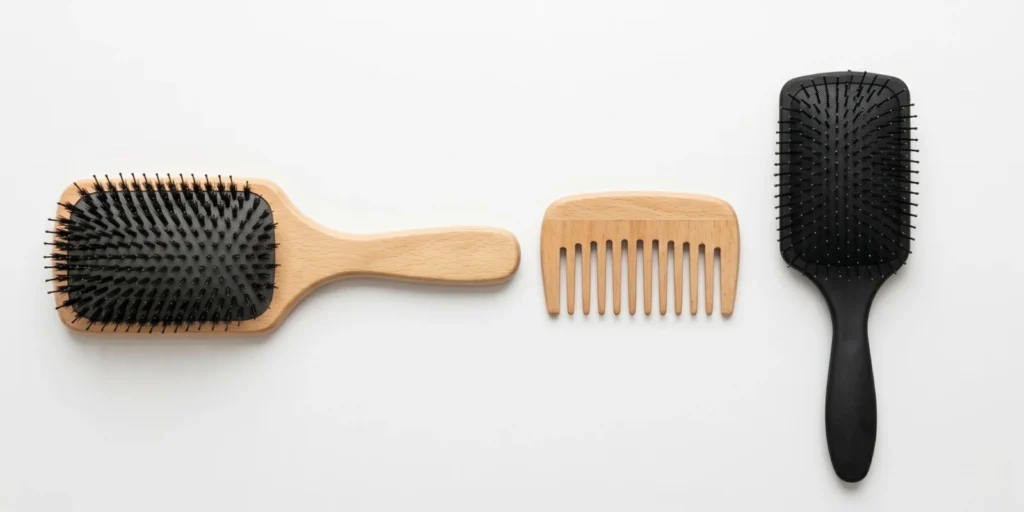
For fine curly or wavy hair, a wide-tooth comb used on damp, conditioner-coated hair is often preferable to any brush for the detangling step. The reduced contact point density of a comb — compared to even a flexible brush — limits the cumulative friction load per pass, and the spacing between teeth prevents the compression of individual strands that can occur when a brush works through a dense section.
Brush Types That Damage Fine Hair
Understanding which brush types to avoid is as practically useful as knowing which to recommend. Fine hair is disproportionately harmed by several common brush specifications.
Hard Nylon Pin Brushes
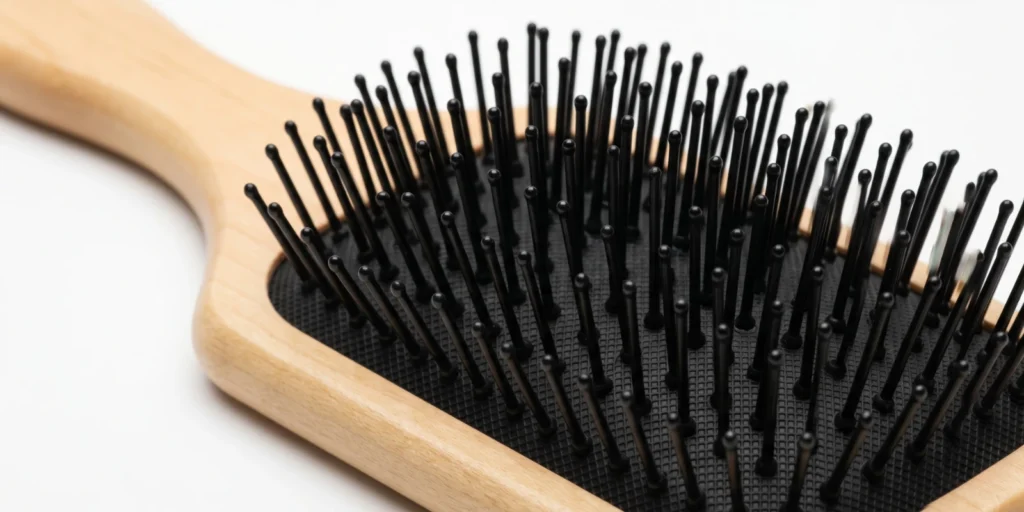
Hard nylon pins with ball tips are effective for detangling and volumising medium to thick hair, but they generate substantially more static and friction than either boar bristle or flexible nylon on fine dry hair. The stiffness that makes nylon pins effective for penetrating thick hair makes them over-aggressive on fine hair, where the required penetration depth is shallow and the cuticle is easily disturbed.
Hard nylon pin brushes used regularly on dry fine hair accelerate cuticle wear, increase static flyaways, and contribute to the appearance of frizz even in hair that is not inherently frizz-prone. For fine-hair consumers reporting that their hair looks worse after brushing, a hard nylon brush is the most likely cause. The mechanism behind this is explained in our article on why brushing makes hair frizzy and what to do instead.
Vented Brushes Used Dry
Vented brushes are designed for use with a blow-dryer, where the airflow through the vents assists in drying and styling. Used without heat on fine dry hair, the open pin configuration provides no smoothing benefit and the relatively sparse, stiff pins generate high friction per contact point. For fine hair, vented brushes should be reserved strictly for blow-dry styling and not used for daily maintenance brushing.
Hard-Base Paddle Brushes
A paddle brush with a hard, non-cushioned base transmits more pin pressure to the scalp and shaft per stroke than an equivalent air-cushion model. For fine hair, this additional pressure increases the cuticle friction and mechanical stress per brushing session. The cushion base is not a luxury specification for fine hair — it is a meaningful performance variable that affects the brushing outcome.
Mixed Bristle Brushes with Long Nylon Pins
Mixed bristle brushes designed for medium to thick hair typically use longer, stiffer nylon pins to achieve the penetration depth required for those hair types. On fine hair, this penetration depth is excessive — the nylon pins pass through the full hair mass and make contact with the scalp with more force than is necessary or appropriate. Mixed bristle brushes designed specifically for fine hair exist, with shorter, finer nylon pins, but standard medium-hair mixed bristle specifications are not appropriate for fine hair daily use.
Technique Adjustments for Fine and Thin Hair
The correct brush used with incorrect technique still produces suboptimal outcomes on fine hair. Several technique variables have a disproportionate effect on fine hair because of the lower structural resilience of each strand.
Brushing Frequency
Daily brushing with a boar bristle paddle brush distributes sebum and smooths the cuticle — these are cumulative benefits that require consistent use to be meaningful. However, multiple brushing sessions per day with any brush type on fine hair compounds cuticle wear unnecessarily. One session of deliberate, full-length brushing per day is sufficient for sebum redistribution and smoothing. Additional passes should be limited to short finishing strokes rather than full root-to-tip sessions.
Brushing Direction and Stroke Length
Long, smooth strokes from root to tip in the direction of cuticle growth cause less cuticle disturbance than short, back-and-forth strokes. For fine hair, stroke consistency is particularly important — irregular pressure or stroke angle creates inconsistent friction distribution that lifts cuticle scales unevenly. Holding the hair taut with one hand while brushing with the other reduces the movement of the hair mass under the brush and limits the mechanical stress transmitted to the shaft.
Avoiding Brushing at Full Wetness
As covered in the wet-hair brushing guide, fine hair is particularly vulnerable immediately after wetting. Allowing the hair to move from soaking wet to damp before beginning any brushing — even with a flexible detangling brush — reduces peak mechanical vulnerability. For fine hair in particular, the difference between brushing at soaking wet and at damp is meaningful for both breakage and cuticle integrity.
Product Application Before Brushing
A light leave-in conditioner or detangling spray applied before dry brushing fine hair reduces the coefficient of friction between strands and between the brush and the hair. For fine hair that is particularly static-prone or prone to flyaways, a small amount of lightweight hair oil applied to the lengths before brushing can also reduce static generation and improve the smoothing outcome. Heavy products should be avoided on fine hair — the concern is weight-induced flattening — but lightweight slip products before brushing produce a measurable reduction in mechanical stress per stroke.
Building a Two-Brush System for Fine Hair
The most effective approach to fine hair brushing is a two-tool system rather than a single brush for all conditions:
Tool 1 — Wet and damp hair: Flexible nylon detangling brush or wide-tooth comb used on conditioner-coated or damp hair, working ends-to-roots in sections. This step removes knots with minimal mechanical force before the hair is in its most vulnerable fully dry state.
Tool 2 — Dry hair daily maintenance and finishing: Soft boar bristle paddle brush with air-cushion base, used on dry or nearly dry hair in long, smooth root-to-tip strokes. This step distributes sebum, smooths the cuticle, and reduces static flyaways.
This system separates the detangling function — where the priority is minimum tension — from the maintenance and finishing function — where the priority is cuticle smoothing and shine enhancement. Using one brush for both functions requires compromising on one or the other, and for fine hair, both functions are critical enough that the compromise produces a noticeably worse outcome than the two-tool approach.
The broader framework for this system is covered in our complete guide on how to choose the right hair brush for your hair type.
Sourcing Considerations for B2B Buyers
The fine hair segment is one of the most specification-sensitive in the hair brush category. Consumers with fine hair tend to notice the difference between correctly and incorrectly specified brushes more quickly and more clearly than medium or thick-hair consumers, because the consequences of misspecification — static, flyaways, breakage, and dullness — are visible and cumulative.
For buyers building fine-hair-specific product lines, the key specification decisions are:
Bristle grade: Fine boar bristle, densely packed, is the appropriate specification for fine hair finishing brushes. Coarser bristle grades intended for medium hair produce too much friction and pressure per contact point on fine hair.
Cushion base: Air-cushion is the appropriate base specification for fine hair paddle brushes. Hard-base equivalents transmit more force per pin and should not be positioned for fine hair.
Pin length in mixed bristle: If mixed bristle is offered for fine hair, nylon pin length should be shorter than standard to limit penetration depth and reduce the over-penetration friction that standard mixed bristle causes on fine hair.
Anti-static properties: Fine hair benefits from anti-static bristle treatment more than any other hair type. Where this specification is available, it is a meaningful differentiator for fine-hair positioning.
Packaging communication: Clear hair-type labelling — “for fine and thin hair” — reduces mismatched consumer purchases and the associated returns and complaints. Fine-hair consumers are actively searching for specification guidance and respond to explicit hair-type positioning.
Both boar bristle and flexible nylon detangling brush formats with fine-hair-appropriate specifications are available through OEM and private label manufacturing routes, with bristle grade, pin length, cushion base, and anti-static treatment adjustable to range positioning requirements.
Frequently Asked Questions
What is the best type of brush for fine hair?
A soft boar bristle paddle brush with an air-cushion base is the best option for daily dry brushing and finishing on fine hair. It generates low friction, reduces static, and redistributes scalp oils along the shaft to improve shine. For wet or damp hair detangling, a flexible nylon detangling brush or wide-tooth comb is required — rigid brushes of any bristle type should not be used on wet fine hair.
Why does my fine hair look frizzy after brushing?
Fine hair is highly susceptible to static generated by synthetic bristle during brushing. Hard nylon pin brushes on dry fine hair are the most common cause of post-brushing frizz in this hair type. Switching to a boar bristle brush reduces static charge and cuticle friction, which typically resolves brushing-induced frizz in straight and wavy fine hair.
How often should fine hair be brushed?
Once per day with a boar bristle paddle brush for sebum distribution and smoothing is sufficient for most fine-hair consumers. Multiple daily brushing sessions compound cuticle wear without proportional benefit. Additional passes — for example, after styling — should be limited to a few short finishing strokes rather than full root-to-tip sessions.
Can brushing fine hair make it thinner?
Repeated mechanical damage from daily brushing with an inappropriate tool — particularly hard nylon pin brushes on dry fine hair — causes cumulative breakage that can reduce apparent hair density over time. The hair shaft is not thinned by brushing, but breakage accumulating faster than the growth rate compensates produces visible reduction in length and density. Using a correctly specified brush and technique prevents this outcome.
Should I brush fine hair when it is wet?
Not with a standard brush. Wet fine hair is particularly vulnerable to breakage because the smaller shaft diameter has less structural resilience under tension. Use a flexible nylon detangling brush or wide-tooth comb on damp, conditioner-coated fine hair, starting from the ends and working upward in sections. Avoid boar bristle and hard nylon pin brushes until the hair is dry.
What brush bristle is best for adding volume to fine hair?
For blow-dry volumising, a round brush with medium-stiffness nylon pins and a smaller barrel diameter creates lift at the roots while the blow-dryer applies heat. For fine hair, avoid very stiff or closely spaced nylon pins — the goal is grip sufficient for tension during blow-drying, not full penetration depth. For natural-dry volume, boar bristle used in lifting strokes from root to tip adds light volume without static.
Conclusion
Fine hair requires lower friction, less static generation, reduced pin pressure, and lighter penetration than medium or thick hair at every stage of the brushing process. The correct tool combination — soft boar bristle for dry maintenance and flexible nylon for wet detangling — addresses these requirements across the full care routine without compromising between them. The most common fine-hair brushing mistakes are using hard nylon pins for daily dry brushing and using any rigid brush on wet or freshly washed hair, both of which cause cumulative breakage and cuticle damage that is easily prevented with the right specification.
For brand developers building fine-hair-specific brush products, the specification precision required by this segment represents a genuine differentiation opportunity. Manufacturers such as JunYi Beauty, which produces soft boar bristle paddle brushes and flexible nylon detangling brushes across fine-hair-appropriate grades and specifications from its Dongguan facility, represent the type of OEM partner suited to brands developing ranges with genuine hair-type performance differentiation at the fine-hair end of the market.