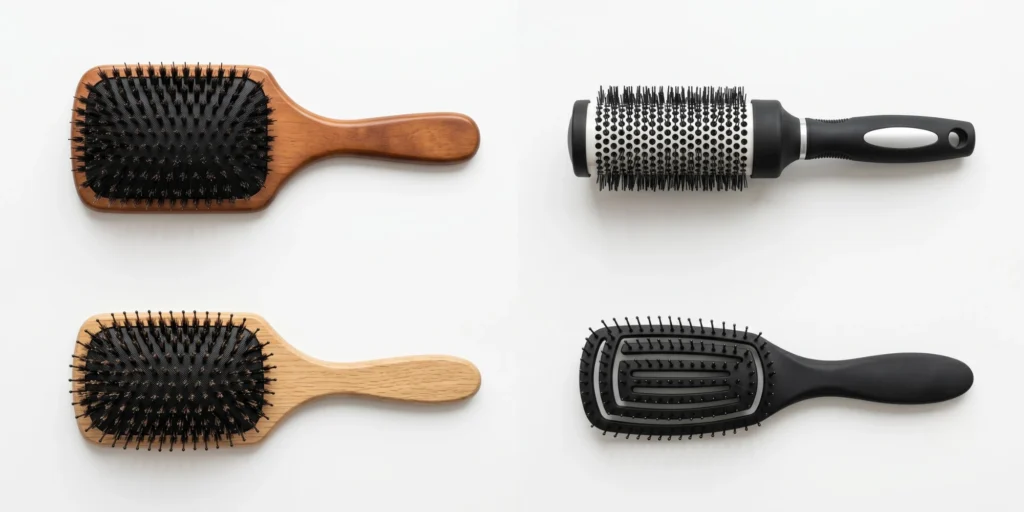
Private label hair brushes represent one of the most accessible entry points into the personal care accessories market. The product category is well-established, the manufacturing infrastructure is concentrated and mature, the consumer market is large and growing, and the technical barriers to producing a credible retail-ready product are lower than in most adjacent categories. A brand owner with a clear hair-type positioning, a defined target channel, and a manufacturer relationship that supports consistent quality can build a viable hair brush range from initial concept to retail-ready product in three to four months.
The steps between concept and shelf are more specific than most first-time brand owners expect. Specification decisions, sample approval processes, certification requirements, and packaging compliance all require attention before production begins — and the cost of discovering gaps in any of these areas after goods have been manufactured is significantly higher than the cost of addressing them upfront.
This guide covers the full private label hair brush process in sequence — from initial market positioning through to reorder management — with the specific decisions and verification steps that matter at each stage. For buyers who have already reached the manufacturer selection stage, the more focused pre-order checklist is covered in our guide on 10 things to check before placing a custom hair brush order.
Step 1: Define Your Market Position Before Defining Your Product
The most common mistake in private label hair brush development is beginning with product selection rather than market positioning. The brush type, bristle specification, price point, packaging format, and certification requirements all follow from positioning decisions — and attempting to make them without a clear positioning framework produces a range that fits no channel particularly well.
Hair Type Targeting
Hair brush performance is hair-type specific in ways that are commercially significant. A brush positioned for fine hair requires different bristle specification, cushion base, and performance claims than one positioned for thick or curly hair. Attempting to position a single brush as appropriate for all hair types either produces an under-specified product or a specification so general that it offers no differentiation.
The most commercially productive approach for new private label brands is to select one or two hair type positions — fine to medium, or curly and coily, for example — and develop a range that serves those positions with genuine specification appropriateness. The hair-type mapping framework in our guide on how to choose the right hair brush for your hair type provides a starting structure for this segmentation.
Channel Selection
The retail channel determines certification requirements, packaging format, MOQ viability, and price architecture. A range destined for Amazon FBA requires different packaging compliance and labelling than one entering a major supermarket chain; a professional salon channel requires different product specification and positioning than a mass-market pharmacy. Selecting the target channel before finalising product specification prevents the need for costly specification or packaging redesign after initial development.
Price Architecture
The price point you intend to retail at determines the unit cost you can absorb while maintaining commercial margin. Working backward from target retail price — applying the margin requirements of the distribution channel, freight, duties, packaging, and certification costs — establishes the unit cost range within which the product must be developed. Products that cannot be manufactured to specification within the unit cost constraint need either a higher retail price or a revised specification.
Step 2: Select the Right Manufacturing Model
Before approaching manufacturers, deciding between OEM and ODM manufacturing is a foundational step that determines how much design IP the brand owns, how much development investment is required, and what reorder flexibility looks like.
OEM vs. ODM for Hair Brushes
In an OEM arrangement, the brand supplies the design — bristle specification, handle design, cushion base construction, logo placement, and packaging — and the manufacturer produces it. The brand owns the design IP and controls all specification variables. Reordering with a different manufacturer is technically possible if tooling ownership has been correctly negotiated.
In an ODM arrangement, the brand selects from the manufacturer’s existing catalogue of brush designs and applies brand identity elements — logo, colour, packaging. The manufacturer retains the design IP. Development lead time is significantly shorter and the investment in design and tooling development is eliminated, but the product is not exclusive and the brand’s control over specification variables is limited to what the manufacturer offers.
For first-time private label brands, ODM is the lower-risk entry point — it requires less development investment, produces a retail-ready product faster, and allows market testing before committing to a proprietary design programme. For brands building a differentiated range where specification exclusivity is part of the value proposition, OEM with custom development is the appropriate model. The full comparison is covered in our article on OEM versus ODM for hair care brands.
Step 3: Manufacturer Qualification
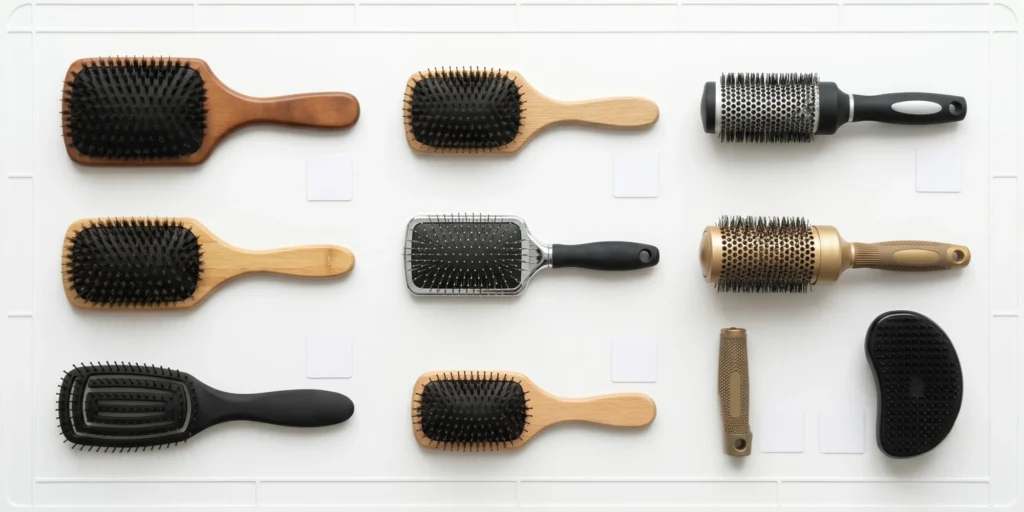
Manufacturer qualification — assessing whether a specific factory is capable of producing your product to the required specification, certification, and consistency standards — is the most consequential step in the private label process. A qualified manufacturer with appropriate certifications dramatically reduces the risk of quality failures, compliance gaps, and supply chain disruptions that are disproportionately difficult to manage after the manufacturing relationship has begun.
Certification Verification
Confirm that the manufacturer holds current, verified certification across the requirements of your target market and retail channel. The core certifications relevant to most hair brush sourcing programmes are BSCI or SEDEX for social compliance, REACH documentation for EU market products, FSC chain-of-custody for wooden handle products making sustainable sourcing claims, and GRS for recycled content claims. The full certification landscape and how to verify each is covered in our guide on hair brush safety certifications.
Certification verification should be based on documents, not on manufacturer claims. Request the audit certificate or test report, confirm the issue date and validity period, and verify that the certified facility is the one producing your specific order.
Production Capability Assessment
Confirm that the manufacturer has demonstrated capability in the specific bristle type and construction your product requires. A manufacturer with strong capability in injection-moulded plastic brushes may not have the same capability in boar bristle or mixed bristle construction. Requesting product samples in your specific specification — not generic catalogue samples — before any commercial commitment is the appropriate assessment method.
The broader factory capability assessment framework — covering quality management systems, production audit approach, and reference checking — is covered in our guide on how to choose a reliable hair brush factory.
Step 4: Product Specification Development
Once a manufacturer has been qualified, developing the product specification is the central technical step in the private label process. The specification document is the reference against which every production unit will be assessed — gaps or ambiguities in the specification create the conditions for the quality disputes that generate the most costly post-production problems.
Bristle Specification
Bristle type, grade, and density are the primary variables that determine how the brush performs. For boar bristle brushes, specify the bristle grade (soft, medium, or coarse), the individual filament diameter range, the bristle row density, and the row configuration. For nylon brushes, specify pin diameter, pin tip type (ball tip, tapered, straight-cut), pin length, and stiffness grade. For mixed bristle, specify the ratio of boar to nylon and the pin configuration.
The performance implications of bristle type selection — and the hair-type appropriateness of boar versus synthetic versus mixed bristle — are covered in our article on boar bristle brush versus synthetic brush. The specification should be informed by the hair-type positioning established in Step 1.
Handle and Base Specification
Handle material (ABS plastic, wood, bamboo, recycled plastic, bio-based alternatives), surface finish (matte, gloss, soft-touch), handle length and ergonomic profile, and logo application method (embossing, laser engraving, printed insert, debossing) should all be specified. The cushion base — air-cushion versus hard base — affects the pin pressure applied during use and is a meaningful performance variable for fine and sensitive hair types.
Colour and Surface Matching
If the handle colour or surface finish is critical to brand identity, specify Pantone colour references rather than relying on visual matching from a physical sample. Pantone specification ensures colour consistency across production runs and prevents the batch-to-batch colour variation that occurs when manufacturers colour-match by eye.
Step 5: Sample Development and Approval
The sample development process typically involves two to three rounds before golden sample approval. Each round consumes development time and budget — understanding the process prevents unrealistic timeline expectations.
Development Sample
The first development sample is produced to confirm the general design direction — handle shape, bristle type, overall proportions. At this stage, colour, finish, and logo placement may not yet be finalised. The development sample review should identify any structural or ergonomic issues before the more expensive specification-locked samples are produced.
Pre-Production Sample
The pre-production sample incorporates all revisions from the development sample and represents the intended final specification — including finalised colour, logo placement, and hardware specification. This is the sample that should be evaluated against every specification variable in the product brief. Any issues identified at this stage are still correctable before golden sample approval without incurring production rework costs.
Golden Sample
The golden sample is the physically approved unit that becomes the production standard — the reference against which all production output is assessed. Once a golden sample is approved and signed off by both the buyer and the manufacturer, it should be stored by both parties as the objective quality reference. Do not approve a golden sample that has any specification deviation from the intended product, even a minor one — golden sample approval communicates acceptance of the current state as the production standard.
Step 6: Packaging Development
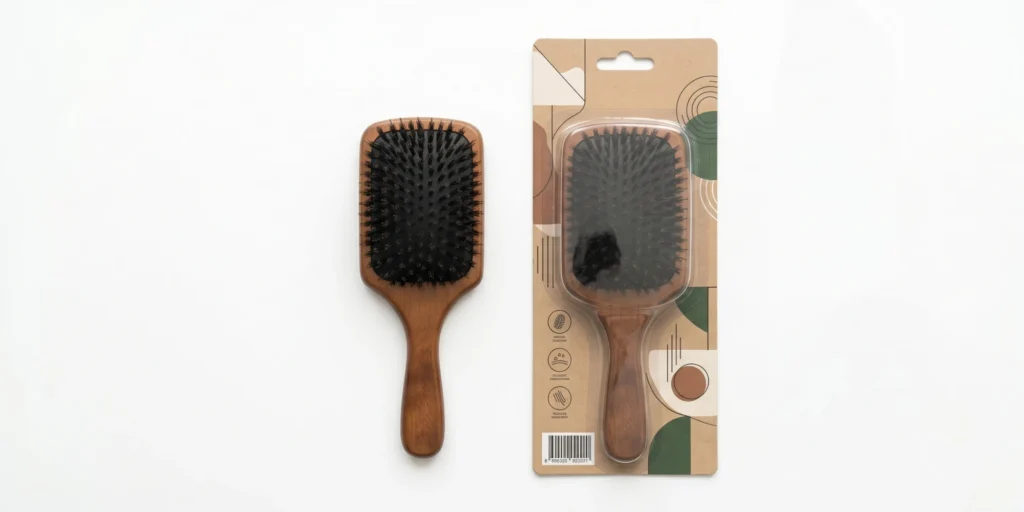
Packaging development should begin in parallel with product sample development, not after golden sample approval. The brush dimensions, hang hole requirements, and product claim content are all inputs into the packaging design, and revising any of them after packaging artwork has been completed generates additional design and print costs.
Format Selection
The packaging format is determined by the target retail channel. A brush destined for pegboard display in a pharmacy or supermarket requires a header card with a hang hole and a specific pegboard peg spacing. A brush for Amazon FBA requires a polybag with FNSKU label placement and suffocation warning text. A premium brush for boutique retail may use a window box or a soft-touch gift box format. Selecting the format before briefing packaging artwork production prevents the need for reformatting after artwork is complete.
The full range of packaging format options, MOQ thresholds, and channel compliance requirements is covered in our guide on custom hair brush packaging.
Packaging Claims and Compliance
The packaging brief should include all required claims and labelling: product name, brand name, hair-type suitability claim, country of origin, barcode, any legally required warnings (Proposition 65 for US market, suffocation warning on polybags), and any sustainability certification logos (FSC, GRS) being claimed. Packaging claims must be consistent with the product’s actual specification — a brush labelled “for fine hair” that uses a medium-grade nylon pin specification will generate the consumer returns that follow from specification-claim misalignment.
Step 7: Pre-Production Verification
Before authorising production and releasing the deposit for the production run, several verification steps should be completed.
Tooling Ownership Confirmation
If the product involves custom tooling — handle moulds, base moulds, or custom components — confirm in writing that the buyer owns the tooling following payment, and that the tooling can be transferred to a different manufacturer if the relationship ends. Tooling ownership is one of the most consistently contested points in OEM manufacturing relationships, and it is most effectively resolved before production rather than after.
Certification Currency Check
Confirm that all relevant certifications are current at the time of production order placement, not just at the time of manufacturer qualification. BSCI audit certificates expire; test reports may have been issued for material specifications that have since changed. A fresh verification at the production order stage is a standard risk management step.
Payment Term Confirmation
Standard payment terms for hair brush OEM production are typically 30 percent deposit at order placement and 70 percent balance before shipment — though terms vary by manufacturer and order volume. Confirm the payment schedule, the trigger event for the balance payment (production completion versus passing pre-shipment inspection), and whether a pre-shipment inspection is included in the arrangement or requires separate engagement.
Step 8: Production Monitoring and Pre-Shipment Inspection
In-Production Quality Checks
For buyers placing significant first orders, requesting in-production photographs or video showing the production batch against the golden sample is a reasonable expectation to establish with the manufacturer before production begins. This is not a substitute for pre-shipment inspection, but it provides early visibility into any production issues before the full batch is completed.
Pre-Shipment Inspection
A pre-shipment inspection — conducted either by the buyer’s representative or by a third-party quality inspection service — assesses the production output against the golden sample before the balance payment is released and before goods are shipped. It is the most effective single intervention for preventing the receipt of a non-conforming production batch.
A professional pre-shipment inspection covers visual quality against the golden sample, functional testing (for brushes: bristle retention, cushion base function, handle integrity), packaging compliance, carton labelling, and quantity verification. Third-party inspection services such as SGS or Bureau Veritas operate across China’s manufacturing regions and can typically be engaged for a single inspection at commercially reasonable rates.
Step 9: Logistics and Import Compliance
Shipping Mode Selection
Sea freight is the most cost-efficient shipping mode for production volumes above approximately 500 units for most brush formats. Air freight is appropriate for urgent initial orders or small replenishment quantities where the speed premium is justified. Express courier (DHL, FedEx, UPS) is appropriate for sample shipments and very small quantities but is not economical at production volumes.
Sea freight lead times from China to Europe are typically 25 to 35 days; to the US East Coast, 20 to 28 days; to the US West Coast, 15 to 22 days. These transit times need to be incorporated into the full lead time calculation — from order placement to warehouse receipt — for inventory planning purposes.
Import Classification and Duties
Hair brushes are classified under HS code 9603 (brushes, paint rollers, squeegees, mops and mops) for customs purposes, with sub-classifications by bristle type and intended use. Import duty rates vary by destination market and are subject to change — confirming the applicable duty rate and any applicable trade preference agreements before finalising landed cost calculations is a standard import planning step. For US imports from China, confirm the current tariff classification and any Section 301 tariff implications relevant to your product category.
Step 10: Launch, Sell-Through Analysis, and Reorder Planning
Sell-Through Tracking
Tracking sell-through velocity from launch — units sold per week or per month, by SKU and by channel — provides the data needed to identify which brushes are performing and which are not before committing to reorder quantities. First-order quantities should be sized conservatively to limit exposure on slow-moving SKUs while maintaining sufficient stock on fast-movers. A common mistake is ordering equal quantities across all SKUs in a range at launch, which typically results in overstock on slow movers and stockout on fast movers simultaneously.
Reorder Consistency Management
When placing a reorder, confirm with the manufacturer that the same bristle grade, handle material specification, colour, and cushion base are being used — and request updated material test reports if any inputs have changed since the original production run. Reorder consistency is one of the variables most commonly addressed inadequately, and the consumer returns that follow from a second production run with perceptibly different quality undermine the brand equity built by the first run.
Range Extension Timing
Range extension — adding new brush types, hair-type positions, or bristle specifications — is most effectively timed after the initial range has achieved consistent sell-through and reorder volume. Extending before the core range is established dilutes development focus and inventory investment. The first range should demonstrate that the brand’s positioning, channel fit, and product quality are commercially viable before development resources are allocated to new SKUs.
Frequently Asked Questions
How long does it take to launch a private label hair brush range?
From initial manufacturer contact through to goods in warehouse, the realistic timeline for a first private label hair brush range is 14 to 20 weeks. This covers manufacturer qualification (2–3 weeks), sample development and approval (4–6 weeks), packaging development and approval (3–4 weeks in parallel), production (4–6 weeks), and shipping (3–5 weeks by sea). Buyers who compress sample approval rounds or packaging development to save time typically recover those weeks in post-production correction costs.
What is the minimum investment required to launch a private label hair brush?
The minimum viable investment depends on MOQ, bristle specification, and packaging format. An ODM programme using catalogue brush designs with header card packaging at a 1,000-piece MOQ per SKU, with a unit cost of USD 2 to 5 depending on specification, requires a production investment of USD 2,000 to 5,000 per SKU before freight, duty, and packaging print costs. Custom OEM development with proprietary handle tooling adds tooling costs of USD 500 to 2,000 per mould.
Can I start with one SKU and expand later?
Yes, and this is generally the lower-risk approach for first-time private label brands. Launching one or two core SKUs — a paddle brush and a detangling brush, for example — limits initial capital exposure while allowing market validation before the range is extended. Most manufacturers accommodate single-SKU orders within standard MOQ thresholds.
Do I need my own product liability insurance?
Yes. Any brand owner placing private label personal care products on the market should hold product liability insurance appropriate to the markets in which the product is sold. The specific coverage level required varies by market and retail channel — major retailers typically specify minimum coverage levels as a condition of listing.
What should I do if a production batch fails the pre-shipment inspection?
If a pre-shipment inspection identifies non-conforming production, the appropriate response depends on the severity and nature of the deviation from the golden sample. Minor cosmetic deviations may be acceptable with a price adjustment; structural or functional deviations require rework or replacement before the balance payment is released and before goods are shipped. Having the pre-shipment inspection result and the golden sample available enables an objective negotiation — which is why both are essential components of the pre-production setup.
Conclusion
Launching a private label hair brush range is a structured process with specific decisions, verification steps, and timeline dependencies at each stage. The brands that navigate it successfully are not necessarily those with the largest budgets or the most product development experience — they are those that define their positioning clearly before making product decisions, qualify manufacturers against verifiable certification and capability criteria, invest in the sample approval process without compressing it, and manage reorder consistency with the same rigour as the original production run.
For brand owners building private label hair brush ranges with the OEM and private label manufacturing support that covers the full process — from specification development and sample approval through certification documentation and packaging compliance — manufacturers such as JunYi Beauty, operating three dedicated production facilities with ISO 9001 and BSCI certification from its Dongguan base, represent the type of production partner suited to brands that need both manufacturing capability and process support across the full launch sequence.