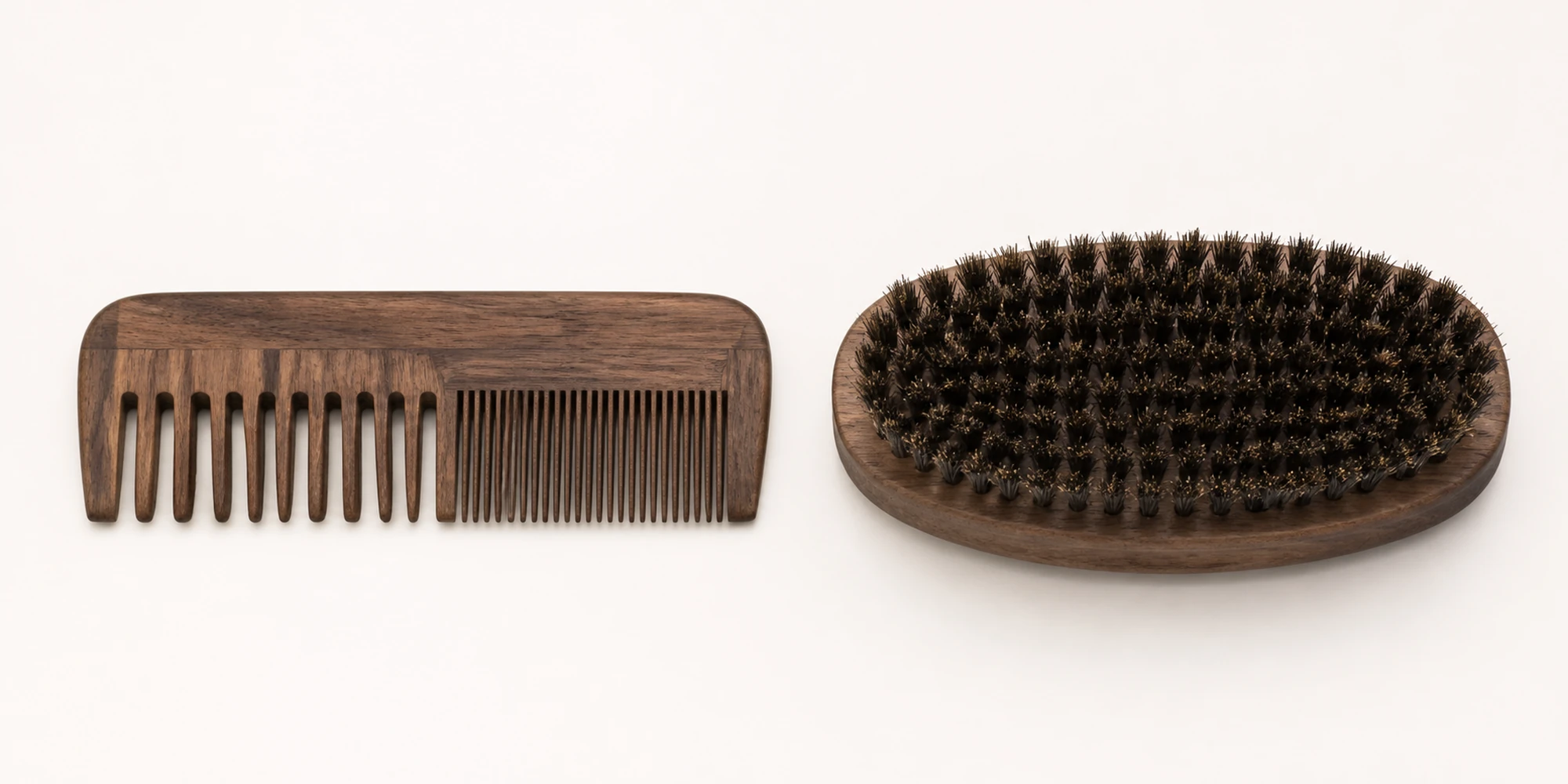
Beard grooming tools split into the same two broad categories as scalp hair tools — combs and brushes — but the reasoning for choosing between them shifts once facial hair is the subject. Beard hair is coarser and more coiled than most head hair, grows against a different surface (skin rather than a hair-covered scalp), and serves different grooming goals: shaping, distributing beard oil, training growth direction, and controlling the skin underneath as much as the hair itself.
This guide compares beard combs and beard brushes on what each actually does, which beard lengths and hair types favour one over the other, and whether the honest answer is “both” rather than “either.” For the underlying comb-versus-brush mechanics that inform this comparison, see our guide on hair brush vs hair comb: differences and when to use each.
How a Beard Comb Works
Structure and Contact Pattern
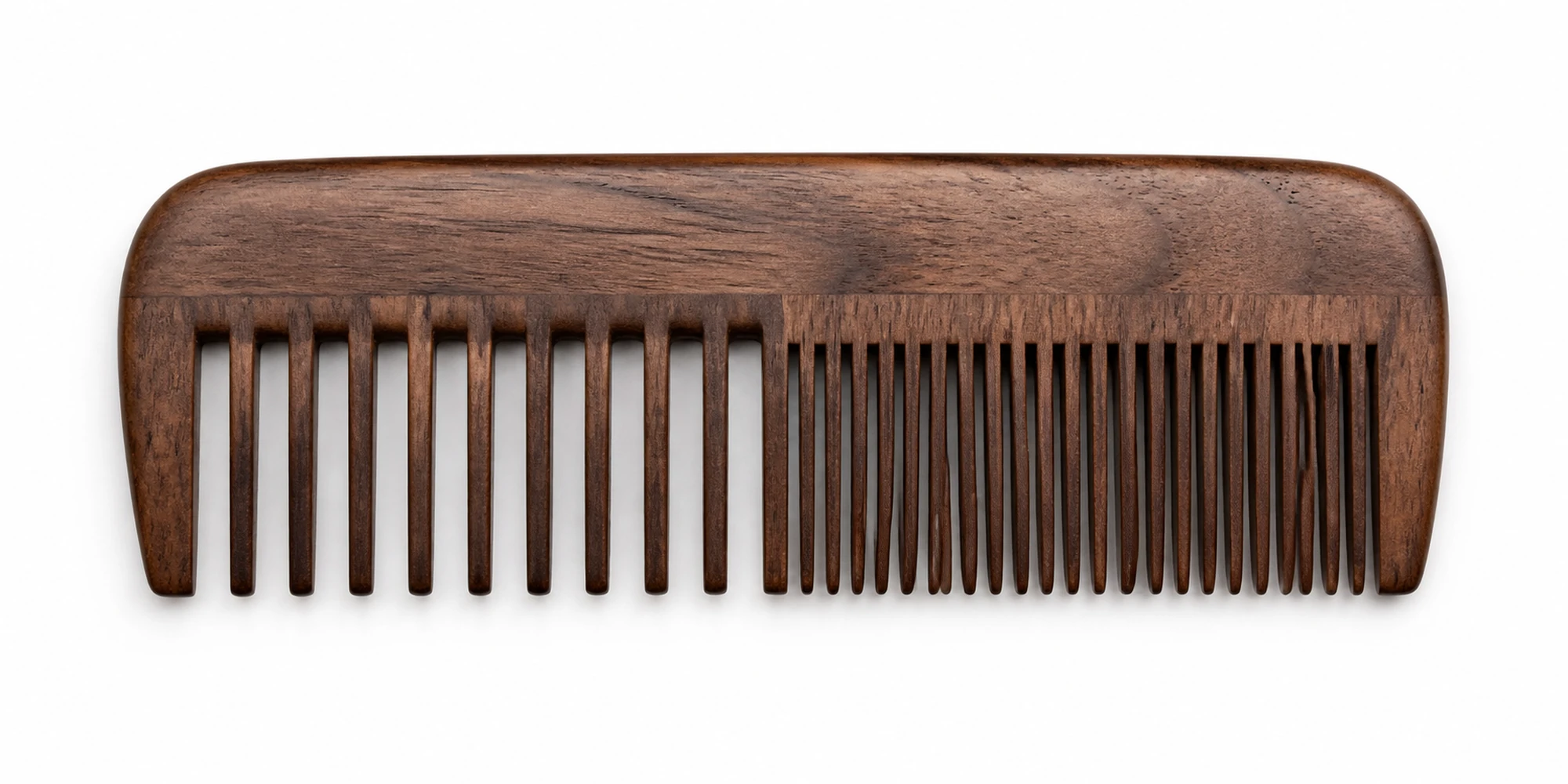
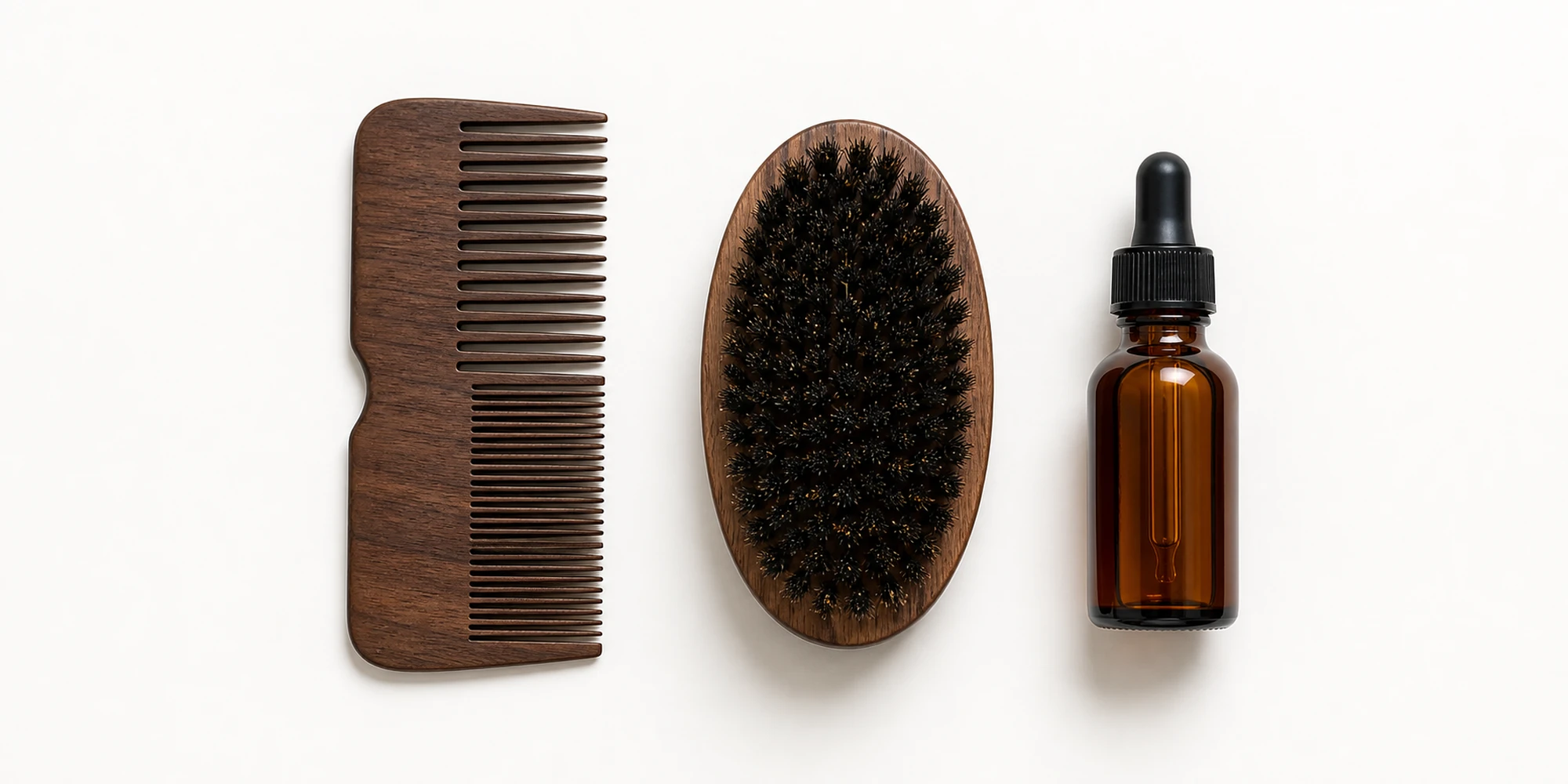
A beard comb has a single row of teeth — most commonly in wood, cellulose acetate, or metal — spaced to pass through beard hair with a defined, predictable path. Beard-specific combs are typically shorter than head-hair combs, with tooth spacing calibrated for coarser, more coiled facial hair rather than finer scalp hair, and often feature a dual-density design similar to a styling comb: wider teeth on one side for initial detangling, finer teeth on the other for precision shaping.
What It’s Good At
A comb’s lower contact-point density makes it the better tool for detangling knotted or matted beard sections, particularly on longer beards where hair has had time to tangle. It is also the more precise tool for shaping — creating a clean, defined edge line along the cheek or neckline, or training the beard into a specific silhouette during the growing-out phase. Rat-tail style beard combs with a pointed end are sometimes used for this edge-definition work specifically.
What It’s Not Good At
A comb does not effectively distribute beard oil or balm through the full volume of the beard the way a brush does — its narrow contact path picks up and moves product along a line rather than working it into the surrounding hair mass. It also does very little for the skin underneath the beard, since the teeth pass through the hair with minimal contact against the skin surface itself.
How a Beard Brush Works
Structure and Contact Pattern
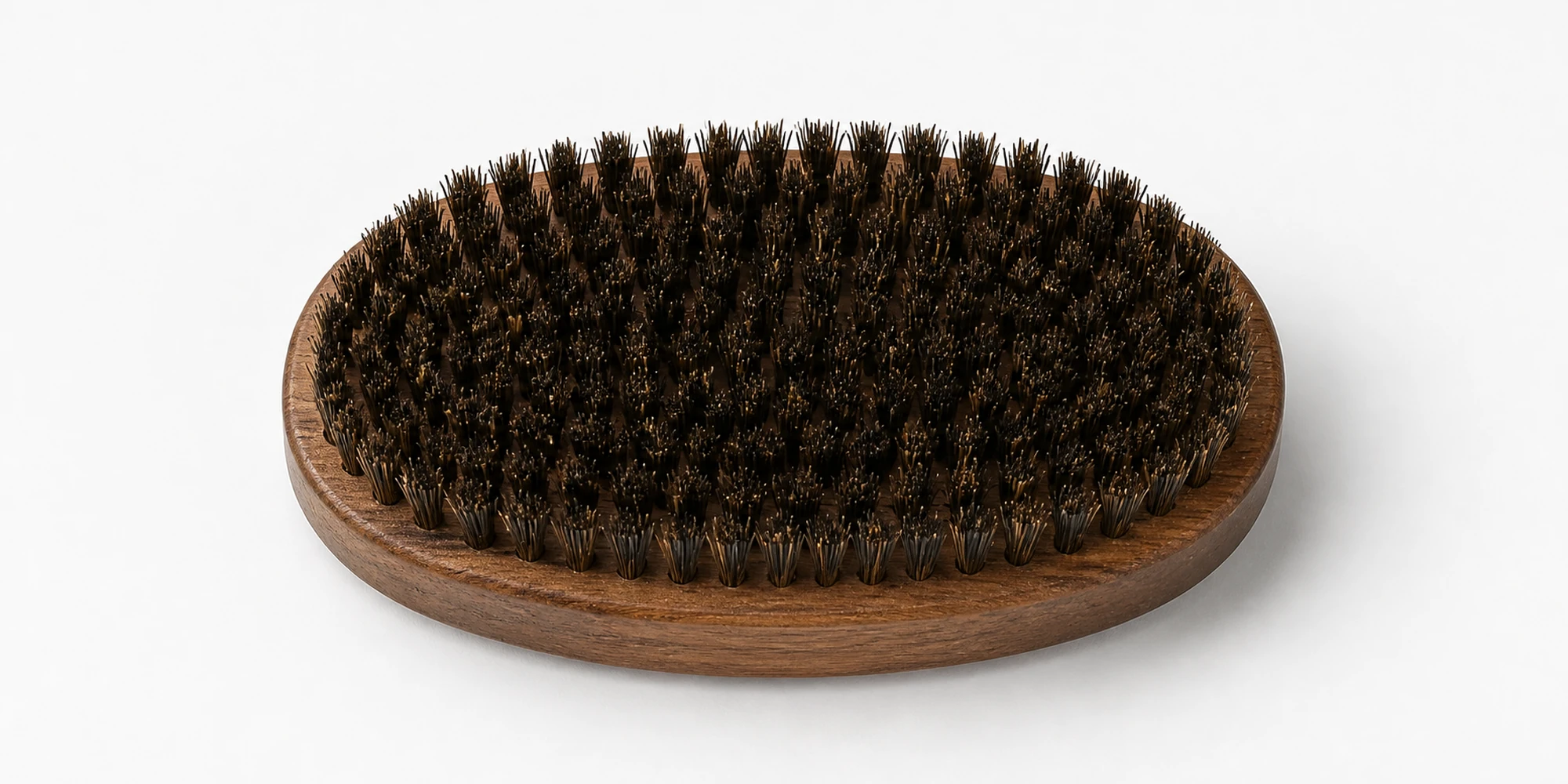
A beard brush is typically a small, dense-bristle brush — usually boar bristle, sometimes mixed with synthetic fibre — set into a compact, often round or oval base sized to fit comfortably in the hand and cover the beard area efficiently. The bristle pattern is closer to a scalp brush’s dense, surface-covering arrangement than a comb’s single-row path.
What It’s Good At
A brush is the more effective tool for distributing beard oil and balm evenly through the full beard, since the dense bristle contact spreads product across many strands simultaneously rather than along a single line. It is also the better tool for exfoliating and stimulating the skin beneath the beard — the bristle tips make direct, repeated contact with the skin surface during brushing, which helps loosen dead skin and product buildup that can contribute to beard-related skin irritation (sometimes called “beardruff”). Boar bristle specifically also redistributes the skin’s natural sebum through the beard hair, a mechanism covered in more detail in our article on whether boar bristle brushes genuinely reduce frizz in the context of scalp hair, where the same oil-redistribution principle applies.
A brush is also generally better than a comb at training beard hair to grow in a consistent direction over time, since the broader bristle contact shapes the hair mass rather than just a narrow section.
What It’s Not Good At
A brush is less effective than a comb at working through significant knots or tangles — the dense bristle pattern can catch on a tangled section without the clean pass-through a comb’s spaced teeth provide. It is also a less precise tool for sharp shaping and edge-line definition, since the brush head covers a broader area than a comb’s fine teeth.
Beard Length Changes the Answer
Stubble to Short Beard (Under 1 Inch)
At this length, a beard brush is generally the more useful tool. There is rarely enough hair length to tangle meaningfully, so a comb’s detangling advantage is less relevant, while a brush’s skin stimulation and product distribution benefits apply from the earliest growth stages. A brush at this stage also helps train the direction of new growth, which matters more when the beard is still establishing its pattern.
Medium Beard (1 to 4 Inches)
This is the length range where both tools genuinely earn a place in the routine. A brush for daily oil distribution, skin stimulation, and directional training; a comb for detangling and shaping the edges, particularly after a shower when the beard is damp and more prone to tangling. Most beard care guidance for this length recommends using both — brush first to distribute product and identify problem areas, then comb to detangle and define the shape.
Long Beard (Over 4 Inches)
Longer beards accumulate more genuine tangles and knots, and the comb becomes the more consistently necessary tool for daily maintenance — detangling a long beard with only a brush becomes progressively less effective and more uncomfortable as length increases. A brush remains useful for oil distribution and skin care underneath the beard, but for the mechanical work of keeping a long beard tangle-free, a comb (often a wide-tooth style similar in principle to a wide-tooth head hair comb) is the more appropriate primary tool. The general principle that wider tooth spacing reduces mechanical stress on tangled hair — covered in our guide on types of hair combs — applies to beard hair as much as scalp hair.
Hair Type and Texture Considerations
Straight to Wavy Beard Hair
Straight and lightly wavy beard hair generally tangles less than curlier textures, and either tool works reasonably well for daily maintenance. A brush is often sufficient as the sole daily tool at this texture, with a comb reserved for occasional detangling or precise shaping.
Curly and Coily Beard Hair
Curly and coily beard hair — common in many beard textures, particularly in tighter growth patterns — tangles more readily and is more prone to the ingrown-hair and irritation issues that a comb’s precision and a brush’s skin-stimulation both help address in different ways. For this texture, using a wide-tooth comb on damp, oil-coated beard hair for detangling, followed by a brush for distribution and direction, tends to produce the best combined result — closely paralleling the wet-comb, dry-brush approach recommended for curly scalp hair.
Coarse, Wiry Beard Hair
Coarse beard hair — thicker in diameter than most head hair — benefits from a comb with wider tooth spacing to avoid excessive resistance during combing, and from a brush with firmer, denser bristle to make meaningful contact through the hair mass down to the skin. Softer, finer-bristle brushes designed for head hair are often insufficiently firm to be effective on coarse beard hair.
Using Both: A Practical Routine
For most beard lengths beyond stubble, the combined routine outperforms either tool used alone:
Step 1 — Apply beard oil or balm. Apply it to damp or dry beard hair, focusing on the skin underneath as much as the visible hair.
Step 2 — Brush first. Use the beard brush in the direction of intended growth to distribute the product through the full beard and stimulate the underlying skin. This step also surfaces any tangled sections that will need comb attention.
Step 3 — Comb to detangle and shape. Use the comb to work through any remaining knots, starting from the ends and working up, then use the fine-tooth side or a precision comb to define the edge lines and overall shape.
Step 4 — Finish with a light brush pass. Smooth the final shape and ensure even product distribution across the surface.
This two-tool sequence mirrors the wet-detangle, dry-finish logic used for scalp hair, adapted for beard-specific concerns — skin health, oil distribution, and shape definition — that don’t have a direct scalp-hair equivalent.
Material and Construction Considerations
Comb Material
Wood and cellulose acetate combs generate less static and friction against coarse beard hair than standard injection-moulded plastic, reducing the flyaway and static issues that can make a beard look less groomed even after combing. Metal combs are more durable for daily heavy use but can feel colder and, at lower quality, may have less refined tooth edges that snag coarser beard hair.
Brush Material
Boar bristle is the standard material for beard brushes specifically because of its oil-redistribution and skin-stimulation properties — the same properties that make it effective on scalp hair apply directly to beard care. Firmness matters more here than in most scalp brush contexts: a beard brush needs enough bristle stiffness to penetrate through denser, coarser beard hair to reach the skin, which is why beard-specific boar bristle grades are often firmer than those used in fine-hair scalp brushes.
Handle and Base Size
Both beard combs and beard brushes are generally sized smaller than their scalp-hair equivalents, designed to be manoeuvred with precision in the smaller area of the face and jaw rather than covering the broad surface of a scalp.
Sourcing Considerations for B2B Buyers
For buyers developing men’s grooming or beard care ranges, beard combs and beard brushes represent a natural complementary pairing rather than competing products, and range architecture should reflect this.
Material specification for beard-specific firmness: Beard brushes require firmer bristle grades than equivalent scalp brushes to penetrate coarser hair effectively. Specifying a beard-appropriate boar bristle grade — rather than reusing a fine-hair scalp brush specification — is a meaningful quality differentiator in this category.
Dual-density comb design: A comb with both wide and fine tooth zones on a single tool serves both the detangling and precision-shaping functions beard care requires, reducing the need for a buyer to purchase and carry two separate combs.
Set and kit positioning: Because the beard comb and beard brush genuinely serve complementary rather than substitutable functions, a paired kit — comb, brush, and often a beard oil or balm — is a natural bundle format for this category, supporting higher transaction values than single-item sales while reflecting genuine use-case logic rather than artificial bundling.
Material premium positioning: Wood, cellulose acetate, and horn (where regionally appropriate and compliant) combs, paired with genuine boar bristle brushes, support premium men’s grooming positioning distinct from mass-market plastic and synthetic alternatives.
Beard combs and beard brushes in wood, acetate, and boar bristle formats, including paired kit configurations, are available through OEM and private label manufacturing routes, with tooth spacing, bristle grade, and handle material adjustable to range positioning requirements.
Frequently Asked Questions
Do I need both a beard comb and a beard brush?
For beard lengths beyond light stubble, yes — they serve genuinely different functions. A brush distributes oil, stimulates the skin underneath, and trains growth direction. A comb detangles knots and defines precise shape and edge lines. Using both, brush first then comb, produces a more complete result than either alone.
Which is better for a short beard?
A brush is generally more useful for stubble to short beards, since there is rarely enough length to tangle meaningfully, while the skin stimulation and oil distribution benefits of a brush apply from the earliest growth stages.
Which is better for a long beard?
A comb becomes progressively more necessary as beard length increases, since longer beards accumulate genuine tangles that a brush alone struggles to work through comfortably. A brush remains useful for oil distribution and skin care, but a comb is the more essential daily tool for long beard maintenance.
Does a beard brush help with beard itch or irritation?
Brushing helps by exfoliating dead skin and loosening product buildup underneath the beard, which can reduce the flaking and irritation sometimes called beardruff. It works best combined with beard oil, which addresses the underlying dry skin that often causes the itch in the first place.
What bristle type is best for a beard brush?
Boar bristle is the standard recommendation for beard brushes because of its oil-redistribution and skin-stimulation properties. A firmer bristle grade than typical fine-hair scalp brushes is appropriate, since beard hair is generally coarser and requires more bristle stiffness to penetrate to the skin.
Should I comb or brush my beard first?
Brush first to distribute oil or balm and identify any tangled sections, then comb to detangle and define the shape. This order surfaces problem areas with the brush before addressing them precisely with the comb, rather than trying to detangle first without product distributed through the hair.
Conclusion
A beard comb and a beard brush are not competing solutions to the same problem — they address different aspects of beard care. A brush distributes oil, stimulates the underlying skin, and trains growth direction; a comb detangles and defines precise shape. Which one matters more depends heavily on beard length: brushes dominate at the stubble-to-short stage, both tools earn their place at medium length, and combs become increasingly necessary as beards grow long enough to tangle meaningfully. For most beards beyond light stubble, the honest answer to “comb or brush” is both, used in sequence as part of a complete routine.
For brand developers building men’s grooming ranges around genuine beard-care functionality, manufacturers such as JunYi Beauty, which produces beard combs in wood and acetate alongside firm-grade boar bristle beard brushes — including paired kit configurations — from its Dongguan facility, represent the type of OEM partner suited to ranges built on the complementary comb-and-brush logic that beard care actually requires.