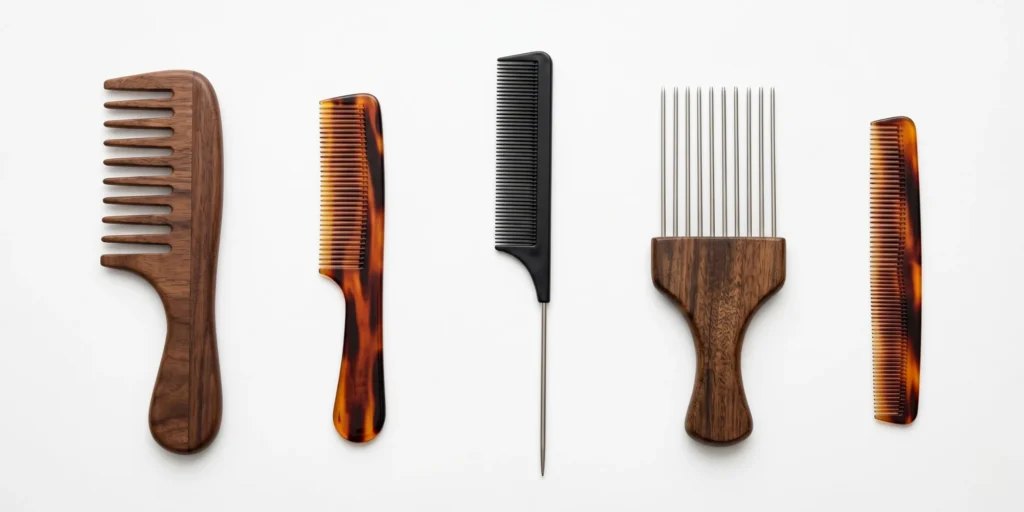
A hair comb is one of the most widely used grooming tools in the world, but the category is far more varied than most people recognise. Different comb shapes are designed around specific mechanical functions — detangling, sectioning, volumising, precision parting, and edge control — and the difference between using the right comb and the wrong one is the difference between a clean styling outcome and unnecessary breakage.
This guide covers every major hair comb type, the function each is designed to perform, which hair types and conditions each suits best, and the material variables that affect durability and performance. For brand developers and importers building hair comb ranges, it also provides a product segmentation framework for positioning comb types by hair-type and use-case rather than by price alone.
How Comb Shape Determines Function
Before covering individual types, it is useful to understand why comb shape matters mechanically. The two primary variables in any comb are tooth spacing and tooth length. Wide spacing means lower contact point density per stroke — fewer teeth engaging fewer strands simultaneously — which reduces friction and is better for fragile, tangled, or curly hair. Fine spacing means higher contact point density per stroke, which creates smoother, more polished results on straight and lightly wavy hair.
Tooth length determines how far the comb penetrates into the hair mass. Longer teeth reach through dense or thick hair; shorter teeth work on the surface layer. The handle design — whether a full handle, a tail extension, or a grip section — determines how the comb is held and what precision of application is possible.
Material affects the surface friction between the tooth edge and individual hair strands. Seamless cellulose acetate and polished wooden combs produce less snagging friction than injection-moulded plastic combs with visible seam lines on the tooth edges. For a deeper comparison of how combs and brushes differ functionally, see our guide on hair brush vs hair comb: differences and when to use each.
The Main Types of Hair Combs
Wide-Tooth Comb
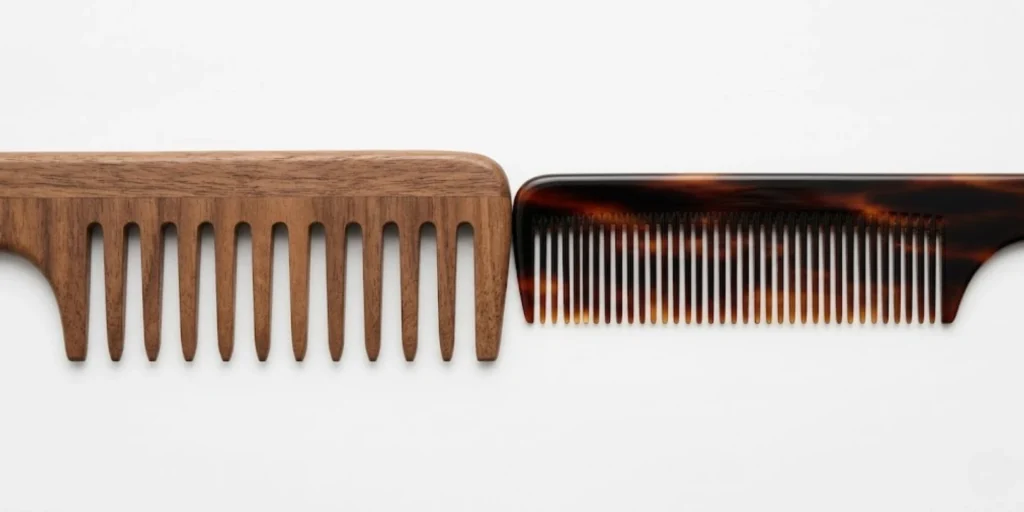
The wide-tooth comb has the most widely spaced teeth of any standard comb type. The spacing — typically 5mm to 8mm between teeth — means each pass engages a small number of strands rather than the full hair volume, which reduces the mechanical force applied per strand during each stroke.
Primary use: Wet hair detangling across all hair types, particularly curly, coily, and thick hair. Product distribution — working conditioner, styling cream, or leave-in product through the hair evenly. Pre-wash detangling on dry hair before washing.
Why it reduces breakage: On wet hair, the lower contact point density of a wide-tooth comb limits the cumulative mechanical load per pass. This is particularly significant for curly and coily hair types where knot accumulation is high and each strand is under more tension during detangling. The wide-tooth comb is the tool most consistently recommended by hair care professionals for wet curly hair precisely because its geometry minimises the force concentration that causes breakage.
Hair type suitability: All hair types for wet use. Specifically recommended as the primary detangling tool for Type 3 and Type 4 curly and coily hair. Also appropriate for colour-treated and chemically processed hair where cuticle damage makes wet strands more fragile.
The question of which comb is most appropriate for detangling wet versus dry hair — and why wet hair requires a different approach — is covered in our guide on whether it is bad to brush wet hair.
Fine-Tooth Comb
The fine-tooth comb has closely spaced teeth — typically 1mm to 2mm apart — that engage the maximum number of strands per stroke. This high contact density produces smooth, polished results on straight and lightly wavy hair and is the appropriate tool for finishing, aligning, and distributing product through hair that has already been detangled.
Primary use: Finishing and smoothing straight or lightly wavy hair after initial detangling. Distributing styling products evenly through fine hair. Creating smooth, polished hairstyles such as slicked buns, sleek ponytails, or straight styles. General daily maintenance on fine to medium straight hair.
What to avoid: Fine-tooth combs should not be used on knotted or tangled hair — the high contact density means every pass applies force to multiple strands simultaneously, making breakage at knot concentration points highly likely. They should also not be used on wet curly or thick hair, where the tooth spacing is insufficient to work through the hair volume without snagging.
Hair type suitability: Fine to medium straight and lightly wavy hair for finishing and daily maintenance. Not appropriate for wet detangling on curly, coily, or thick hair.
Rat-Tail Comb
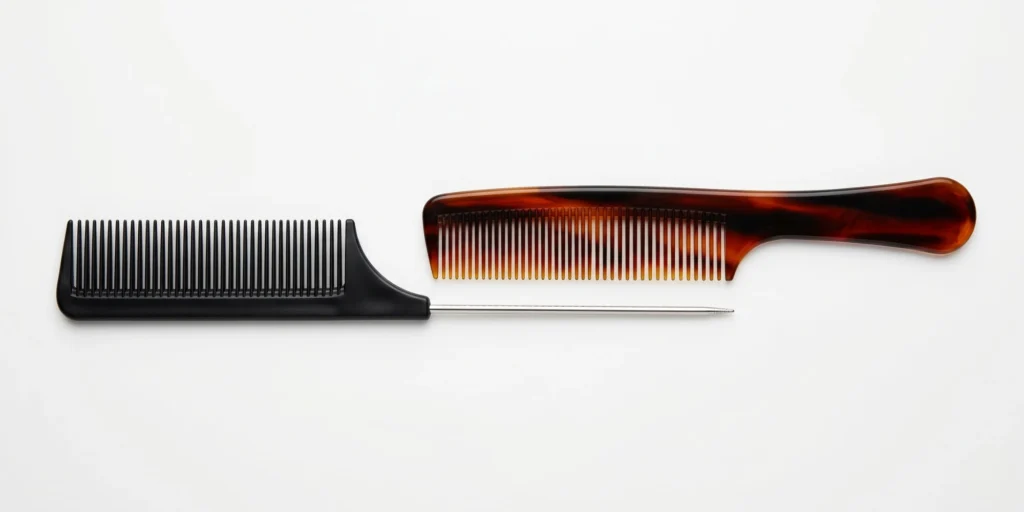
The rat-tail comb — also called a pin-tail comb or parting comb — has a fine or medium tooth section combined with a long, pointed handle extension (the “tail”) used for creating precise scalp partings. The tail is typically made from metal or hard plastic and tapers to a fine point.
Primary use: Creating clean, precise scalp sections for colouring, highlighting, braiding, and styling work. Directing individual sections of hair during blow-dry or roller set applications. Lifting and loosening set curls after roller removal. Used extensively in professional salon environments for sectioning work during chemical services.
Tail material variations: Metal pin tails provide the most durability and precision for professional use but can snag if not handled carefully. Plastic tails are lighter and less likely to cause accidental scalp contact but wear over time. The customisation possibilities for rat-tail combs in professional and salon supply contexts — including tail material, tooth configuration, and handle ergonomics — are covered in our detailed article on custom rat-tail combs for professional use.
Hair type suitability: All hair types — the rat-tail comb is used for sectioning and parting rather than detangling or smoothing, so hair type is less relevant than in other comb categories.
Styling Comb (All-Purpose / Cutting Comb)
The styling comb — also called a barber comb, cutting comb, or all-purpose comb — has two tooth zones: a fine-tooth section at one end and a wider-tooth section at the other. This dual-density design makes it the most versatile single-comb option for professional stylists, allowing them to switch between detangling and precise work without changing tools.
Primary use: Hair cutting — the comb guides the scissors and controls the section being cut, with the wide teeth used for initial lifting and the fine teeth for precision finishing. Blow-dry styling for directional control. General styling work in barbershop and salon environments. Scalp and beard grooming.
Tooth design rationale: The wide-tooth end works through initial knots and lifts the hair section for scissor work; the fine-tooth end refines the section, smooths edges, and controls the exact line being cut. The graduated density in a single tool is the reason the styling comb is the most commonly held comb in a professional stylist’s kit.
Hair type suitability: All hair types in professional styling contexts. For consumer daily use, the dual-density design is useful for medium to thick straight and wavy hair where both functions are needed.
Teasing Comb
The teasing comb — also called a backcombing comb or volumising comb — has a combination of short, closely set teeth for lifting and backcombing, and a pointed tail or handle for sectioning. Some designs include a brush section alongside the teeth for smoothing the outer layer after backcombing.
Primary use: Creating volume through backcombing — pushing hair back toward the root to create lift and fullness at the scalp. Adding volume at the crown or roots for updo styles, formal styling, and styles where height at the roots is required.
How backcombing works: The fine, closely set teeth are moved from mid-length toward the root in short, pushing strokes, which causes the cuticle scales of individual strands to catch on each other and create a matted volume structure. The outer layer is then smoothed over the top using the brush section or a separate finishing tool.
Important limitation: Backcombing applied too aggressively or too frequently is one of the most damaging techniques in regular hair styling, as it deliberately creates cuticle friction and scale disruption. For fine or damaged hair, backcombing should be used sparingly and only with the appropriate product support for cuticle protection.
Hair type suitability: Fine and medium hair for volume creation. Not recommended for damaged, colour-treated, or very fine hair in regular use.
Afro Pick / Wide-Prong Comb
The afro pick — also called a hair pick or fork comb — has long, widely spaced, rounded prongs set into a handle, resembling a fork. The prong spacing is wider than any standard wide-tooth comb, and the length of the prongs allows the tool to penetrate deeply into dense, tightly coiled hair without compressing the curl structure.
Primary use: Lifting and shaping afro-textured, coily, and very curly hair — adding volume at the roots without disrupting the curl pattern. Distributing volume evenly through the hair mass after wash-and-go styling or after sleeping on a style. Used as a finishing tool on afro and natural hair styles to restore shape and height.
Why standard combs are insufficient for this function: Standard wide-tooth combs with conventional tooth length do not penetrate deeply enough into dense afro-textured hair to lift from the root without compressing the surface. The afro pick’s long prongs enter the hair at the root and lift from below, which is a structurally different action from surface combing.
Hair type suitability: Specifically designed for Type 4 coily and afro-textured hair. Also useful for Type 3 curly hair when volume restoration is the goal.
Detangling Comb
The detangling comb is a relatively recent category that sits between the wide-tooth comb and the flexible detangling brush in terms of design philosophy. It has widely spaced, flexible or tapered teeth that are specifically engineered to work through knots progressively rather than pulling through them with consistent resistance.
Primary use: Wet hair detangling across all hair types, with particular effectiveness on curly, thick, and tangled hair. In-shower detangling with conditioner applied. Distributing deep conditioning treatments through the hair evenly.
Distinction from wide-tooth combs: A standard wide-tooth comb has rigid teeth with consistent stiffness — when a tooth encounters a knot, it pulls through with the full force of the combing stroke. A detangling comb has teeth designed to bend or flex slightly under tension, reducing the peak force at each knot contact point. This distinction matters most for very tangled or fragile hair.
Hair type suitability: All hair types for wet detangling. Particularly appropriate for curly, coily, colour-treated, and fine hair where breakage risk during detangling is elevated.
Pocket Comb / Travel Comb
The pocket comb is a compact, typically rectangular comb designed for portability rather than specialised function. Most pocket combs have medium tooth spacing across the full length, though some feature dual-density tooth sections for versatility.
Primary use: Quick touch-ups and maintenance throughout the day. Travel grooming. Beard and moustache maintenance in smaller formats. General purpose styling for short or medium hair where portability is the primary requirement.
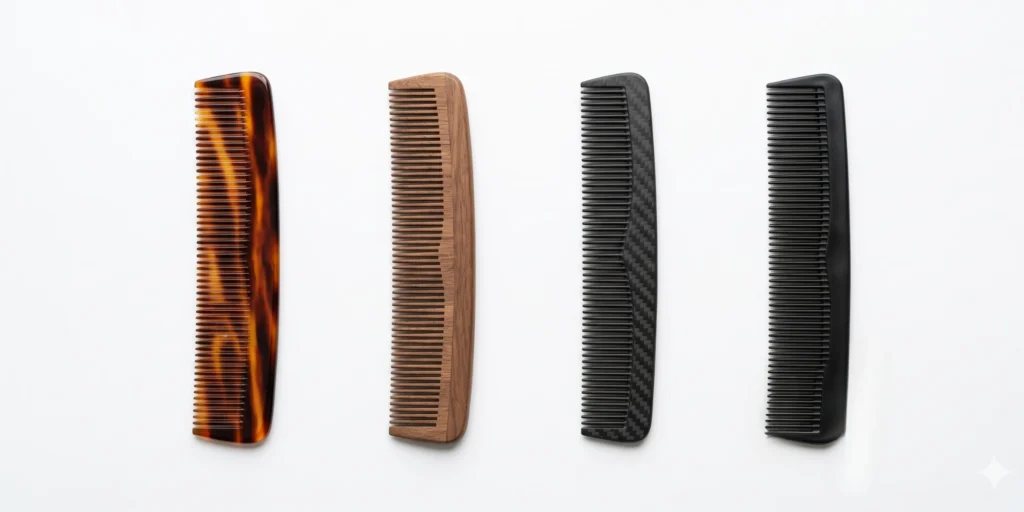
Material considerations for pocket combs: Because pocket combs are carried in bags, pockets, and cases rather than stored on a dressing table, durability and resistance to bending are more important than for stationary tools. Acetate and carbon fibre pocket combs maintain their tooth alignment under the compression stress of being carried; cheaper plastic alternatives may bend and distort.
Hair type suitability: All hair types for casual daily use. Not a specialist tool — versatility and convenience are the primary values.
Comb Materials and Their Effect on Performance
Material choice affects the surface friction between the tooth edge and each hair strand — and this friction difference, multiplied across hundreds of strokes over weeks of use, has a measurable cumulative effect on cuticle condition.
Cellulose Acetate
Cellulose acetate combs are produced from a plant-derived material and are typically finished with polished, seamless tooth edges. The smooth surface generates less friction than standard injection-moulded plastic and is one of the gentlest comb materials available for regular use. Acetate combs are also heat-resistant and anti-static. They are the premium material choice in the comb category, used in professional salon tools and premium consumer products.
Wood
Wooden combs — typically produced from sandalwood, bamboo, or hardwoods — have natural surface properties that generate low static during combing. The porous surface absorbs a small amount of natural scalp oil during use, which can contribute to a light conditioning effect on the hair shaft. The primary limitation of wooden combs is moisture sensitivity: they should not be soaked in water during cleaning, and should be dried promptly after wet-hair contact to prevent warping and tooth separation.
Plastic (ABS, PP)
Standard plastic combs are the most widely used material globally. ABS plastic is more durable and impact-resistant than PP; both are lightweight and inexpensive. The limitation of injection-moulded plastic combs is the visible seam line that forms along the tooth edge during production — this seam can snag hair strands, particularly on fine or damaged hair. Seamless-cut plastic combs, finished by hand or machine after moulding, eliminate this issue.
Carbon Fibre
Carbon fibre combs are heat-resistant, anti-static, extremely lightweight, and durable. They are used primarily in professional styling contexts where heat resistance and durability under heavy use are required. The material’s anti-static properties make it appropriate for consumers with fine hair that generates significant static during combing.
Metal
Metal combs — stainless steel or aluminium — are highly heat-resistant and are used in professional settings where the comb is used in close proximity to heated styling tools. They are not appropriate for general consumer use as daily detangling or maintenance tools, as the rigidity and weight of metal produce more mechanical stress per stroke than plastic or natural alternatives.
Quick Reference: Comb Type by Hair Type and Use Case
| Comb Type | Best Hair Type | Primary Use |
|---|---|---|
| Wide-tooth | All types, especially curly and thick | Wet detangling, product distribution |
| Fine-tooth | Fine to medium straight | Finishing, smoothing, daily maintenance |
| Rat-tail | All types | Sectioning, precision parting |
| Styling / cutting | All types (professional) | Cutting, blow-dry styling |
| Teasing | Fine to medium | Backcombing, volume creation |
| Afro pick | Type 4 coily, Type 3 curly | Root lift, volume restoration |
| Detangling | All types | Wet knot removal, shower use |
| Pocket / travel | All types | Daily touch-ups, portability |
Sourcing Considerations for B2B Buyers
For buyers building hair comb ranges, the comb category’s breadth — from wide-tooth detanglers to professional rat-tail tools to acetate styling combs — requires a segmentation approach that mirrors the use-case and hair-type distinctions above rather than defaulting to a single general-purpose format.
Material tiering: A range that offers standard plastic at the entry level and seamless cellulose acetate or carbon fibre at the premium tier provides clear price architecture with justified differentiation at each level. Plastic and acetate combs are not the same product presented at different prices — the material genuinely affects the user experience and cuticle friction outcome.
Professional versus consumer positioning: Rat-tail combs, cutting combs, and teasing combs are positioned for professional or semi-professional use and command different packaging and channel strategies than consumer detangling or finishing combs. A range that attempts to serve both channels with the same packaging typically underserves both.
Hair-type labelling: Wide-tooth combs positioned for curly hair, detangling combs for wet use, and fine-tooth combs for straight hair finishing — with hair-type guidance clearly communicated on packaging — reduce consumer mismatches and the returns that follow.
MOQ and range depth: Comb moulds are generally lower-cost than brush moulds, and the range of standard available profiles is wider. For buyers entering the comb category for the first time, starting with catalogue profiles (wide-tooth, fine-tooth, pocket comb) before investing in custom shapes is the lower-risk approach. Both standard and custom comb formats are available through OEM and private label manufacturing routes.
The decision framework for how combs fit within a broader hair tool range — and how to position them relative to brushes — is covered in our guide on how to choose the right hair brush for your hair type, which includes a comb-versus-brush comparison by use case.
Frequently Asked Questions
What is the best comb for curly hair?
A wide-tooth comb used on wet, conditioner-saturated hair is the standard recommendation for curly hair detangling. The wide spacing between teeth limits friction per pass and avoids the compression of the curl pattern that finer-tooth combs cause. For Type 4 coily hair that requires volume restoration after styling, an afro pick used on dry hair is the appropriate finishing tool.
What type of comb is best for fine hair?
A fine-tooth comb with polished, seamless teeth — ideally in cellulose acetate — is the most appropriate choice for fine hair finishing and daily use. For detangling, a wide-tooth comb or flexible detangling comb on damp hair minimises the breakage risk that fine hair is prone to during knot removal.
What is a rat-tail comb used for?
A rat-tail comb is used for creating precise scalp partings and sections during styling, colouring, and chemical service work. The pointed tail extension allows the stylist to draw a clean, straight line through the scalp to separate sections precisely. It is not a detangling or finishing tool — its primary function is sectioning and parting precision.
What is the difference between a wide-tooth comb and a detangling comb?
A wide-tooth comb has rigid teeth with consistent stiffness — the tooth spacing reduces contact point density per pass but applies consistent force at each knot encounter. A detangling comb has teeth engineered to flex or taper, reducing the peak force applied at each knot contact point. For most hair types, either works for wet detangling. For very tangled, fragile, or fine hair, the detangling comb’s flex-under-tension mechanism reduces breakage risk more effectively.
Does comb material matter for hair health?
Yes. Seamless cellulose acetate and polished wooden combs generate less friction against the hair shaft per stroke than injection-moulded plastic combs with visible tooth seam lines. Over weeks and months of daily use, this friction difference affects cumulative cuticle wear and hair condition. For fine, damaged, or colour-treated hair where cuticle integrity is already compromised, material quality is a meaningful variable.
Can I use the same comb on wet and dry hair?
Wide-tooth and detangling combs are appropriate for both wet and dry use, though wet use requires more care — working from ends to roots rather than root to tip, applying conditioner or detangling product for slip, and using lighter pressure than on dry hair. Fine-tooth combs and teasing combs are dry-hair tools and should not be used on wet hair, where the high contact density causes breakage at knot concentration points.
Conclusion
The different types of hair combs serve distinct mechanical functions — wide-tooth combs minimise friction on wet fragile hair, fine-tooth combs create polished finishing on smooth dry hair, rat-tail combs enable professional precision sectioning, afro picks lift and restore volume in coily hair, and styling combs give professionals the dual-function versatility needed across cutting and finishing work. Selecting the right comb type begins with understanding what the tool is mechanically designed to do, and matching that to the hair type and use case at hand.
For brand developers sourcing hair comb ranges with clear hair-type differentiation and material quality at each price tier, manufacturers such as JunYi Beauty — which produces plastic, acetate, wooden, and carbon fibre combs across the full range of tooth configurations and handle designs from its Dongguan facility, with OEM and ODM capacity for custom profile development — represent the type of manufacturing partner suited to ranges built around functional differentiation rather than commodity pricing.