Sharing a hair brush is one of those everyday habits — between family members, friends, or in shared households — that most people rarely think twice about. But hair brushes make direct contact with the scalp and hair of everyone who uses them, and that raises legitimate questions about what can and cannot be transmitted through a shared brush. The two most common concerns are head lice and dandruff, and the honest answer differs significantly between them: one is a genuine transmission route, the other is largely a misunderstanding of what dandruff actually is.
This article explains what can realistically spread through a shared hair brush and what cannot, backed by how each condition actually transmits. For consumers making practical decisions about brush hygiene, and for B2B buyers whose product positioning may touch on hygiene claims, understanding the real transmission mechanisms — rather than the assumptions around them — is what separates accurate guidance from myth. The framework connects to the broader hair brush hygiene practices covered across our care guides.
Head Lice: A Genuine Transmission Risk
How Head Lice Spread
Head lice (Pediculus humanus capitis) are small, wingless insects that live on the human scalp and feed on blood. They spread primarily through direct head-to-head contact, which is why they are most common among young children who play in close physical proximity. However, lice and their eggs (nits) can also transfer via shared items that contact the hair and scalp — and hair brushes are among the most direct of these items.
When a person with head lice uses a brush, live lice can be dislodged onto the bristles, and nits attached to shed hairs can remain caught in the brush. If another person uses the same brush shortly afterward, a live louse caught in the bristles can transfer onto their scalp and establish a new infestation.
How Significant Is the Brush Transmission Route?
It is important to be accurate about the level of risk. Direct head-to-head contact remains the dominant transmission route for head lice — the majority of cases spread this way, not through shared objects. Lice cannot jump or fly, and they do not survive long away from the human scalp (typically 24–48 hours without feeding). This means the window during which a shared brush can transmit live lice is limited.
That said, the risk through shared brushes is real, not negligible — particularly when brushes are shared in immediate succession, as commonly happens in households or among children getting ready together. A brush used by someone with an active infestation and then immediately by someone else presents a genuine transmission opportunity.
Practical Precautions
The practical guidance is straightforward: avoid sharing brushes, particularly during known lice outbreaks at schools or in the household. If a brush has been used by someone with an active infestation, it can be decontaminated by soaking in hot water (at least 54°C / 130°F) for 5–10 minutes, which kills both live lice and nits. Cleaning the brush to remove all trapped hair before soaking improves the effectiveness of decontamination.
For households managing an active lice case, dedicating individual brushes to each family member during the treatment period — and decontaminating them — is a sensible precaution alongside the primary lice treatment.
Dandruff: Largely a Misunderstanding
What Dandruff Actually Is
Dandruff is where the common assumption breaks down. Many people assume dandruff is contagious and can spread through shared brushes the way lice can. This is largely incorrect, and the reason lies in what dandruff actually is.
Dandruff — and its more inflammatory form, seborrheic dermatitis — is primarily driven by three factors working together: the natural presence of a yeast called Malassezia that lives on virtually everyone’s scalp, the individual’s sebum (scalp oil) production, and the individual’s own immune and skin sensitivity response to the yeast’s activity. Dandruff is the visible flaking that results from this interaction on a susceptible person’s scalp.
The critical point is that Malassezia yeast is already present on nearly everyone’s scalp as part of the normal skin microbiome. You do not “catch” it from someone else — you already have it. Whether it produces dandruff depends on your own scalp environment and sensitivity, not on exposure to someone else’s flakes.
Why Dandruff Does Not Spread Like an Infection
Because dandruff results from each individual’s own scalp environment and their personal response to a yeast everyone already carries, it does not transmit from person to person the way a contagious infection does. Using a brush that a person with dandruff has used will not “give” you dandruff. The visible flakes transferred are dead skin cells, not an infectious agent that colonises a new host and produces the condition.
Two people can use the same brush and only the one with the underlying susceptibility — the particular combination of sebum production, yeast sensitivity, and skin response — will develop dandruff. The other person’s scalp environment does not become dandruff-prone through exposure.
The Nuance: Not Zero Risk, But Not Contagion
There is a narrow qualification worth stating honestly. While dandruff itself is not contagious, certain genuine fungal scalp infections — such as tinea capitis (scalp ringworm), which is a different condition from ordinary dandruff — are contagious and can theoretically transmit through shared brushes, combs, hats, and pillowcases. Tinea capitis is caused by dermatophyte fungi that do colonise new hosts, and it is a genuine infection rather than a sensitivity response.
Tinea capitis is most common in children and produces symptoms beyond ordinary flaking — patchy hair loss, scaling, redness, and sometimes broken hairs or a boggy inflamed area. If a person has these symptoms rather than ordinary dandruff, the situation is different, and sharing brushes should be avoided, with medical treatment sought. Ordinary dandruff, by contrast, is not this.
Other Things That Can and Cannot Spread Through a Shared Brush
Can Spread
Bacterial and fungal scalp infections: Genuine scalp infections — folliculitis (bacterial infection of hair follicles), tinea capitis (scalp ringworm), and other dermatophyte infections — can transmit through shared brushes because these involve infectious organisms that colonise new hosts. If someone has an active, diagnosed scalp infection, brush sharing should be avoided.
Product and debris transfer: Shared brushes transfer whatever is on them — styling product residue, sebum, dead skin cells, and dislodged hairs. This is a hygiene consideration rather than a health risk for most people, but for those with sensitive scalps or specific product allergies, using a brush coated in someone else’s product residue can cause irritation.
Cannot Spread (Common Misconceptions)
Dandruff (ordinary): As covered above, ordinary dandruff is not contagious and does not spread through shared brushes.
Hair type or texture: An obvious point, but worth stating because it occasionally appears in folk belief — using someone’s brush does not transfer or change hair type, texture, or characteristics.
Grey hair, hair loss, or baldness: None of these transmit through shared brushes. Pattern hair loss is genetic and hormonal; greying is genetic and age-related. Neither is an infectious process.
General “bad hair health”: Hair damage, dryness, or poor condition are results of an individual’s hair care practices, environment, and biology — they are not transmissible states.
Practical Brush Hygiene Guidance
Regardless of transmission concerns, regular brush hygiene is worthwhile for everyone — it maintains brush performance and reduces the accumulation of product residue and sebum that can affect the scalp.
Cleaning Frequency
For personal-use brushes, removing trapped hair after each use and washing the brush every one to two weeks is appropriate for most people. Those who use significant styling product should clean more frequently, as product residue accumulates on bristles and reduces their effectiveness — a consideration covered in our care guidance for boar bristle brushes and frizz, where product buildup directly undermines the brush’s smoothing function.
Cleaning Method
Remove all trapped hair first, then wash with warm water and a small amount of gentle shampoo. For natural bristle brushes, avoid soaking the base — which can weaken the bristle setting and, for wooden handles, cause warping — and air-dry bristle-side down. Synthetic brushes tolerate more thorough washing. For decontamination after known lice or infection exposure, hot water soaking at 54°C or above for 5–10 minutes is effective.
If You Must Share
In households where brush sharing is difficult to avoid entirely, cleaning the brush between users reduces transfer of product residue and provides some hygiene benefit. During active lice outbreaks or when anyone in the household has a diagnosed scalp infection, sharing should stop entirely and individual brushes should be assigned and decontaminated.
The best practice — particularly for households with children, where lice outbreaks are most common — is simply to assign each person their own brush. Given the low cost of hair brushes relative to the inconvenience of managing a lice transmission, individual brushes are a sensible default.
Sourcing Considerations for B2B Buyers
For buyers developing hair brush products, hygiene is an increasingly relevant positioning dimension — particularly for family, children’s, and travel product lines.
Hygienic Material Selection
Silicone and certain synthetic materials are easier to clean and sanitise than natural bristle, and they do not absorb product residue and moisture the way natural bristle does. For products positioned around hygiene — children’s brushes, shared-use combs, salon tools — non-absorbent, easily-sanitised materials support the hygiene claim. Natural bristle, while excellent for performance, requires more careful maintenance and is less suited to frequent sanitisation.
Antimicrobial Treatments
Some hair brush products incorporate antimicrobial additives into the plastic or coating, marketed as reducing bacterial growth on the brush surface between cleanings. Where these claims are made, they should be substantiated with appropriate testing and comply with the biocidal product regulations of the target market — antimicrobial claims are subject to specific regulatory requirements in both the EU and US. Overstating antimicrobial benefit, or making unsupported “prevents infection” claims, creates regulatory exposure.
Individual-Use Positioning for Family Ranges
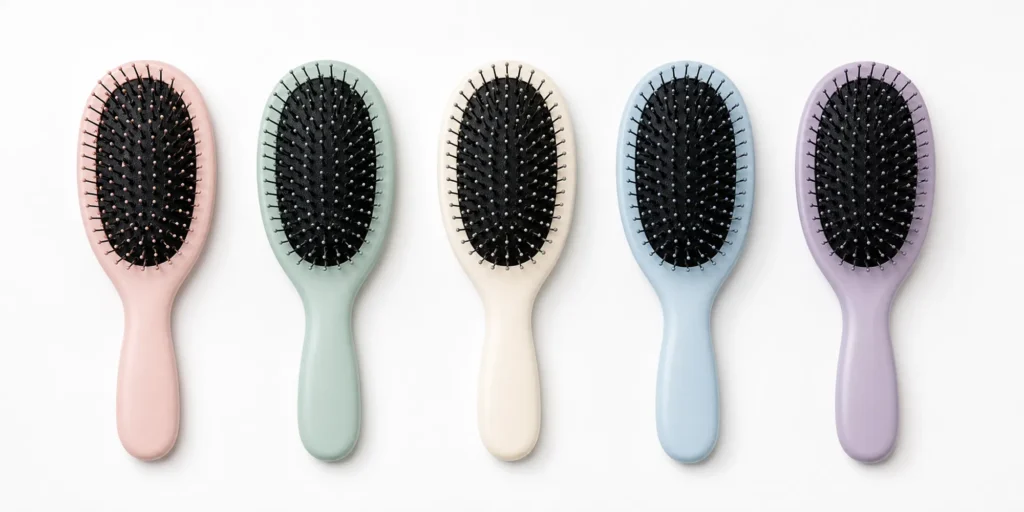
Family and children’s brush ranges can be positioned around individual assignment — colour-coded sets, named or differentiated brushes for each family member — which serves both a practical hygiene function (reducing sharing) and a commercial function (selling multiple units per household). This aligns genuine hygiene guidance with range architecture.
Compliance and Claim Discipline
Hygiene and health claims on hair brush packaging are subject to consumer protection and, where antimicrobial or health-protective claims are made, biocidal and medical device regulations. Defensible positioning focuses on ease of cleaning, material sanitisation properties, and individual-use convenience rather than claims to prevent specific infections or conditions. The broader certification and compliance framework is covered in our article on hair brush safety certifications.
Hygiene-oriented brush and comb formats in easily-sanitised materials, including colour-differentiated family sets, are available through OEM and private label manufacturing routes.
Frequently Asked Questions
Can you catch head lice from sharing a hairbrush?
Yes, this is a genuine transmission route. Live lice can be dislodged onto brush bristles and transfer to another person’s scalp, particularly when brushes are shared in immediate succession. However, direct head-to-head contact remains the dominant way lice spread. Avoiding brush sharing — especially during outbreaks — and decontaminating brushes in hot water (54°C or above) after exposure are effective precautions.
Is dandruff contagious through a shared brush?
No. Ordinary dandruff is not contagious. It results from an individual’s own scalp environment — their sebum production and their personal sensitivity to a yeast (Malassezia) that is already present on nearly everyone’s scalp. Using a brush that a person with dandruff has used will not give you dandruff. The flakes transferred are dead skin cells, not an infectious agent.
What scalp conditions can actually spread through a shared brush?
Genuine infections — bacterial folliculitis, and fungal infections such as tinea capitis (scalp ringworm) — can transmit through shared brushes because they involve infectious organisms that colonise new hosts. These are different from ordinary dandruff. If someone has patchy hair loss, redness, scaling, or other symptoms beyond ordinary flaking, a shared brush should be avoided and medical advice sought.
How do I clean a hairbrush to remove lice?
Remove all trapped hair, then soak the brush in hot water at 54°C (130°F) or above for 5 to 10 minutes. This temperature kills both live lice and nits. For natural bristle or wooden brushes, be cautious with prolonged hot water exposure, which can damage the material — synthetic brushes tolerate this decontamination better.
How often should I clean my hairbrush?
For personal-use brushes, remove trapped hair after each use and wash the brush every one to two weeks. Those who use significant styling product should clean more frequently, as buildup reduces brush effectiveness. Removing hair and washing regularly maintains both hygiene and brush performance.
Is it safe to share a brush within a family?
For most people with healthy scalps and no active conditions, occasional sharing carries low risk — with the important exception of head lice, which spread easily among children. During lice outbreaks, or when any family member has a diagnosed scalp infection, sharing should stop entirely. The simplest approach is to assign each person their own brush, which is inexpensive and avoids the issue.
Conclusion
The two most common concerns about sharing a hair brush have different answers. Head lice can genuinely spread through shared brushes — a real if secondary transmission route worth taking seriously, especially in households with school-age children, and easily addressed by not sharing and by hot-water decontamination when needed. Ordinary dandruff, by contrast, is not contagious: it results from each person’s own scalp environment and their response to a yeast everyone already carries, and it does not transmit through shared objects. The genuine infectious concern in this category is not dandruff but true scalp infections like tinea capitis, which are distinct conditions with distinct symptoms.
The practical takeaway is straightforward: assign individual brushes where possible, clean brushes regularly, and stop sharing entirely during lice outbreaks or diagnosed scalp infections. For brands developing hygiene-oriented brush ranges, manufacturers such as JunYi Beauty — which produces easily-sanitised silicone and synthetic brush formats and colour-differentiated family sets alongside its natural bristle ranges from its Dongguan facility — represent the type of OEM partner suited to product lines where hygiene positioning is grounded in accurate guidance rather than overstated health claims.