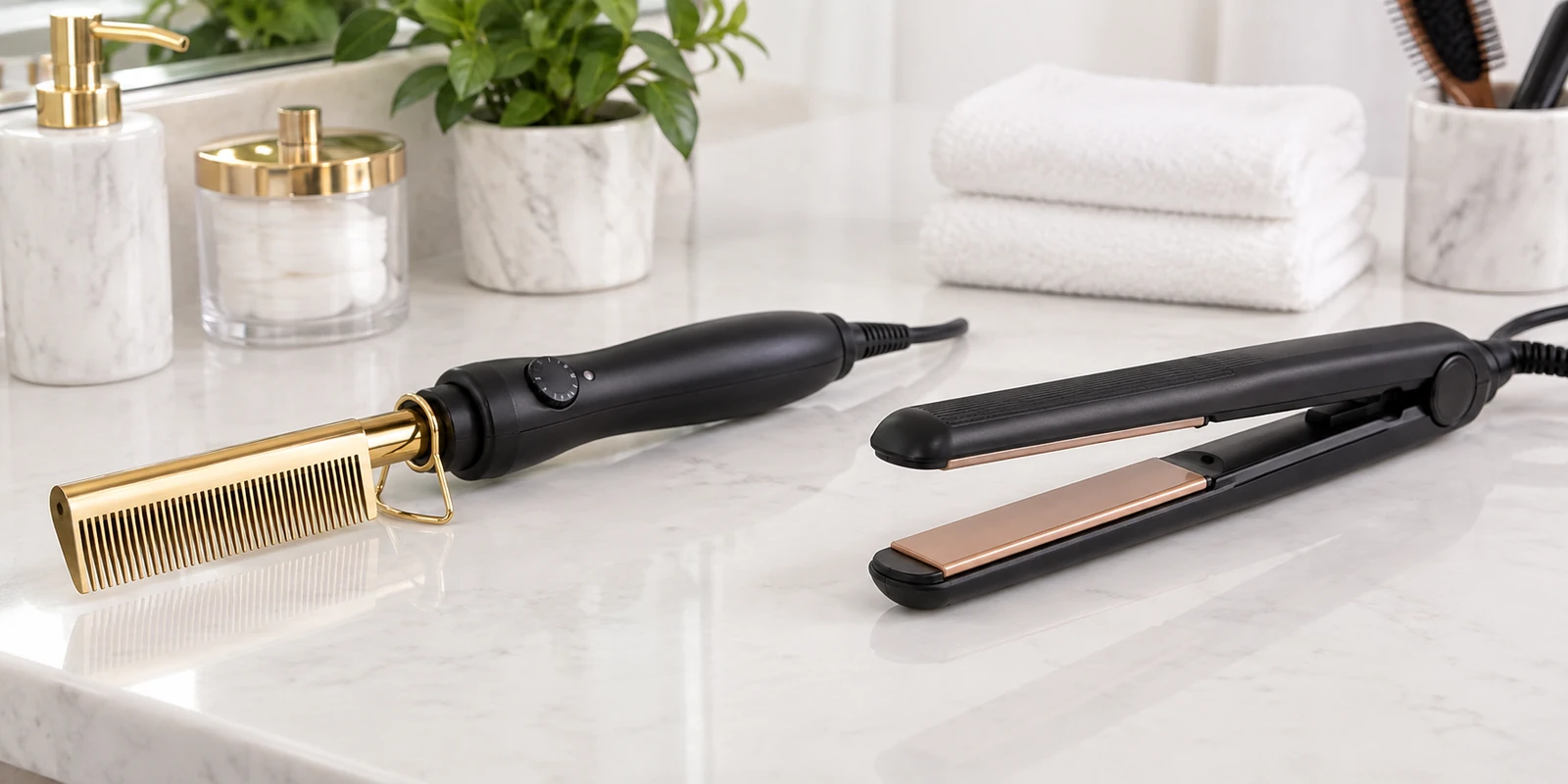
Hot combs and flat irons are both used to straighten natural, textured hair, but they apply heat through fundamentally different mechanisms with different implications for straightening thoroughness, root-to-scalp proximity, and the specific damage risks each carries. For Type 3 and 4 natural hair specifically — the primary use case this comparison serves — the choice between the two tools is not simply a matter of preference, since the two mechanisms genuinely differ in how completely they straighten dense, tightly coiled hair.
This guide compares hot combs and flat irons on how each works, straightening thoroughness on natural hair specifically, heat damage mechanisms, technique differences, and which tool suits which hair density and styling goal, so the choice can be based on the actual mechanics involved rather than general heat-styling assumptions that don’t fully translate to Type 3 and 4 hair texture. For the broader material and heat-resistance framework relevant to both tools, see our guide on heat-resistant hair brush materials.
How Each Tool Works
The Hot Comb Mechanism
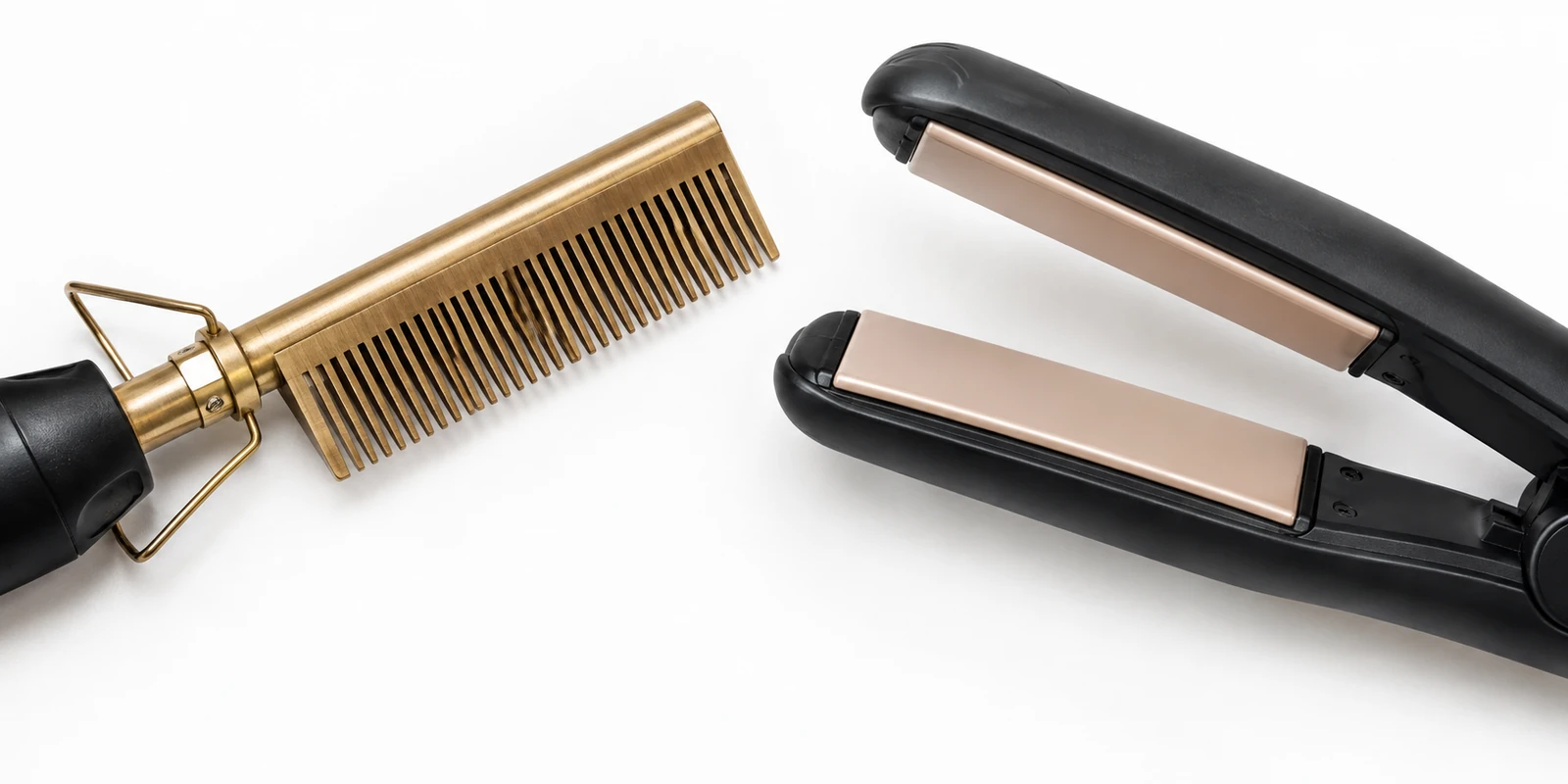
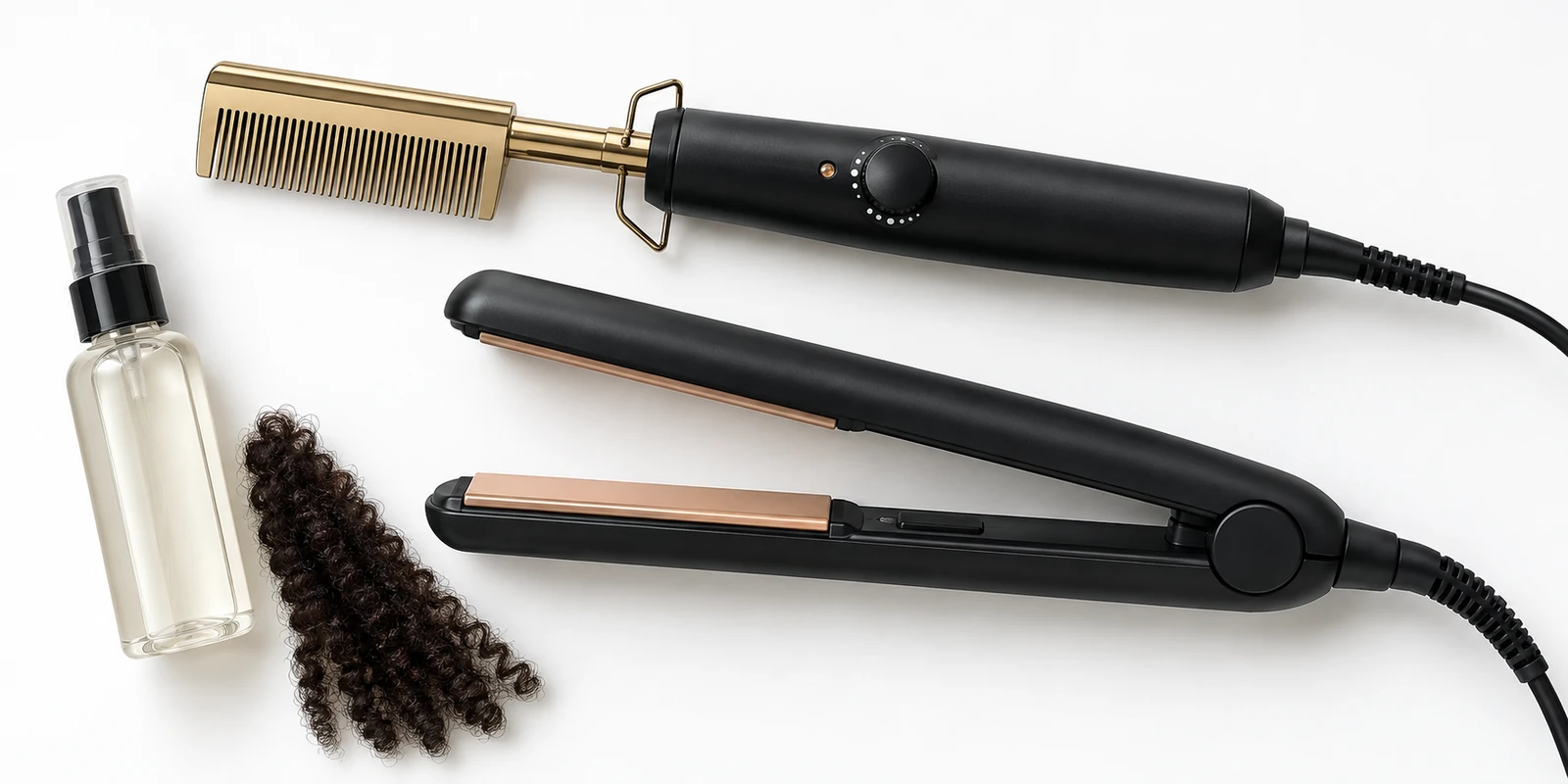
A hot comb — traditionally a metal comb heated on a stove or hot plate, though electric self-heating versions are now standard — has closely spaced teeth that are drawn through a section of hair from root to tip in a single, continuous motion. The heated metal teeth make direct contact with the hair shaft as they pass through, and critically, the comb’s teeth can reach close to the scalp in a way a flat iron’s flat plates generally cannot without risking direct scalp contact.
The Flat Iron Mechanism
A flat iron applies heat through two flat plates that clamp around a section of hair, gliding along the length under consistent pressure. As covered in our comparison of straightener brushes and flat irons, the flat plate design creates high-contact-area, even heat transfer across the clamped section, but the flat, wide plate shape means the tool typically starts its pass a short distance from the scalp rather than at the root itself, to avoid burning the scalp with the flat, broad heated surface.
Straightening Thoroughness on Natural Hair Specifically
Why Root Proximity Matters More for Type 3 and 4 Hair
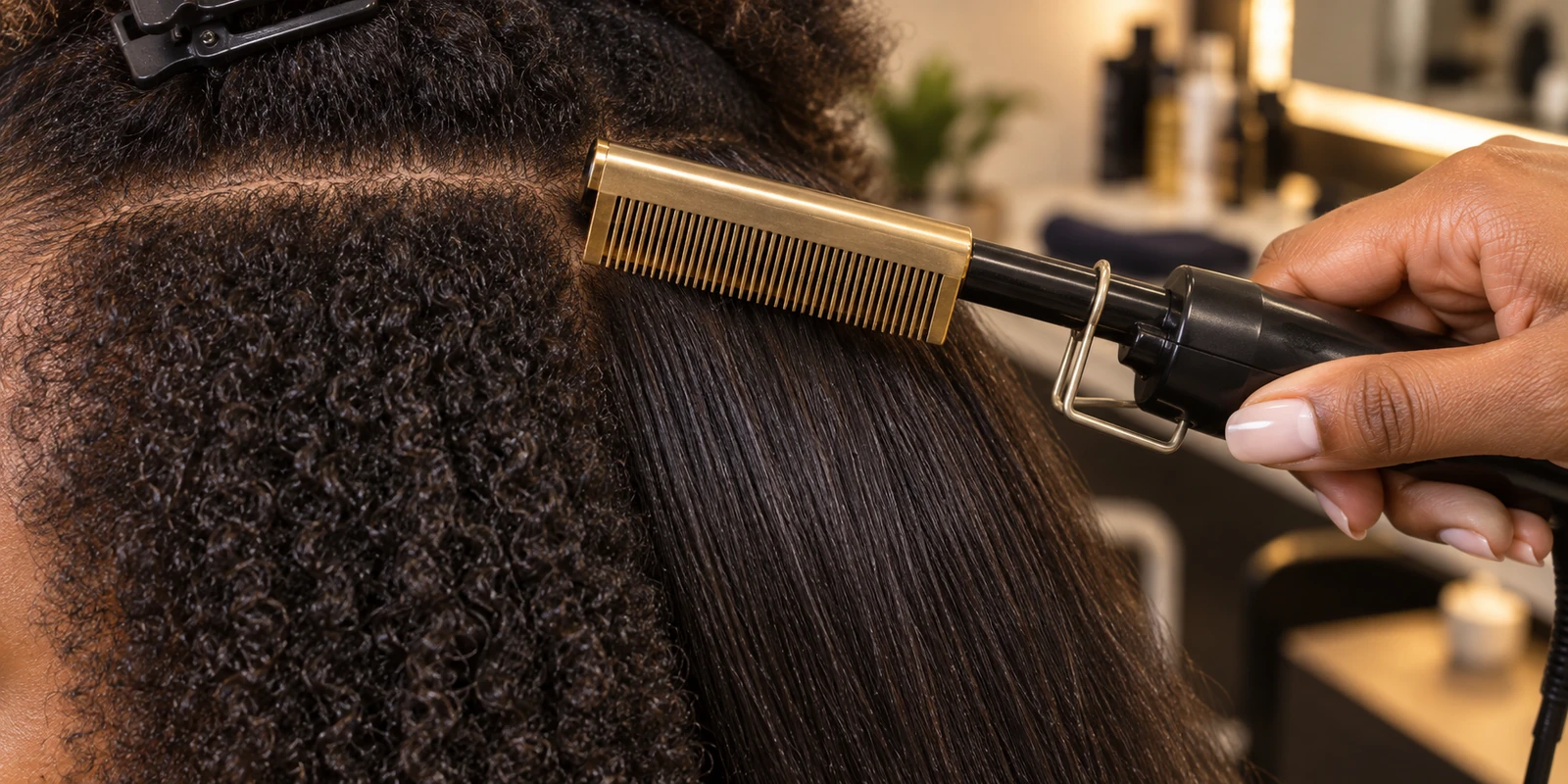
This is the central mechanical difference that makes this comparison distinct from a general hot-tool comparison. Dense, tightly coiled Type 3 and 4 hair has the most curl pattern and shrinkage concentrated at and near the root — a flat iron starting its pass an inch or more from the scalp leaves that root section significantly less straightened than the rest of the strand, producing a visible “root swell” or less complete straightening at the base that is a common complaint specifically with flat iron use on this hair texture.
The Hot Comb’s Advantage at the Root
A hot comb’s narrow teeth can be drawn much closer to the scalp than a flat iron’s flat plates without the same burn risk, since the contact area at any given moment is smaller and more controlled. This allows a hot comb to straighten the root section more completely than a flat iron typically achieves in a single pass, which is the primary reason hot combs remain a preferred tool specifically for Type 4 hair in many professional and personal styling contexts, despite flat irons being more broadly popular for hair straightening generally.
Where the Flat Iron’s Even Heat Distribution Matters More
Once past the root section, a flat iron’s clamping, even-pressure contact generally produces a smoother, more uniformly straightened result along the mid-lengths and ends than a hot comb’s single-pass contact, which can leave more subtle texture variation along the length if the pass isn’t repeated. For hair that is already less densely coiled at the root — looser Type 3 patterns, or hair that has been pre-stretched through blow-drying — this flat iron advantage matters more, since the root-proximity problem is less pronounced to begin with.
The Common Combined Approach
Many professional stylists working with Type 4 hair specifically use a hot comb first, focused on the root section and overall pre-straightening, followed by a flat iron pass for final smoothing and shine along the full length — leveraging each tool’s specific mechanical advantage rather than relying on either tool alone for the complete process. This combined technique is common enough in natural-hair styling practice to be worth understanding as a genuine third option beyond “hot comb or flat iron.”
Heat Damage Considerations Specific to Natural Hair
Direct Metal Contact vs. Clamped Plate Contact
A hot comb’s teeth make more concentrated, direct metal-to-hair contact at any given point than a flat iron’s broader flat plate contact, which some stylists and researchers suggest can create more localised heat exposure per point of contact, though a flat iron’s clamping pressure applies its own form of concentrated mechanical-plus-thermal stress. Neither mechanism is inherently safer in an absolute sense — the practical damage risk depends heavily on temperature setting, pass speed, and section thickness for both tools.
Reversion Risk and Repeated Heat Exposure
Type 3 and 4 hair is more prone to humidity-driven reversion (the hair reverting back toward its natural curl pattern in humid conditions) than straighter hair types, which can tempt users into repeated touch-up heat applications to maintain the straightened style — repeated re-application of heat to the same sections, whether with a hot comb or flat iron, is a more significant cumulative damage driver for this hair type than the choice between the two tools for any single styling session.
Protein and Structural Considerations
Type 3 and 4 hair, due to its coil structure, often has more variable diameter along a single strand and more points of natural curvature where the hair shaft is already under more inherent structural stress than straighter hair types. This means the baseline vulnerability to heat-related protein damage can be higher for a given temperature and pass compared to straighter hair, making appropriate temperature selection and heat protectant use — covered in more detail in our straightener brush vs flat iron guide’s damage-management section — particularly important for this hair type regardless of which specific tool is chosen.
Pressing and the Role of Pre-Treatment
Traditional hot comb “pressing” technique typically involves applying a pressing oil or cream to the hair before combing, which serves both a protective function (some heat buffering) and a mechanical function (reducing friction as the comb’s teeth pass through the dense hair section). Flat iron technique on natural hair similarly benefits from a heat protectant, but the traditional pressing-product step is more specifically associated with hot comb technique on Type 4 hair than with flat iron use generally.
Technique Differences
Sectioning
Both tools require smaller, more numerous sections on Type 3 and 4 hair than on straighter hair types, given the density and the importance of even heat contact through the full section. Hot comb technique traditionally uses somewhat smaller sections than flat iron technique, partly a function of the comb’s narrower straightening path per pass.
Pass Speed and Repetition
A hot comb pass is typically a single, continuous, relatively unhurried motion from root to tip; multiple passes over the same section are less common in traditional hot comb technique than in flat iron use, where two or three passes per section to achieve full smoothness is common practice, particularly on denser hair.
Pre-Straightening Preparation
Both tools perform better on hair that has been blow-dried straight (or significantly stretched) beforehand rather than applied directly to curly, unstretched hair, since starting from a partially straightened base reduces the total straightening work either tool needs to do in a single pass — a preparation step that matters more for natural hair texture than for hair types that are already closer to straight before any heat tool is introduced.
Which Tool Fits Which Situation
Type 4 Coily Hair, Root-Focused Straightening Priority
A hot comb, potentially followed by a flat iron pass for final smoothing, is the combination most consistently recommended for this hair texture where root proximity and complete root straightening are priorities that a flat iron alone struggles to fully achieve.
Type 3 Curly Hair, Looser Pattern
A flat iron alone is often sufficient, since the root-proximity problem is less pronounced with a looser curl pattern, and the flat iron’s even, smooth mid-length and end result is a genuine advantage for this texture.
Frequent Touch-Ups Between Full Styling Sessions
Neither tool is ideal for frequent touch-up use given the cumulative damage risk discussed above; for this use case, protective styling and heatless methods between full straightening sessions reduce the total heat exposure burden more effectively than choosing one tool over the other for touch-ups specifically.
Professional Pressing Services
Hot combs remain a standard tool in professional natural-hair pressing services specifically, where the traditional technique and product routine (pressing oil, careful root-focused sectioning) has a long-established track record for this hair texture that many stylists specialising in natural hair continue to rely on.
Sourcing Considerations for B2B Buyers
For buyers developing hot comb or flat iron products positioned for natural hair textures specifically, several specification and positioning considerations apply.
Tooth or plate material for direct root proximity: For hot combs marketed specifically for root-proximity straightening, tooth material and heat distribution evenness matter significantly, since inconsistent heat across the tooth section undermines the tool’s core advantage. Ceramic-coated metal teeth, following the material principles covered in our heat-resistant hair brush materials guide, distribute heat more evenly than plain uncoated metal.
Temperature accuracy and adjustability for dense hair: Type 3 and 4 hair often requires a specific, accurately-held temperature range that is neither too low to straighten effectively nor so high that it risks damage at the concentrated points of contact a hot comb’s teeth create. Documented temperature accuracy is a more meaningful specification claim for this product category than a simple maximum-temperature number.
Positioning around the combined-technique reality: Given that many professional and personal routines use a hot comb and flat iron together rather than choosing one exclusively, product positioning and content that acknowledges this combined-use pattern — rather than framing the products as competing, mutually exclusive choices — reflects genuine customer behaviour more accurately and can support cross-selling both product categories to the same natural-hair-focused customer base.
Chemical and heat safety certification: Electrically heated hot combs and flat irons both require electrical safety certification (CE, ETL/UL, or market equivalents) alongside the material heat-resistance specifications covered in our certification guide on hair brush safety certifications.
Both hot comb and flat iron formats with ceramic-coated heating elements and documented temperature accuracy, suited to natural hair straightening use cases, are available through OEM and private label manufacturing routes, with tooth or plate material, temperature range, and heat distribution specification adjustable to range positioning requirements.
Frequently Asked Questions
Is a hot comb or flat iron better for natural hair?
For Type 4 coily hair specifically, a hot comb generally achieves more complete root straightening than a flat iron alone, since its narrow teeth can work closer to the scalp than a flat iron’s flat plates without the same burn risk. For looser Type 3 patterns, a flat iron alone is often sufficient. Many professional routines use both tools together — hot comb for the root, flat iron for final smoothing.
Why does my flat iron leave my roots less straight than the rest of my hair?
Flat irons typically start their pass a short distance from the scalp to avoid burning it with the flat, broad heated plate surface, which leaves less complete straightening at the root on dense, tightly coiled hair where curl pattern and shrinkage are most concentrated near the scalp. This is a more pronounced issue on Type 3 and 4 hair than on looser hair textures.
Is a hot comb more damaging than a flat iron?
Neither tool is inherently more damaging in an absolute sense — actual damage risk depends heavily on temperature, pass speed, and section thickness for both. A hot comb’s teeth create more concentrated direct metal contact at any given point, while a flat iron applies clamping pressure across a broader flat surface; both represent different forms of thermal and mechanical stress rather than one being categorically safer.
Can I use a hot comb and flat iron together?
Yes, and this is a common professional technique for Type 4 hair specifically — using a hot comb first, focused on root straightening, followed by a flat iron pass for final smoothing and shine along the full length. This combined approach leverages each tool’s specific mechanical advantage rather than relying on either alone.
Do I need a pressing oil for hot comb straightening?
Traditional hot comb technique typically includes a pressing oil or cream applied before combing, which reduces friction as the comb’s teeth pass through dense hair and provides some heat buffering. This preparatory step is more specifically associated with hot comb technique than with flat iron use generally, though heat protectant products benefit both tools.
How often can I safely straighten natural hair with heat?
Frequent touch-ups between full styling sessions carry meaningful cumulative damage risk regardless of which tool is used, given Type 3 and 4 hair’s tendency toward humidity-driven reversion that can tempt repeated heat reapplication. Protective styling and heatless methods between full straightening sessions reduce total heat exposure more effectively than favouring one tool over the other for frequent touch-ups.
Conclusion
Hot combs and flat irons straighten natural hair through genuinely different mechanisms, and for Type 3 and 4 hair specifically, the choice matters more than it does for straighter hair types — a hot comb’s narrow-tooth root proximity addresses the concentrated curl pattern and shrinkage near the scalp that a flat iron’s flat plates typically cannot fully reach in a single pass, while a flat iron’s even clamping contact produces smoother, more uniform results along the mid-lengths and ends. Rather than treating the two as strictly competing options, understanding where each tool’s mechanical advantage lies — and that many professional routines combine both — produces better straightening outcomes than defaulting to a single tool based on general heat-styling assumptions that don’t fully account for natural hair’s specific texture and root-density characteristics.
For brand developers building hot comb and flat iron products genuinely specified for natural hair straightening performance, manufacturers such as JunYi Beauty, which produces ceramic-coated hot comb and flat iron formats with documented temperature accuracy suited to Type 3 and 4 hair straightening from its Dongguan facility, represent the type of OEM partner suited to ranges where root-proximity and even-heat-distribution claims need to reflect genuine engineering rather than general heat-tool marketing.