Private label hair brush customization is the process of selecting a brush construction, appearance and brand presentation for production under the buyer’s label. The useful decisions are functional first: hair type, detangling action, heat exposure and channel requirements should guide the design.

Start With the Brushing Job
Start with the related OEM hair brush manufacturing overview when defining the production route.
A brush brief should state what the tool must do before it lists colours or decoration. Detangling, smoothing, scalp contact, blow-dry control and travel storage lead to different constructions. A broad paddle, a vented round brush and a cushion brush cannot be compared only by appearance because their working surfaces and user actions differ.
Record the intended hair length, density, curl pattern and wet or dry use. For a professional line, also record heat exposure, cleaning expectations and replacement concerns. These notes give the manufacturer a reason for each component choice and make sample feedback more precise.
What Private Label Hair Brush Customization Covers
For a cost and tooling comparison, use the custom hair brush cost breakdown.
Most private label projects combine selected components rather than inventing every part from zero. The available range depends on the selected platform, mold and process. The following matrix keeps the brief practical.
| Component | Common options | Specification to confirm |
|---|---|---|
| Bristles or pins | Nylon, mixed, ball-tip or specialty layouts | Spacing, tip finish and retention |
| Cushion | Soft or firm pad, different colours | Recovery, fit and edge seal |
| Handle | Plastic, wood-look or other selected finish | Grip, balance and mold constraints |
| Surface | Gloss, matte, texture or printed area | Approved colour and wear expectations |
These options should be treated as a system rather than a menu of isolated decorations. A denser pin field may need a different cushion support; a longer handle can change balance; and a surface treatment can change the cleaning or wear expectation. Ask the manufacturer to explain which changes are cosmetic, which change the working surface, and which require a tooling review.
Private label also has a boundary between selecting an existing platform and developing a new product. Existing designs can shorten the route to sampling, while a new silhouette, vent pattern or cushion shape requires more design control and a clearer ownership record. A buyer should decide which level is needed before asking for a final quote.
How Bristles, Pins and Cushions Change the Brush
Logo placement can be planned with the hair brush logo options guide.
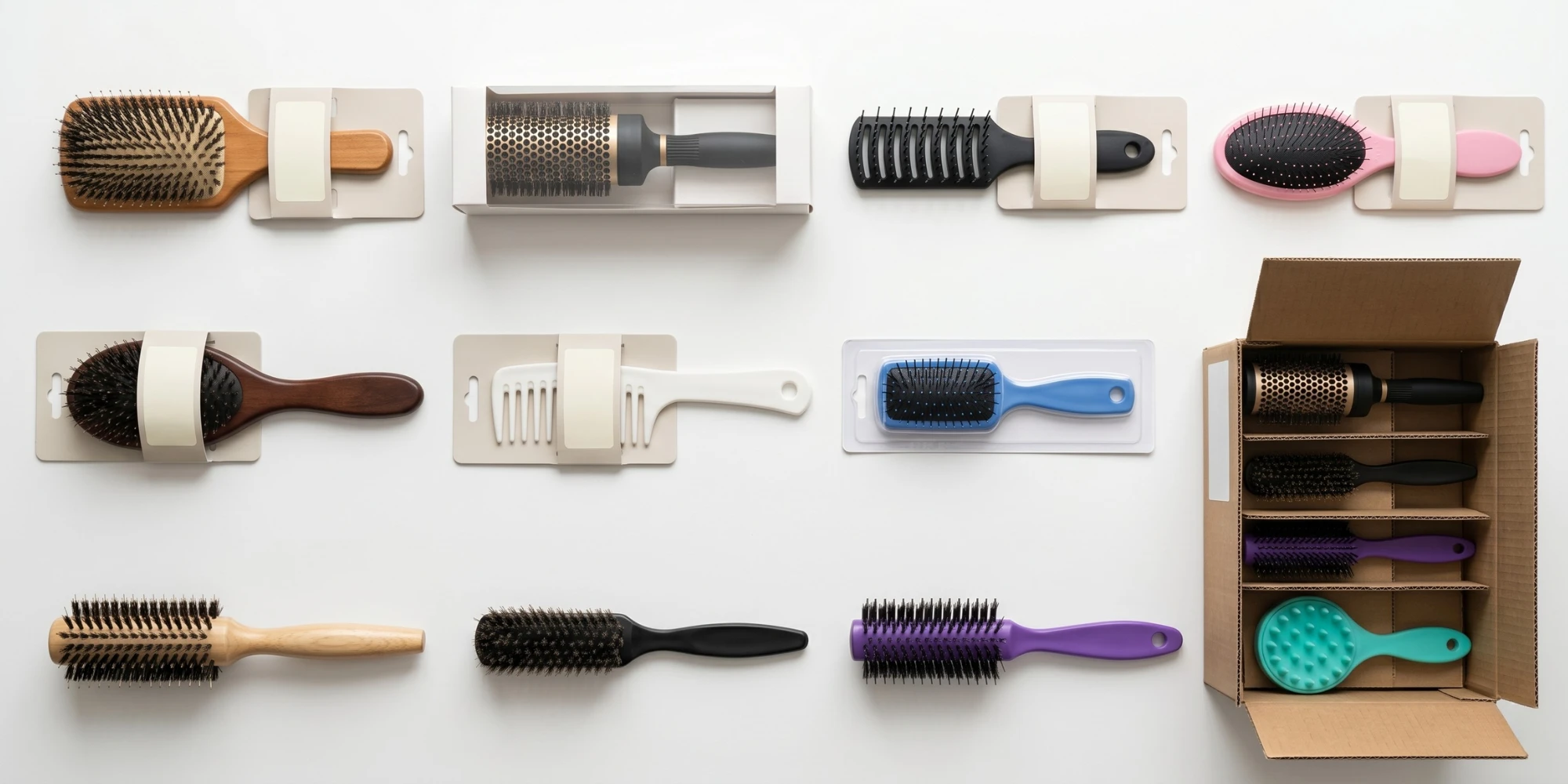
The brushing surface controls the feel, detangling path and cleaning behavior. Pin spacing affects how much hair enters the working area. Tip finishing affects scalp contact. Cushion firmness changes how the surface follows the head and how much pressure reaches the pins.
Questions for the sample
- Does the brush pass through the intended hair section without excessive snagging?
- Are pin tips smooth and consistent?
- Does the cushion return to shape after normal pressure?
- Are pins firmly retained after repeated brushing?
These checks are product-specific. A description such as “gentle” or “anti-breakage” should not replace a defined construction and sample test.
How Handle Shape and Surface Finish Affect the Brief
The handle affects control, packing volume and perceived quality. A long handle may help salon use, while a compact format may suit travel or gift sets. Balance should be checked with the finished head attached because a handle that feels comfortable alone can feel heavy once the working surface is installed.
Finish choices should be linked to the channel. Gloss can highlight colour depth but may show scratches. Matte surfaces can change grip and cleaning expectations. Wood-look or soft-touch effects need a physical sample because a digital image cannot show the final texture accurately.
Logo, Packaging and Channel Requirements
Branding can be placed on the handle, back plate, cushion or package. Printing, hot stamping, laser engraving and metal plates have different contrast, setup and wear behavior. Select the logo method after the surface and production route are known.

Packaging is part of the product specification. Record the package dimensions, barcode area, language, warnings and whether the brush must be protected from crushing. A custom package can create its own minimum and lead time, even when the brush uses an existing mold.
Packaging and channel requirements should be defined before the final sample is approved. A salon display, an e-commerce shipment and a retail shelf can need different protection, language, barcode space and carton handling. The brush specification may stay the same, but the packaging file and inspection points can change.
How to Approve Samples and Revisions
For smaller launches, compare this process with the stock-mold MOQ guide.
Approve one controlled sample version. The record should show the brush model, dimensions, colour references, logo artwork, packaging and open points. If a change is requested, identify whether it affects the mold, surface, working surface or package. This prevents a verbal revision from becoming an untraceable production change.
Customization and MOQ Trade-offs
Each added variant increases the number of samples, colour setups and inventory lines. A buyer can reduce early complexity by using one body shape, one primary colour and one logo position while testing the core function. Later variants can be added after the first product has a clear demand signal.
Keeping a Customization Brief Reviewable
Use a one-page specification sheet before requesting a final quote. Put the brush reference, target use, head dimensions, pin or bristle layout, handle material, finish, colour references, logo position, package format and inspection points in separate fields. Attach reference images as examples, but identify which details are binding and which are only visual direction.
During review, label each decision as approved, open or changed. This prevents a late colour discussion from being mistaken for approval of the working surface. It also makes it easier to compare a revised sample with the previous version.
Do not use decoration to solve a function problem
A new coating, logo plate or package may improve presentation, but none of those changes fixes excessive snagging, unstable pins or an unbalanced handle. Functional testing should be completed before the final decorative treatment is approved. If the working surface changes, repeat the relevant sample checks.
Private label development is a series of linked decisions. The clearest brief explains why each component is present and which result the buyer expects to see in the approved sample.
Check compatibility between the parts
Customization choices interact. A denser pin field may need a different cushion support; a longer handle can change balance; a textured finish may change the cleaning method; and a metal logo plate can affect the package fit. Ask the manufacturer to review the complete assembly rather than pricing each visual feature in isolation.
Keep a component drawing or annotated reference for every approved variant. If a supplier proposes a substitute material or process, record the reason and request a new sample where the change could affect feel, durability or appearance.
Use a sample to resolve visual uncertainty
Colour chips, digital renders and reference photographs are useful for discussion, but they do not show the complete interaction of surface, cushion, pins and handle. A physical sample should resolve the points that affect the customer experience. Record the approval against a revision so that a visually similar replacement is not treated as identical without checking.
This approach keeps private label customization practical: fewer untracked variants, clearer feedback and a specification that can be inspected when production starts.
For a multi-SKU launch, approve the common platform first, then check each colour or logo variation against that platform. The review should identify what is unchanged and what is new. This saves time without assuming that a different finish or package has no effect on the final product.
When a product will be sold through salons, retail shelves and online channels, note the channel-specific requirements in the brief. A salon may value grip and repeated use, while a retail package may need a different display format. The brush construction can remain shared, but the packaging and communication should be tested for the actual route to market.
Finally, keep a clear distinction between a visual preference and a measurable requirement. “Soft feel” can be supported by a cushion specification and sample check; “premium appearance” needs an agreed finish, colour reference and acceptable variation. Translating preferences into checks makes the final approval more useful.
A sample record should identify the model, dimensions, material, bristle or pin layout, cushion, handle finish, colour reference, logo artwork and package version. Mark each item as approved, open or changed. If a revision affects the working surface or mold, repeat the relevant functional checks rather than approving from a photograph alone.
Quality-management language should be used accurately. ISO 9001 is a framework for managing processes and continual improvement; it does not replace product-specific inspection or market compliance. The buyer still needs a defined acceptance sample and measurable checks for the intended brush.
See ISO 9001 quality-management requirements for the general system framework and GS1 barcode guidance for product identification. Neither source defines a particular hair-brush design or supplier promise.
FAQ
See the low-MOQ hair brush guide for launch-quantity questions.
Can I change the bristles on an existing brush mold?
It depends on the head construction and pin layout. Ask whether the change uses the existing tooling or requires a new component, then approve a physical sample.
What should a private label brush brief include?
Include the brushing job, target hair type, dimensions, working surface, handle, colours, logo, packaging and inspection points. A reference image alone is not enough.
Does a custom logo require a new mold?
Not always. Some logo methods use a finishing or packaging step, while an integrated molded mark may require tooling changes. Confirm the method and artwork placement before quoting.
Private label customization is easier to control when functional decisions come before decoration. The related hair brush logo options guide and custom brush cost breakdown can be used alongside the specification brief. Manufacturers such as JunYi Beauty can be evaluated against the same component, sample and inspection criteria used for any B2B brush supplier.