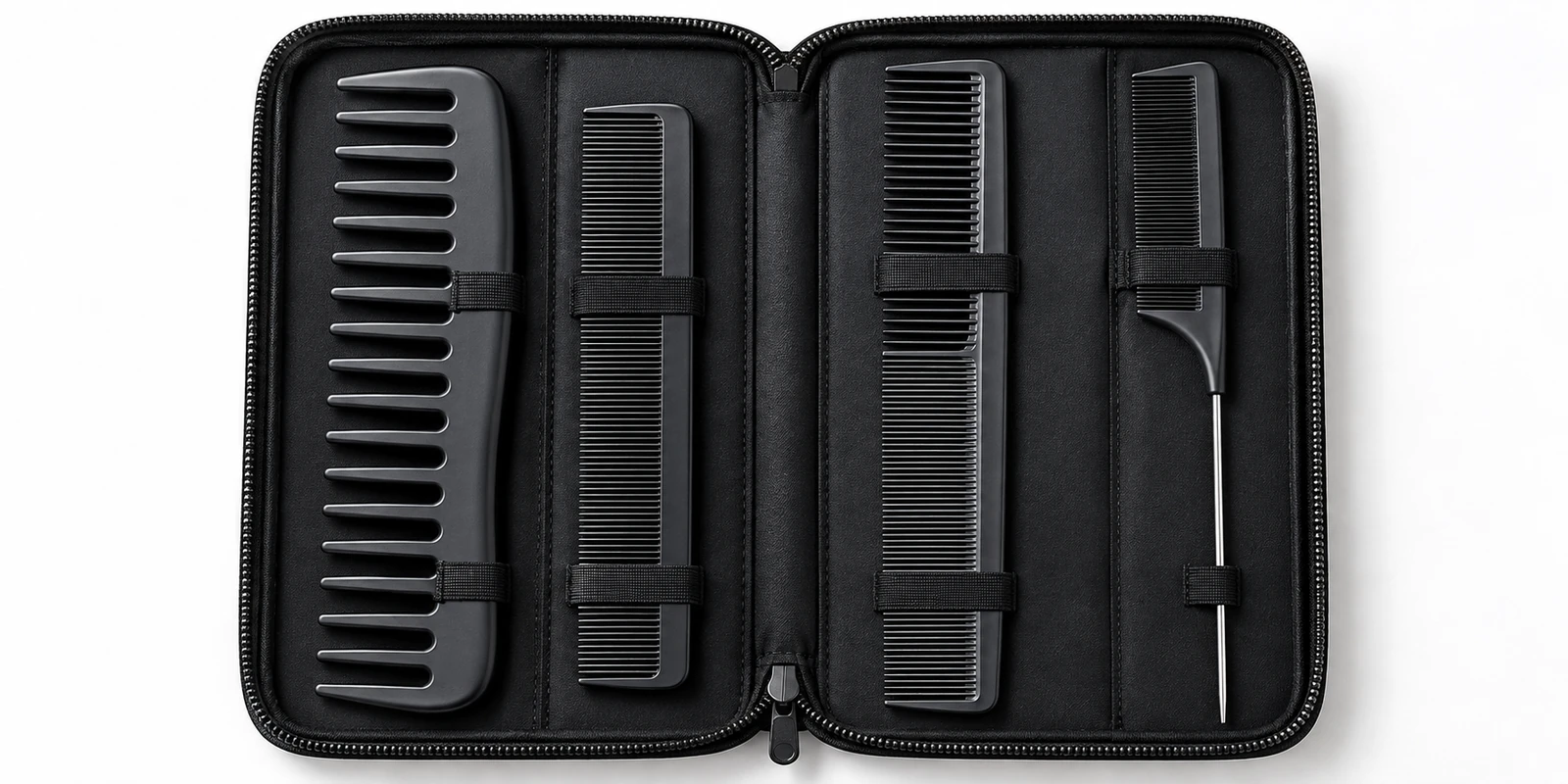
A professional comb set is more than a bundle of assorted combs at a discount — a genuinely useful set covers the distinct functions a stylist or barber actually cycles through during a working day, without unnecessary duplication or filler items added purely to inflate the piece count. Buyers evaluating comb sets, and B2B buyers assembling one for wholesale or private label, both face the same underlying question: which comb types earn a place in the set, and which are padding.
This guide breaks down what a well-constructed professional comb set should include, how to weight the set toward the functions professionals actually use most, common set-construction mistakes that reduce real-world value, and how set composition should shift for different professional segments — general salon, barbering, and colour services. For the individual comb types this guide draws on, see our companion guides on 12 types of professional hair combs and types of hair combs.
The Core Four: Non-Negotiable Set Components
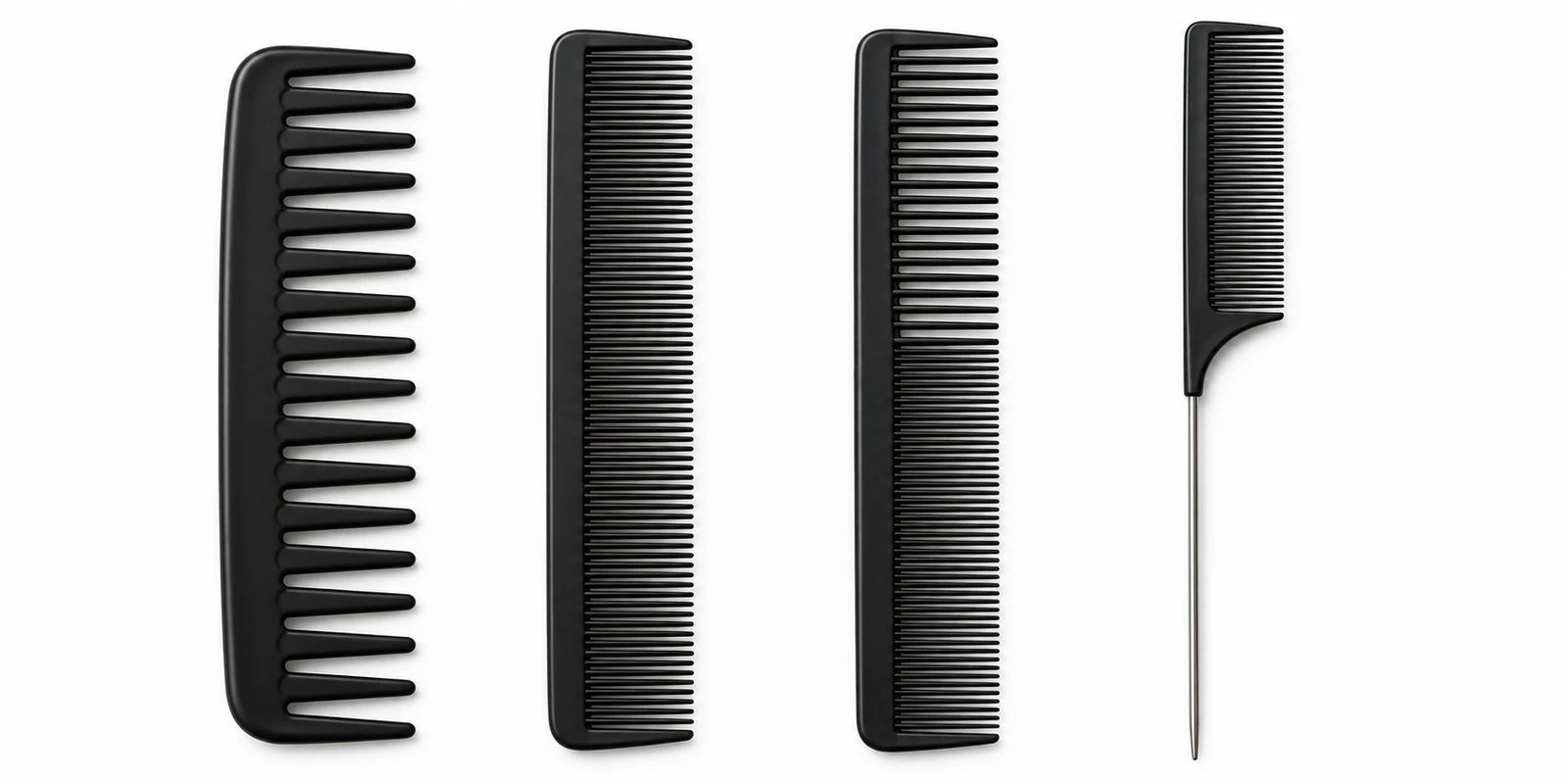
Wide-Tooth Comb
Essential for wet detangling, product distribution, and pre-service section preparation across virtually every hair type and service. No professional set is complete without one, and it should be positioned as the first tool reached for at the start of most services rather than a secondary item.
Fine-Tooth Comb
Covers finishing, precise product distribution on straight or styled hair, and the smooth, polished results many services require as a final step. Paired with the wide-tooth comb, these two cover the majority of general detangling-through-finishing needs on their own.
All-Purpose Styling / Cutting Comb
The dual-density comb most stylists and barbers reach for constantly throughout a working day — guiding scissors during cuts, lifting sections, general styling work. Given its daily-use frequency, this is arguably the single highest-value item in any professional set and should never be substituted with a lower-quality filler version to cut set cost.
Rat-Tail / Pin-Tail Comb
Required for precise sectioning during colour, styling, and general service work. As covered in our pin tail vs rat tail comb guide, the tail material (stainless steel vs. plastic) is the meaningful specification variable here — a set marketed as “professional” should include a metal-tail version, not a plastic-tail consumer-grade substitute.
Specialist Additions Worth Including
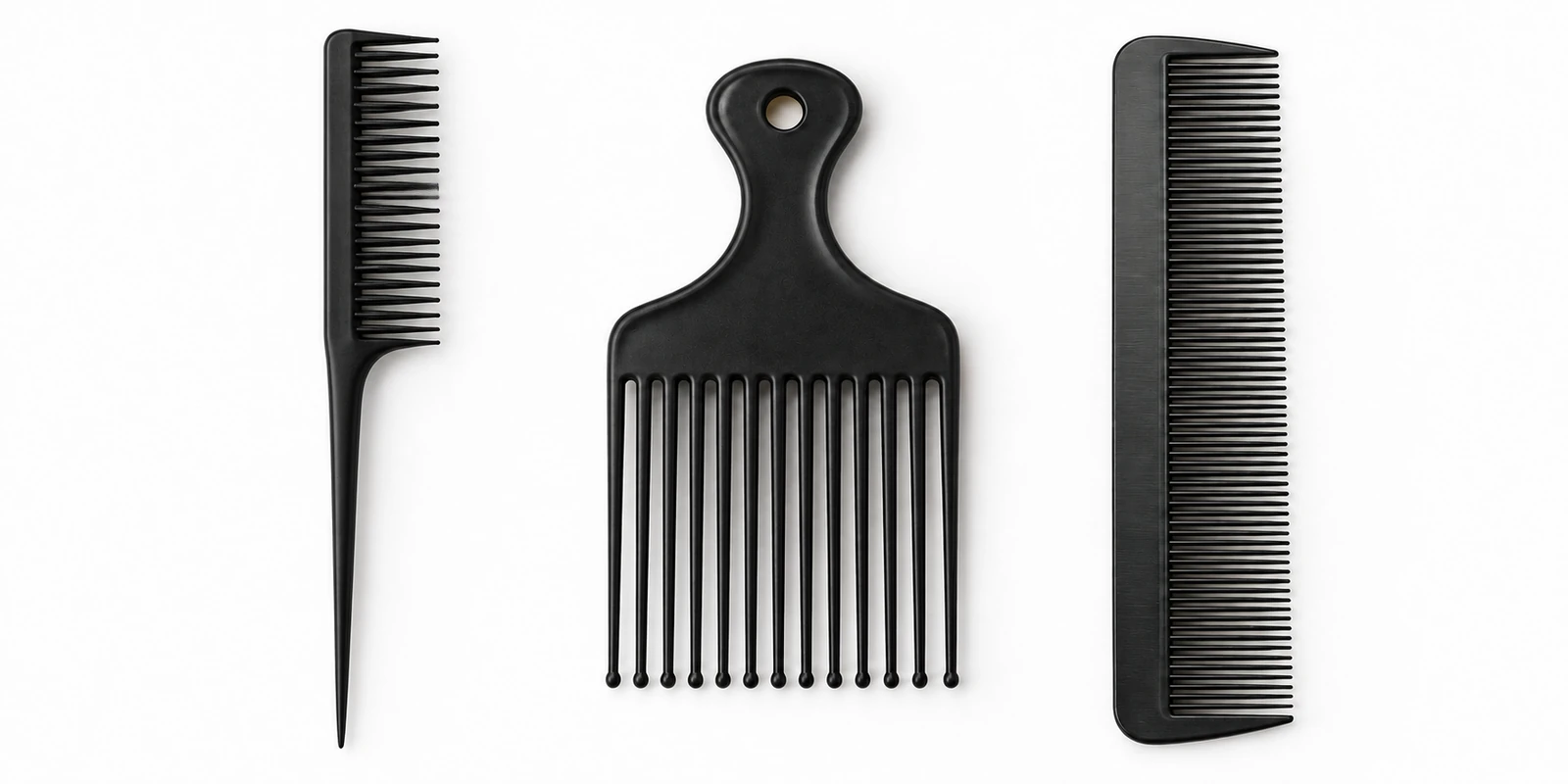
Teasing / Backcombing Comb
For sets targeting stylists who do updos, volume work, or bridal/event styling, a genuine fine-tooth teasing comb — meeting the tooth-density specification covered in our teasing comb guide — adds real functional range. A teasing comb with tooth spacing too wide to actually backcomb effectively is a common way sets pad their piece count without adding genuine capability.
Afro Pick
For any set serving a salon or barbershop working with textured and coily hair, an afro pick is not optional — it performs a root-lift and volume-restoration function no other comb in the set replicates. Its absence in a “professional” set is a meaningful gap for any business serving a textured-hair clientele.
Barber Fade Comb
For barbering-focused sets specifically, a flat-backed fade comb designed for clipper-over-comb technique is essential rather than optional, since general-purpose combs cannot provide the same stable clipper-guiding edge.
Detangling Comb
A flexible or tapered-tooth detangling comb, distinct from the standard wide-tooth comb, adds genuine value for sets serving clients with fine, fragile, or heavily textured hair where reduced peak force at each knot matters — though this is a reasonable set component to treat as optional depending on the target clientele.
Items That Are Often Padding, Not Function
A Second or Third General-Purpose Comb
Sets sometimes include multiple wide-tooth or fine-tooth combs differing only in colour or minor cosmetic variation, presented as additional “pieces” to inflate a marketed count (such as a “10-piece set”) without adding a distinct function. A buyer evaluating a set should ask what function each additional piece serves beyond the core four before treating a higher piece count as inherently better value.
Handleless Palm Combs in General Sets
As covered in our 12 types of professional hair combs guide, handleless palm combs are a lower-volume specialty item most relevant to colourist precision work specifically. Including one in a general-purpose set adds cost without adding value for the majority of buyers who won’t use this specific tool, and it’s better positioned as an add-on for colourist-specific sets rather than a standard general-set inclusion.
Low-Grade Materials on “Bonus” Items
The most common quality failure in comb sets isn’t the composition itself but a pattern where the core items (often the most visually prominent, like the styling comb) receive reasonable material investment while additional “bonus” pieces are produced in the cheapest available plastic to hit a target retail price point — a set is genuinely only as good as its weakest component, since a stylist will notice and be frustrated by a poor-quality piece regardless of how good the rest of the set is.
Set Composition by Professional Segment
General Salon Starter Set
The core four (wide-tooth, fine-tooth, styling comb, rat-tail) covers the majority of general salon needs. A genuine teasing comb is a reasonable fifth addition for a salon doing any volume of updo or event styling work.
Barbershop-Focused Set
Core four plus a fade comb is the appropriate barbering baseline. A pocket or folding comb, as covered in our pocket comb vs full-size comb guide, is a practical addition for tool-belt carry between clients, though it’s a lower-priority inclusion than the fade comb specifically.
Colourist-Focused Set
Core four with particular emphasis on a stainless-steel-tail rat-tail comb (rather than a plastic-tail substitute), plus a tint/colour application comb for precise root and section application. A handleless palm comb is a reasonable specialist addition here specifically, where it isn’t for a general set.
Textured-Hair Specialist Set
Core four plus an afro pick and a detangling comb, reflecting the specific mechanical needs of coily and textured hair that general-purpose combs address less effectively, as covered across our types of hair combs guide.
Material Considerations Across a Set
A set that varies material tier across its components without disclosing this clearly can create the impression of uniform quality where none exists. As covered in our comparisons of carbon fiber vs ABS plastic combs and titanium combs vs carbon fiber combs, material grade should be documented per component in a genuinely professional set rather than left to a single general “professional grade” claim covering the whole set.
For sets targeting the professional (rather than consumer-gift) market specifically, seamless-finished ABS at minimum — rather than standard moulded plastic with visible seam lines — is a reasonable baseline expectation across all set components, with cellulose acetate or premium materials reserved for sets explicitly marketed at a corresponding premium price point.
Storage and Presentation
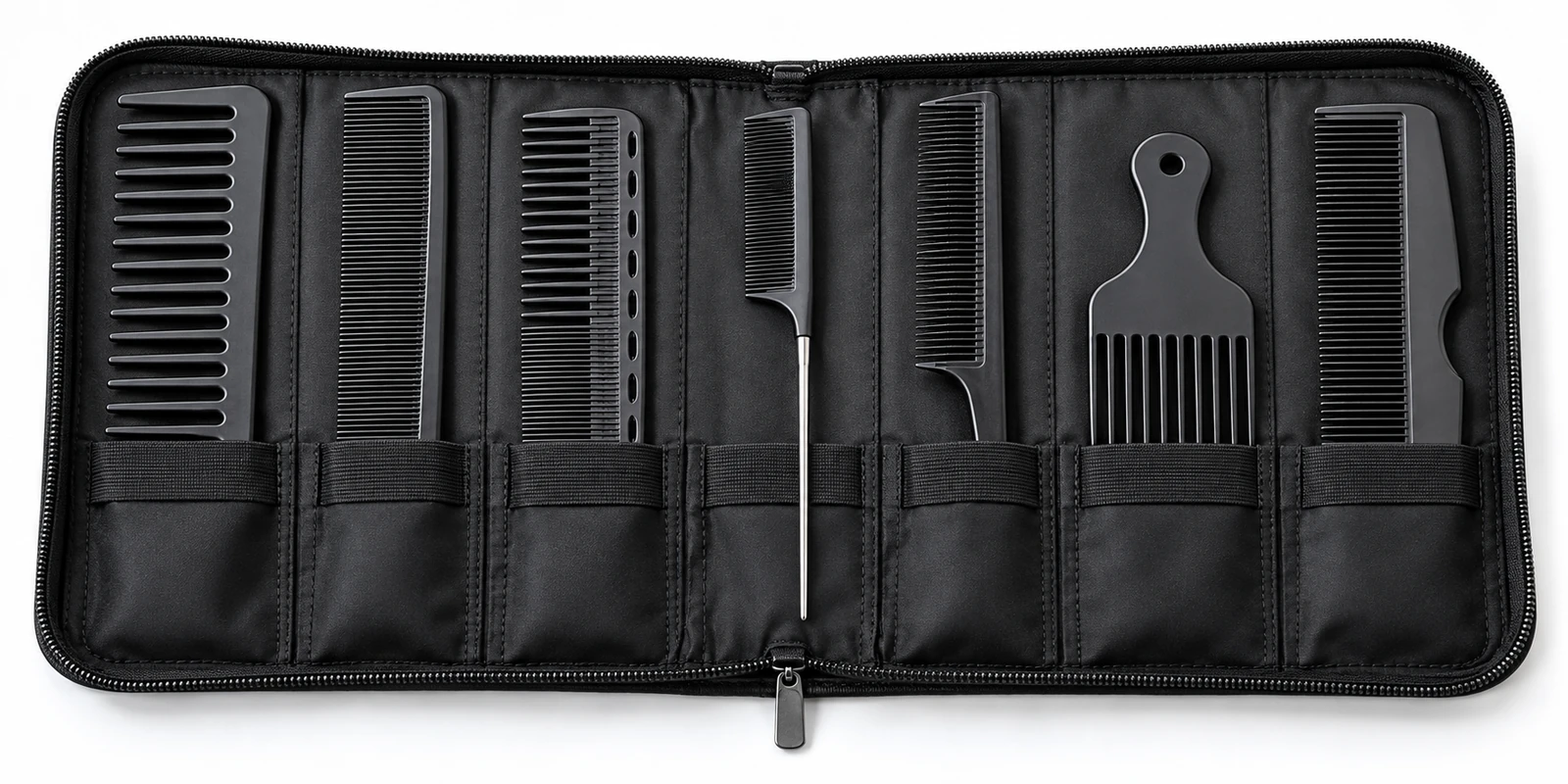
A dedicated case or roll — rather than loose combs in a box — is a genuine functional addition for a professional set, since combs carried loose in a kit bag are prone to tooth damage and are harder to locate quickly during a service. Case material and construction (durable zip or snap closure, individual comb slots rather than a single open compartment) is worth evaluating with the same specification scrutiny as the combs themselves, since a case that fails after a few months of daily professional use undermines the set’s overall value regardless of comb quality.
Sourcing Considerations for B2B Buyers
For buyers developing or private-labelling professional comb sets, set composition and per-component specification discipline are the two factors that most determine whether a set delivers genuine professional value or reads as padded piece-count marketing.
Anchor every component to a specific function: Before finalising a set’s composition, each included comb should map to a distinct, genuine use case relevant to the target professional segment — general salon, barbering, colourist, or textured-hair specialist — rather than being included simply to increase the marketed piece count.
Specify material per component, not just for the set as a whole: A “professional-grade” claim covering an entire set is less useful to an informed buyer than documented material and construction specification for each individual comb, particularly given how common it is for sets to under-specify secondary or “bonus” components relative to the core pieces.
Match set composition to segment, not a single universal set: Offering segment-specific set variants (general salon, barbering, colourist, textured-hair) rather than a single one-size-fits-all set allows each buyer to receive genuinely relevant components rather than paying for pieces irrelevant to their specific service mix.
Evaluate case/storage construction with the same rigour as the combs: A durable, well-constructed case is a genuine value-add for a professional set and should be specified and sourced with the same attention as the comb components themselves, rather than treated as an afterthought packaging detail.
Professional comb sets across general salon, barbering, colourist, and textured-hair-specialist configurations, with per-component material specification and durable case options, are available through OEM and private label manufacturing routes, with individual comb specification, set composition, and case construction adjustable to range and segment requirements.
Frequently Asked Questions
What are the essential combs every professional comb set should include?
A wide-tooth comb, fine-tooth comb, all-purpose styling/cutting comb, and a stainless-steel-tail rat-tail comb form the non-negotiable core — these four cover detangling, finishing, daily cutting/styling work, and precision sectioning, which together address the majority of general professional needs across salon and barbering contexts.
Is a bigger comb set (more pieces) always better value?
Not necessarily. Sets sometimes inflate their piece count with duplicate general-purpose combs or low-grade specialty items that add little genuine function. A smaller set where every piece serves a distinct, well-specified purpose typically delivers more real value than a larger set padded with redundant or under-specified components.
Should a comb set include a teasing comb?
For general salon or barbering sets, a teasing comb is a reasonable but optional fifth addition, most valuable for professionals doing regular updo, volume, or event styling work. It should have genuinely fine, closely-set teeth to perform actual backcombing — a moderate tooth spacing marketed as a teasing comb won’t deliver the intended function.
What should I look for in the rat-tail comb included in a set?
Confirm whether the tail is stainless steel or plastic. A genuinely professional-grade set should include a metal-tail rat-tail comb, since plastic tails are more suited to consumer or general-purpose use and don’t hold the fine point precision colour and sectioning work requires over repeated daily professional use.
Do barbershop comb sets need different components than salon sets?
Yes — a barbering-focused set should include a flat-backed fade comb for clipper-over-comb technique, which general salon sets typically omit since it serves a barbering-specific function. A pocket or folding comb is also a more relevant addition for barbershop tool-belt carry than for a stationary salon workstation.
How can I tell if a comb set uses consistent material quality across all pieces?
Look for per-component material specification rather than a single blanket “professional grade” claim covering the whole set. Physically compare the core pieces (styling comb, wide-tooth comb) against any additional or “bonus” pieces — a noticeable quality gap between them is a common sign that secondary components were under-specified to control overall set cost.
Conclusion
A genuinely useful professional comb set is built around function, not piece count — the core four (wide-tooth, fine-tooth, styling comb, and a metal-tail rat-tail comb) cover the majority of daily professional needs, with specialist additions like a teasing comb, afro pick, fade comb, or detangling comb layered in based on the specific professional segment the set serves. The most common way sets fail to deliver genuine value is not through poor comb selection but through under-specified “bonus” components and inflated piece counts that don’t map to real functional need — evaluating a set by what each individual piece actually does, and at what material specification, is a more reliable value assessment than piece count or general “professional” marketing language alone.
For B2B buyers developing or private-labelling professional comb sets built around genuine segment-specific function and per-component specification integrity, manufacturers such as JunYi Beauty, which produces segment-configured comb sets across general salon, barbering, colourist, and textured-hair-specialist compositions with documented per-component material specification from its Dongguan facility, represent the type of OEM partner suited to sets where every included piece needs to earn its place rather than pad a marketed count.