
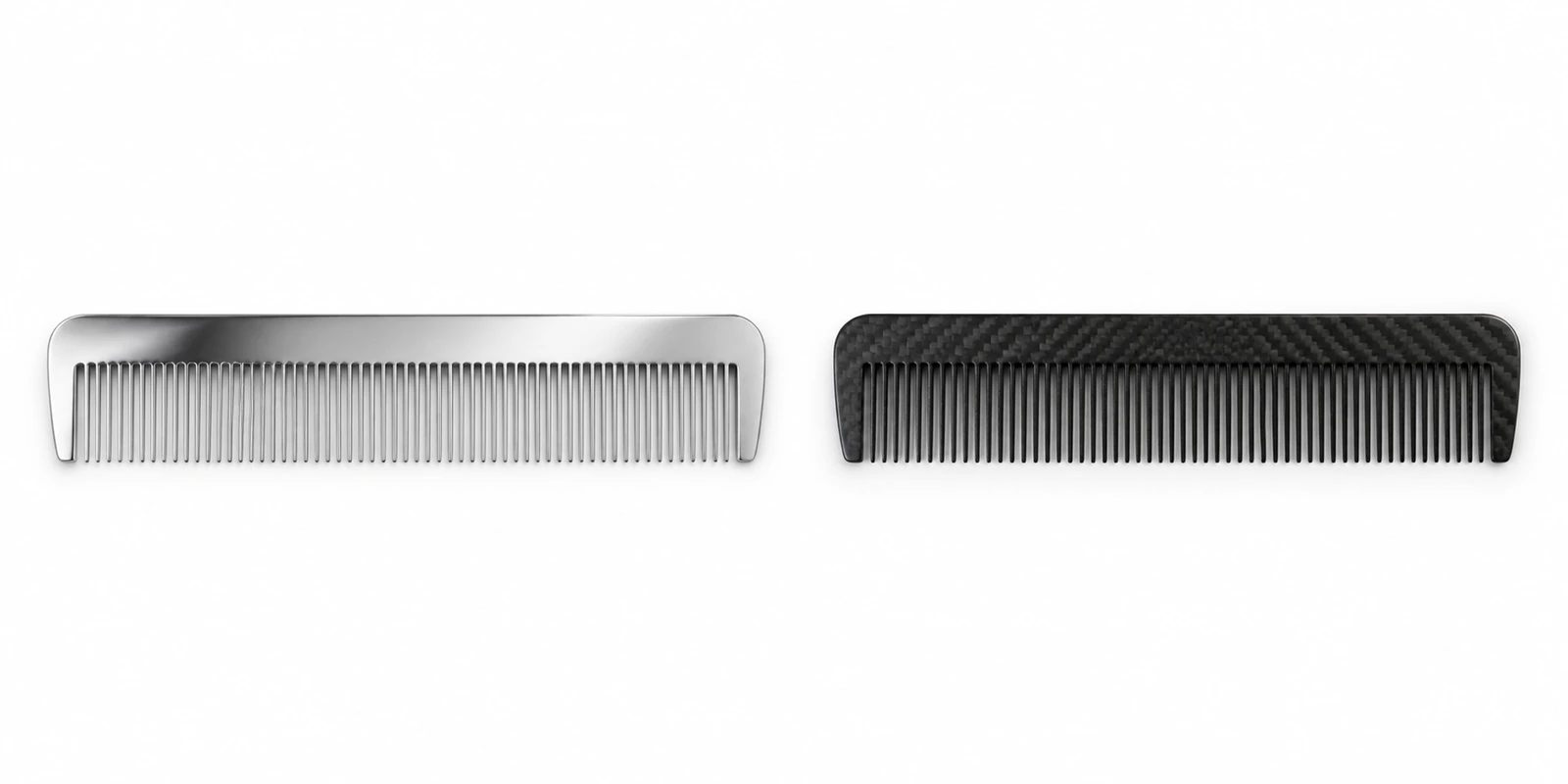
Titanium and carbon fiber sit at the top of the professional comb material hierarchy, both commanding premium price points and both marketed heavily around heat resistance, durability, and salon-grade performance. They are not, however, interchangeable premium options — the two materials have genuinely different physical properties, different manufacturing processes, and different performance profiles that make one or the other the better fit depending on the specific use case a comb is being specified for.
This guide compares titanium and carbon fiber combs across heat conductivity and resistance, weight and handling, durability, static and friction performance, and cost, so buyers can make a specification decision based on the actual physics involved rather than treating both as generically “premium.” For the broader material spectrum this comparison sits within, see our guide on carbon fiber vs ABS plastic combs.
What Each Material Actually Is
Titanium Combs
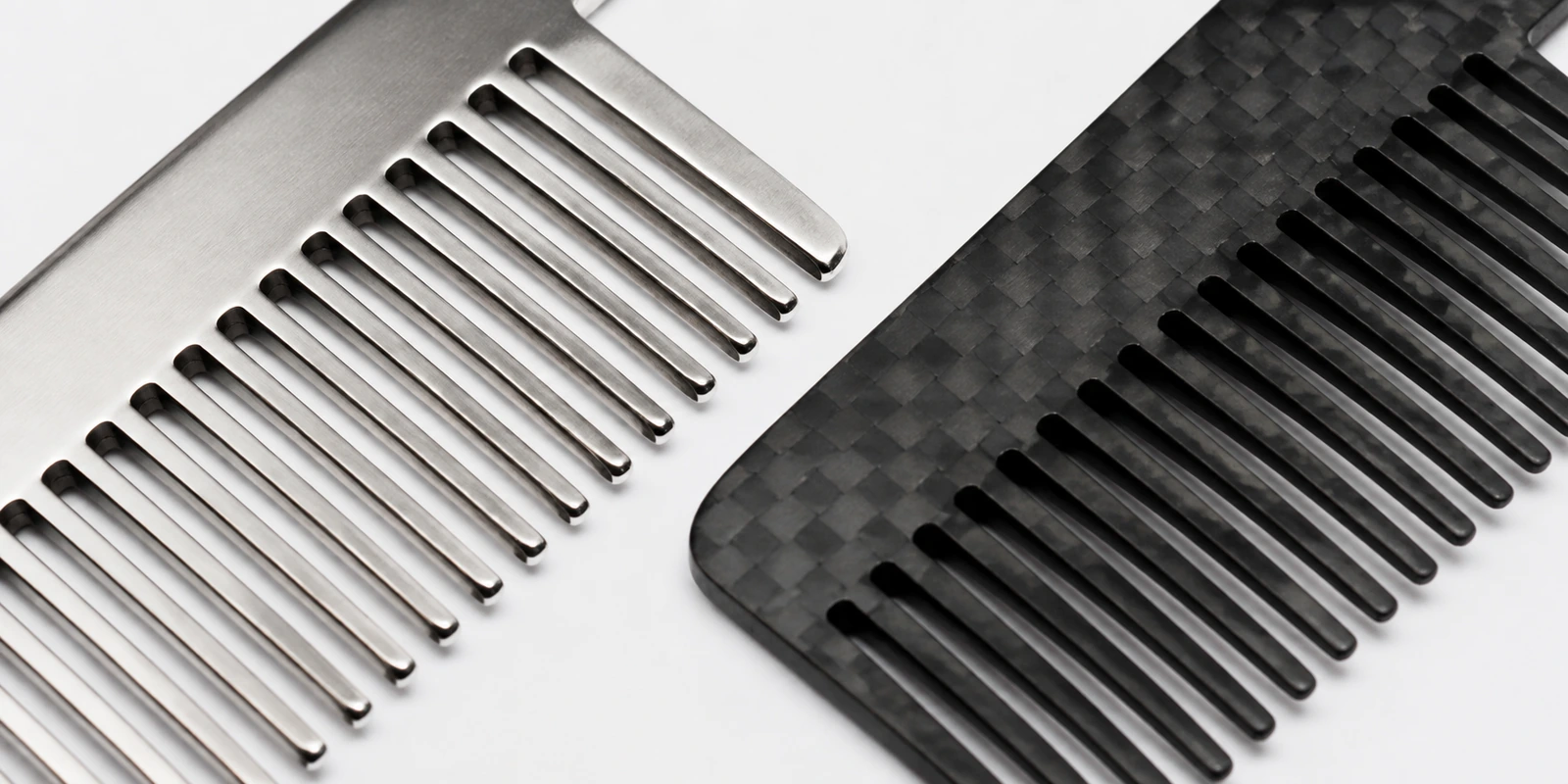
Titanium combs are typically produced from titanium alloy sheet or, in some cases, titanium-coated metal, rather than pure titanium — pure titanium is more difficult and costly to machine into the fine tooth profiles a comb requires, so alloy blends or coated base metals are more common in practice. Titanium is a true metal, meaning it conducts heat directly and rapidly rather than resisting it the way a composite material does.
Carbon Fiber Combs
As covered in our comparison of carbon fiber and ABS plastic, “carbon fiber” combs in this category are carbon-fiber-reinforced polymer composites — carbon fiber content blended into a plastic base — rather than combs constructed from raw woven carbon fiber sheet. This composite structure is fundamentally different from titanium’s solid metal construction, and the two materials achieve heat tolerance through opposite mechanisms: titanium conducts and dissipates heat rapidly, while carbon-fiber composite resists heat transfer through the polymer matrix.
Heat Performance: Two Different Mechanisms
Titanium’s Heat Conduction Advantage
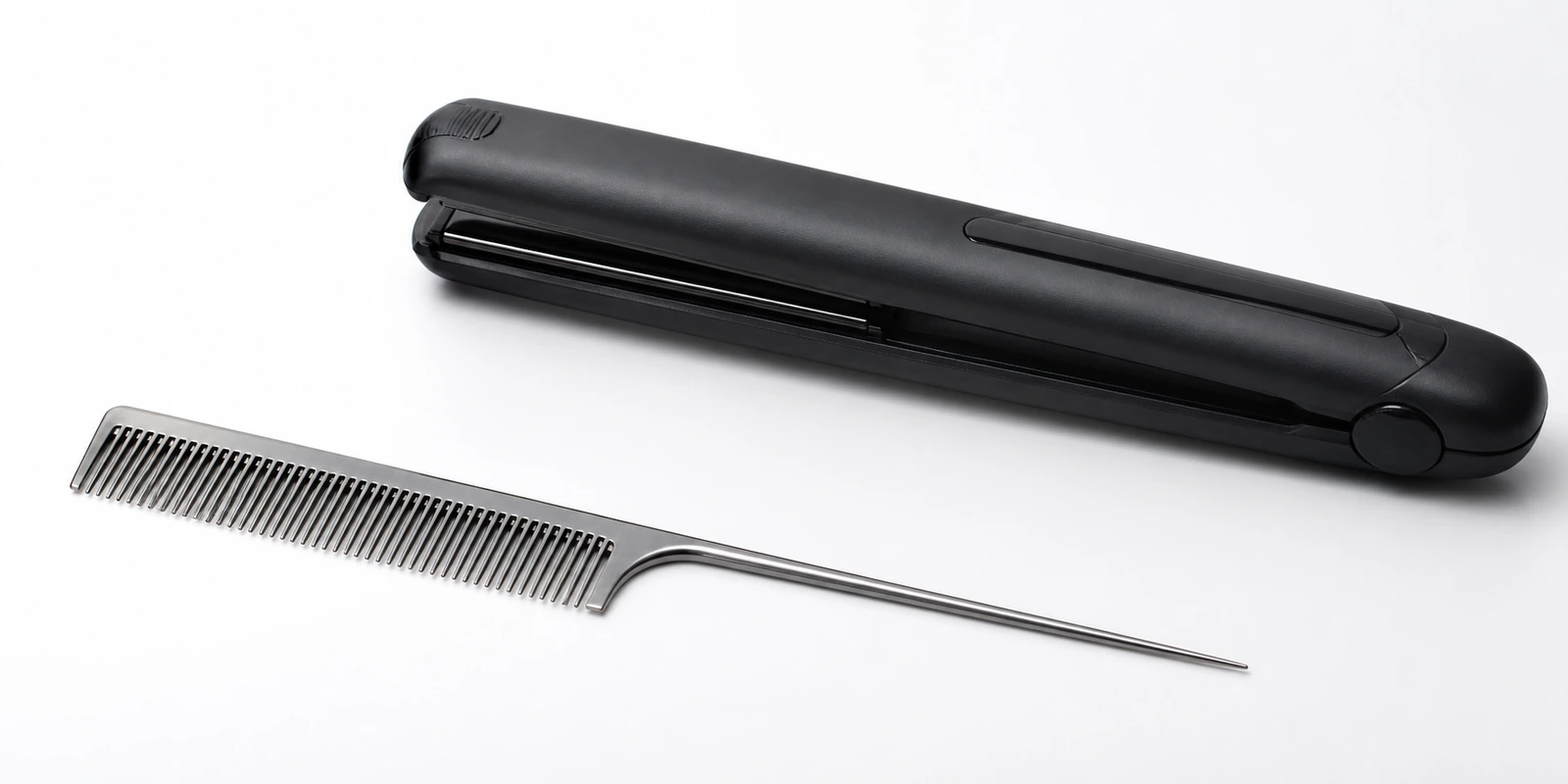
Titanium’s defining thermal property in this context is rapid, even heat conduction. When a titanium comb is used in direct proximity to a flat iron or curling iron — a common professional technique for sectioning hair while straightening — the metal conducts heat quickly across its surface without the localised hot spots that can occur in less thermally conductive materials. This even heat distribution is a genuine functional advantage in heat-adjacent professional styling work, where the comb itself may briefly contact or sit very close to a heated styling tool repeatedly throughout a service.
Titanium also has a very high melting point relative to any hair styling temperature range, meaning there is no realistic risk of the comb itself warping or degrading from heat exposure in normal professional use — a different kind of “heat resistance” than carbon fiber’s, based on simply not being affected by the temperatures involved rather than resisting heat transfer.
Carbon Fiber’s Heat Resistance Advantage
Carbon-fiber composite achieves heat tolerance through the opposite mechanism — the polymer matrix resists heat transfer rather than conducting it away. This means a carbon fiber comb held near a heat source stays cooler to the touch at the handle than a titanium comb would in the same position, since titanium’s rapid conduction carries heat along the entire tool including the section the stylist is holding. For extended sectioning work near heat sources, this can make carbon fiber more comfortable to hold for long periods, even though titanium tolerates the heat exposure itself without damage.
Practical Implication
For techniques involving brief, direct proximity or contact between the comb and a heated iron — where even heat distribution across the tooth section matters for the styling result — titanium’s conductive properties are genuinely advantageous. For techniques involving prolonged holding near (but not directly touching) heat sources, where handle comfort over a long service matters more than conduction performance, carbon fiber’s heat-resisting properties are more comfortable in practice. Both materials meaningfully outperform standard ABS plastic, which is covered in more detail in our heat-resistant hair brush materials guide.
Weight and Handling
Titanium
Titanium is notably lightweight for a metal — significantly lighter than stainless steel at equivalent dimensions — but it is still generally heavier than a carbon-fiber composite comb of the same size, since even titanium’s favourable strength-to-weight ratio doesn’t fully close the gap with a polymer-based composite. For stylists who prefer the substantial, precise feel of a metal tool in hand, titanium’s weight is often experienced as a positive quality signal rather than a drawback.
Carbon Fiber
Carbon-fiber composite combs are typically the lightest option in the premium comb material category, which reduces hand fatigue during long professional days involving frequent, repeated combing and sectioning motions. For high-volume salon use where a stylist may pick up and use a comb dozens of times per service across many services in a day, the cumulative weight difference across a full working day is a meaningful practical consideration.
Durability and Structural Properties
Titanium
Titanium alloy combs are highly resistant to bending, corrosion, and general wear, and titanium’s strength-to-weight ratio means the tooth section can be made thin and precise without sacrificing structural rigidity — useful for fine-tooth sectioning work requiring both precision and durability under repeated pressure. Titanium does not corrode under normal salon conditions (moisture, cleaning products, repeated washing), making it a genuinely long-service-life material for high-frequency professional use.
Carbon Fiber
Carbon-fiber composite is durable under normal flexing and impact, and — as covered in our carbon fiber vs. ABS comparison — significantly outperforms standard plastic in this respect. However, carbon-fiber composite is generally more prone to catastrophic failure under extreme impact (a hard drop or crushing force) than titanium, which tends to bend rather than shatter under comparable stress. For most normal comb use, this distinction rarely matters in practice, but it is a genuine structural difference between the two materials.
Static and Friction Performance
Titanium
As a conductive metal, titanium does not build up static charge the way plastic or even carbon-fiber composite can under certain conditions, making it a genuinely neutral, low-static material against the hair shaft. Combined with a well-polished tooth edge, titanium produces very low friction against hair during combing.
Carbon Fiber
Carbon fiber’s inherent anti-static properties, covered in our ABS comparison guide, also perform well here, though the mechanism is different — carbon fiber’s electrical conductivity characteristics reduce static buildup rather than titanium’s simple lack of a charge-holding surface. In practice, both materials perform comparably well on static reduction, and the difference between them on this specific variable is unlikely to be the deciding factor for most buyers.
Cost and Manufacturing Considerations
Titanium
Titanium is generally the more expensive of the two materials at comparable comb sizes, both in raw material cost and in manufacturing complexity — titanium is harder to machine into fine, precise tooth profiles than either carbon-fiber composite or standard plastic, requiring more specialised tooling and production expertise. This typically translates to a higher per-unit cost and, in many cases, higher MOQs from manufacturers with the specific capability to work with titanium at the tolerances a fine-tooth comb requires.
Carbon Fiber
Carbon-fiber composite, while still a premium material relative to ABS, is generally more accessible to produce than titanium — the injection moulding process, while requiring more precision than standard ABS moulding, is closer to conventional plastic comb manufacturing than titanium’s metal-machining process. This generally makes carbon fiber combs available at a lower cost point and often lower MOQ than titanium equivalents, while still commanding a meaningful premium over standard ABS.
Practical Cost Comparison
Buyers should expect titanium combs to sit above carbon-fiber composite combs in cost at most comparable specification levels, with the gap varying by titanium alloy grade, tooth precision, and manufacturer. For buyers evaluating whether the cost step from carbon fiber to titanium is justified for a given range, the heat-conduction and corrosion-resistance advantages of titanium are the specific, defensible reasons to make that step — not a general “titanium is better” assumption.
Which Material Fits Which Use Case
Professional Colour and Chemical Service Combs
Titanium’s corrosion resistance against repeated exposure to colour, bleach, and chemical service products, combined with its precise, durable fine-tooth capability, makes it well suited to combs used specifically in colour and chemical service contexts, where repeated product exposure over years of professional use is a genuine durability test that favours titanium’s corrosion resistance over carbon fiber.
Heat-Adjacent Styling Combs
For sectioning combs used in direct proximity to flat irons and curling irons during styling services, titanium’s even heat conduction is a genuine functional advantage for the styling technique itself, not just a marketing claim.
High-Volume Daily-Use Combs
For combs used constantly throughout a working day — general sectioning, detangling, and styling combs that a stylist picks up dozens of times per service — carbon fiber’s lighter weight reduces cumulative hand fatigue in a way that matters practically over a full working day, and its lower cost supports stocking multiple units without the investment titanium would require.
Premium Retail and Gift Positioning
Both materials support premium retail positioning above standard ABS or acetate. Titanium’s metal construction and corrosion resistance support a more overtly “professional-grade” positioning narrative; carbon fiber’s lightweight, modern-material aesthetic suits a slightly different premium positioning, often associated with performance and technical sophistication rather than traditional professional-tool durability.
A Note on Titanium-Coated vs. Solid Titanium
Some products marketed as “titanium combs” are actually a base metal (often stainless steel) with a titanium coating applied to the surface, rather than solid titanium alloy construction throughout. A titanium coating can provide some of the corrosion-resistance and low-friction surface benefits of titanium, but does not deliver the same strength-to-weight ratio or long-term durability as solid titanium alloy construction, since the coating can wear down over years of repeated cleaning and use in a way that solid titanium construction does not. As with the carbon-fiber-percentage question covered in our ABS comparison, buyers should request clarification on whether a “titanium” product is solid alloy or coated base metal, since this materially affects both performance and appropriate pricing.
Sourcing Considerations for B2B Buyers
For buyers stocking or specifying premium comb materials, titanium and carbon fiber occupy adjacent but distinct positions in a well-structured range rather than one simply outranking the other.
Specify construction type explicitly: For titanium products, confirm and document whether the comb is solid titanium alloy or titanium-coated base metal — this is the single most consequential specification variable for both performance and defensible pricing, paralleling the carbon-fiber-percentage documentation recommended in our carbon fiber vs ABS plastic combs guide.
Match material to genuine use case in positioning copy: Titanium’s heat-conduction and corrosion-resistance advantages are specific and defensible claims for heat-adjacent and chemical-service-context combs. Carbon fiber’s weight and heat-resistance advantages are specific and defensible claims for high-frequency daily-use combs. Positioning either material with generic “premium” or “professional-grade” language without reference to its actual mechanical advantage under-communicates genuine differentiation to professional buyers who understand the distinction.
Tiered professional range architecture: A well-structured professional comb range can include both materials at adjacent premium tiers — carbon fiber for general high-frequency professional and semi-professional use, titanium for specialist colour-service and heat-adjacent sectioning tools — rather than treating the two as competing options for the identical use case.
MOQ and lead time planning: Titanium’s more complex manufacturing process typically carries higher MOQs and longer lead times than carbon-fiber composite production. Buyers planning a range spanning both materials should confirm these separately rather than assuming parity with carbon-fiber or standard plastic sourcing terms, a consideration also covered in our guide on 10 things to check before placing a custom hair brush order.
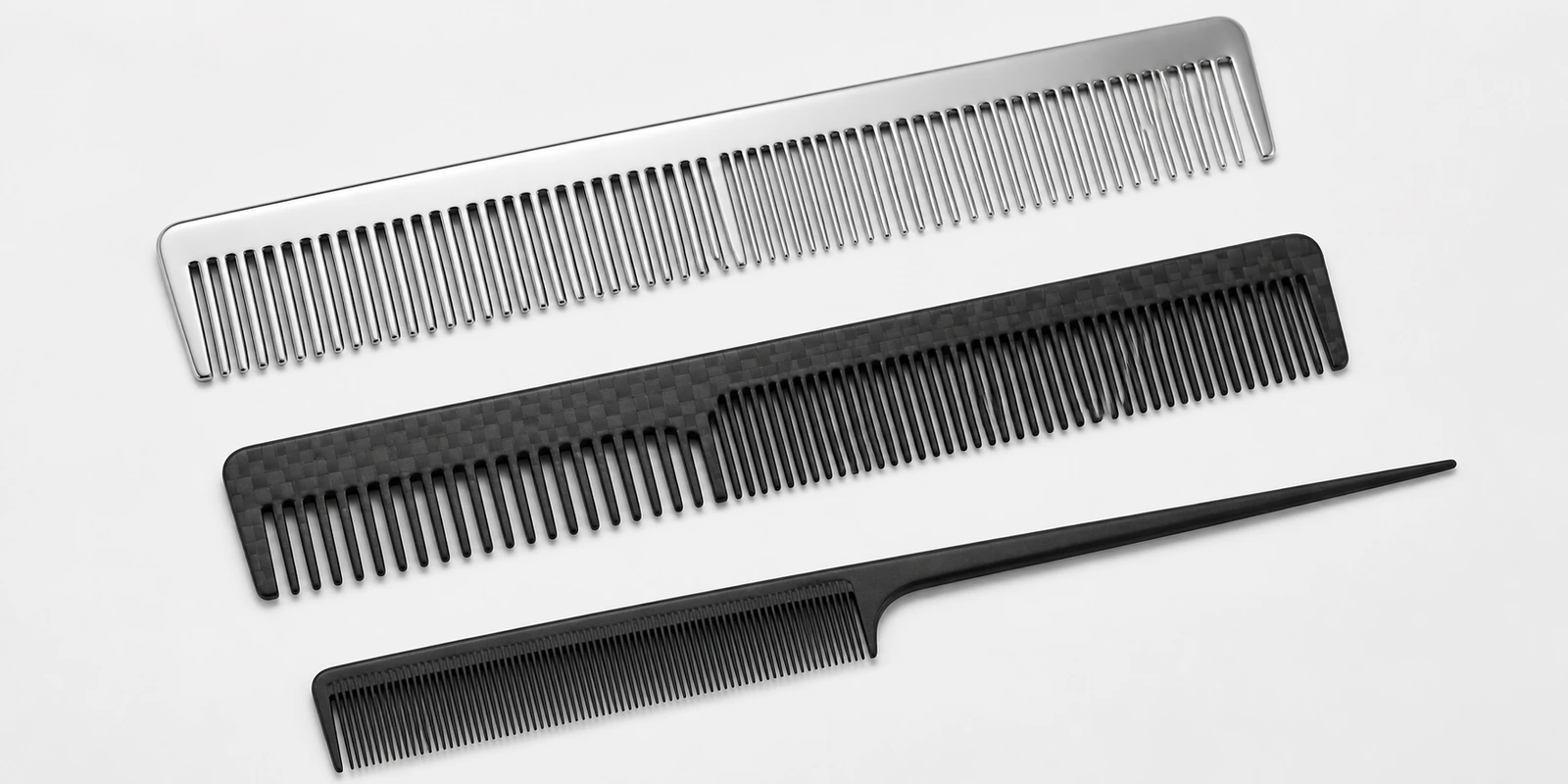
Both titanium alloy and carbon-fiber composite comb formats, across fine-tooth, rat-tail/pin-tail, and styling comb configurations, are available through OEM and private label manufacturing routes, with material construction, tooth precision, and finish adjustable to range positioning requirements.
Frequently Asked Questions
Is titanium or carbon fiber better for a hair comb?
Neither is universally better — they suit different use cases through different mechanisms. Titanium conducts heat rapidly and evenly, resists corrosion from colour and chemical products, and holds a very fine, durable tooth edge, making it well suited to heat-adjacent professional styling and chemical service work. Carbon fiber resists heat transfer, is significantly lighter, and costs less, making it well suited to high-frequency daily professional and semi-professional use.
Does titanium get hot near styling tools?
Yes, titanium conducts heat rapidly, which means it heats up quickly and evenly when near a heat source rather than resisting the heat the way carbon fiber does. This is functionally useful for techniques where even heat distribution across the comb matters, but it also means the handle can become warmer to hold than a carbon fiber comb in the same position.
Is titanium comb the same as titanium-coated comb?
No. A solid titanium alloy comb is constructed from titanium throughout and delivers the material’s full strength, corrosion resistance, and heat-conduction properties over its full service life. A titanium-coated comb has a base metal (often stainless steel) with a titanium surface coating, which provides some surface-level benefits but does not match solid titanium’s durability, since the coating can wear down over years of use.
Which material is lighter, titanium or carbon fiber?
Carbon-fiber composite is generally lighter than titanium at equivalent comb dimensions, even though titanium has a favourable strength-to-weight ratio compared to other metals. For stylists doing high-frequency repeated combing throughout long working days, this weight difference reduces cumulative hand fatigue.
Why are titanium combs more expensive than carbon fiber combs?
Titanium is more expensive as a raw material and significantly more difficult to machine into fine, precise tooth profiles than carbon-fiber composite, which is produced through a moulding process closer to conventional plastic manufacturing. This combination of material and manufacturing cost generally makes titanium combs the more expensive of the two premium options.
Do titanium combs resist hair dye and chemical products better than carbon fiber?
Yes, this is one of titanium’s clearer advantages. Titanium’s corrosion resistance against repeated exposure to colour, bleach, and other chemical service products over years of professional use is a genuine durability advantage over carbon-fiber composite in colour and chemical service contexts specifically.
Conclusion
Titanium and carbon fiber are both genuine premium comb materials, but they achieve their performance advantages through different physical mechanisms and suit different specific use cases rather than one simply being the superior choice. Titanium’s rapid heat conduction, corrosion resistance, and precise durable tooth edge make it the better fit for heat-adjacent styling techniques and chemical service contexts. Carbon fiber’s lighter weight, heat-resisting (rather than heat-conducting) properties, and lower cost make it the more practical choice for high-frequency daily professional and semi-professional use. A buyer’s decision should follow the specific mechanical demand of the intended use case rather than a general assumption that either material is categorically better than the other.
For buyers building a professional comb range that spans both premium materials with genuine, documented construction specifications, manufacturers such as JunYi Beauty, which produces solid titanium alloy and carbon-fiber composite comb formats with documented material construction from its Dongguan facility, represent the type of OEM partner suited to ranges where premium material claims need to reflect genuine construction rather than marketing labelling alone.