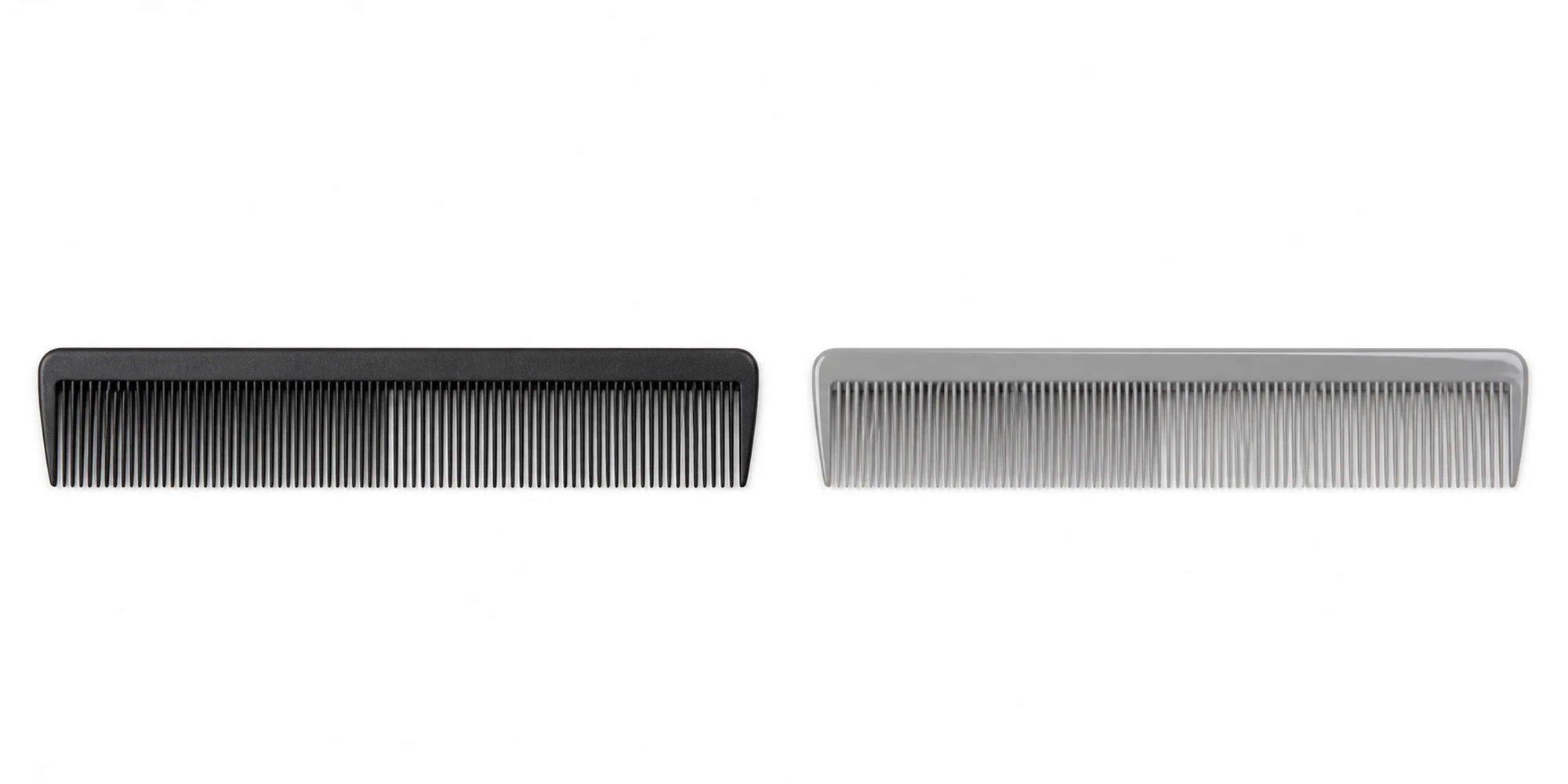
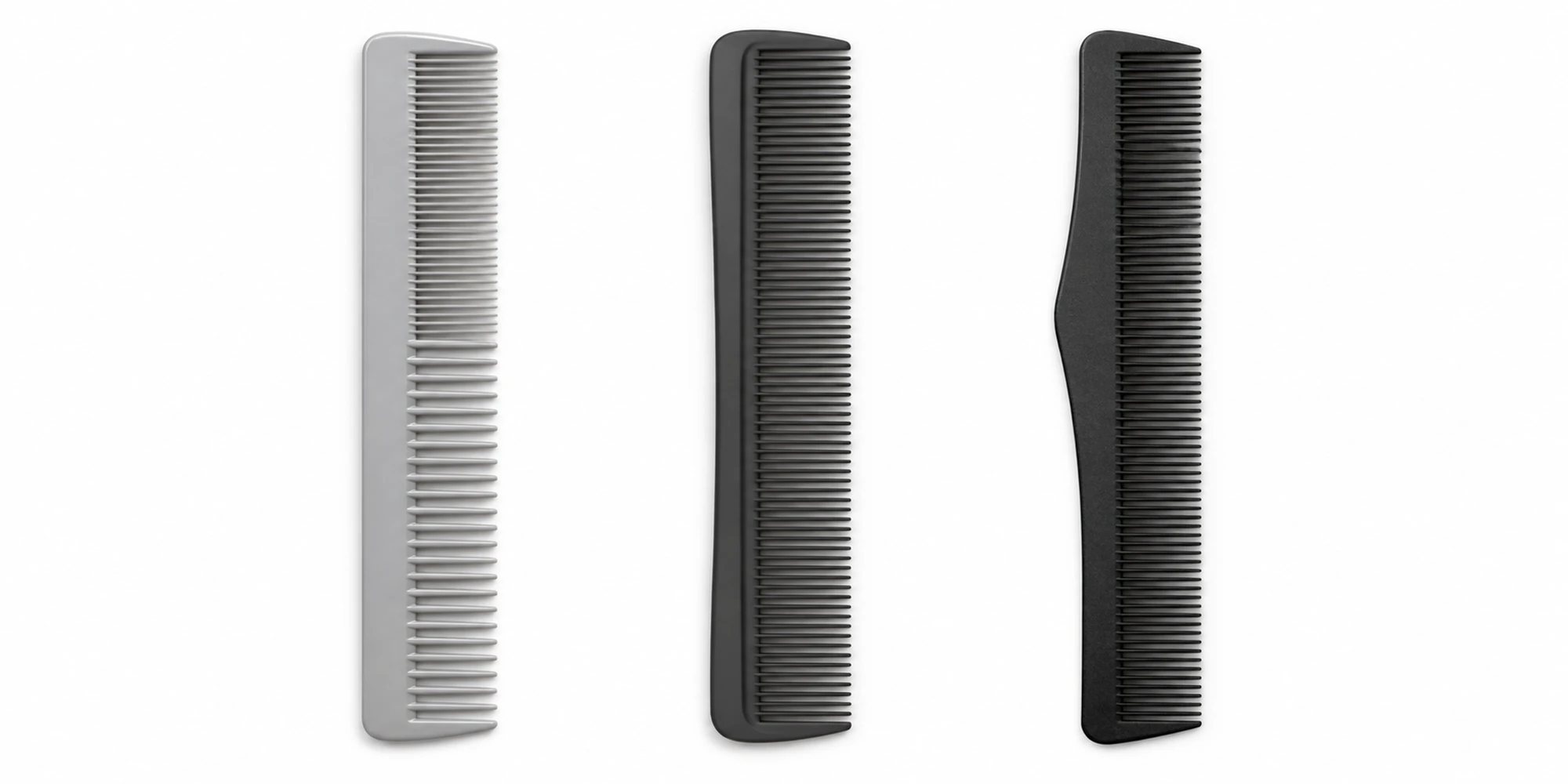
Carbon fiber and ABS plastic sit at nearly opposite ends of the comb material spectrum — one a premium, heat-resistant, anti-static material associated with professional styling tools, the other a cost-efficient, highly mouldable plastic that dominates mass-market and drugstore comb production. For retail and wholesale buyers deciding what to stock, the choice is rarely about which material is objectively better — it is about matching material cost, performance, and positioning to the specific customer segment and price tier a given SKU is meant to serve.
This guide compares carbon fiber and ABS plastic combs across manufacturing cost, heat resistance, static and friction performance, durability, and the retail positioning each material supports, so buyers can make stocking decisions based on margin and customer fit rather than material reputation alone. For the broader material comparison across the full comb category, see our guide on types of hair combs.
What Each Material Actually Is
Carbon Fiber Combs
“Carbon fiber” combs in the hair tool category are typically carbon-fiber-reinforced nylon or polymer composites rather than pure woven carbon fiber — the carbon fiber content is blended into a plastic base to add stiffness, heat resistance, and a distinctive matte or textured finish, rather than the comb being constructed from raw carbon fiber sheet. The carbon fiber percentage in the composite varies by manufacturer and affects both cost and performance, and is a specification variable worth confirming rather than assuming from the “carbon fiber” label alone.
ABS Plastic Combs
ABS (Acrylonitrile Butadiene Styrene) is a standard injection-moulded thermoplastic — the same material used across a huge range of consumer products for its combination of impact resistance, mouldability, and low cost. ABS combs are produced at high volume through standard injection moulding, with tooling costs and per-unit costs both significantly lower than carbon-fiber-composite alternatives.
Heat Resistance
Carbon Fiber’s Genuine Advantage
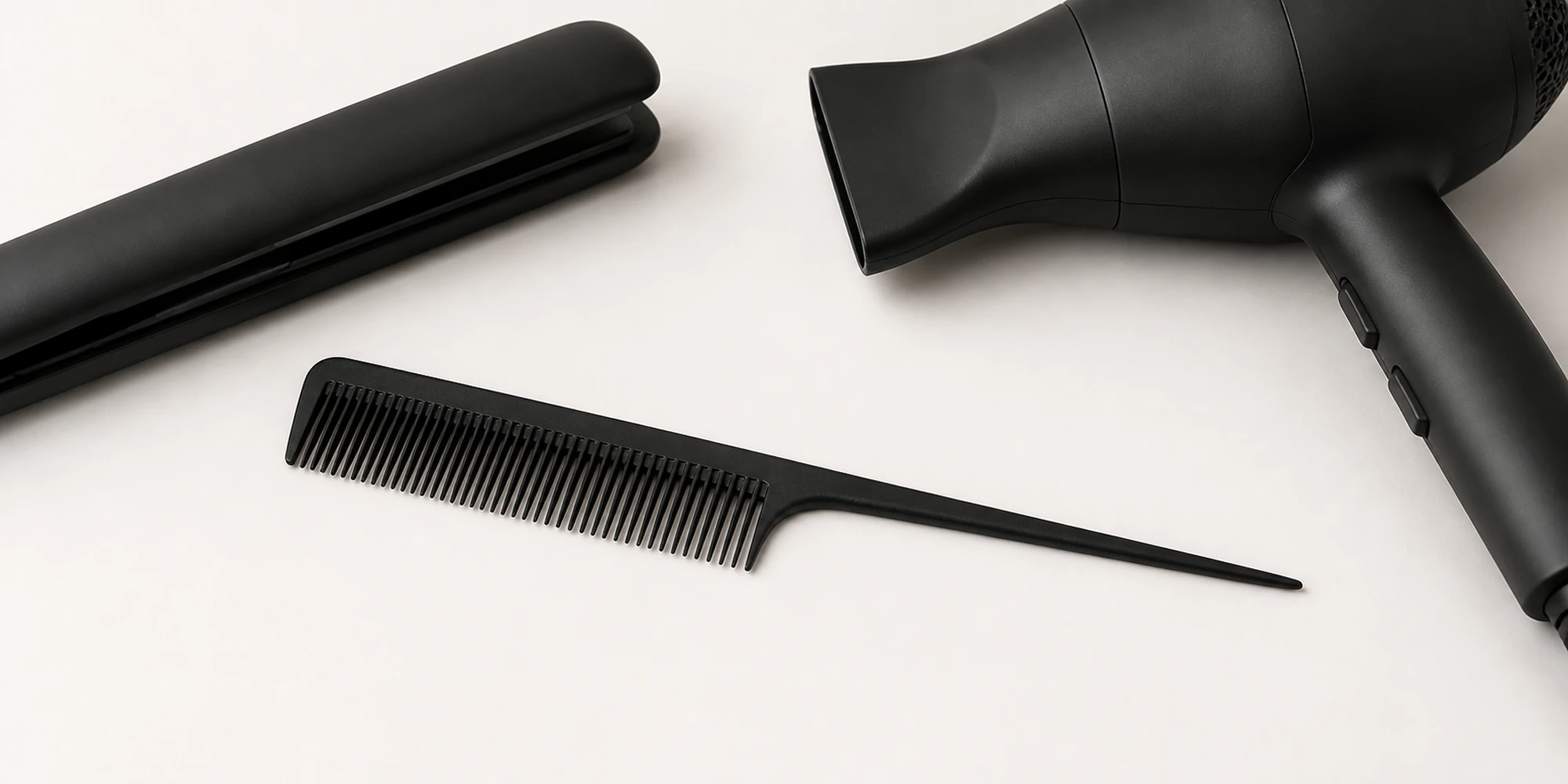
Carbon-fiber-composite combs are among the more heat-resistant plastic-category comb materials available, tolerating sustained proximity to styling heat sources — blow dryers, and in some formulations, direct or near-direct contact with flat irons and curling irons — without the softening or warping that standard ABS experiences under the same conditions. This is the primary functional reason carbon fiber appears in professional and salon-oriented comb lines specifically.
ABS’s Limitation
Standard ABS has a heat deflection temperature in the range of 80–100°C, below the sustained temperatures reached during normal blow-dry use and well below flat iron or curling iron proximity heat. An ABS comb used regularly near heat styling tools will soften, warp, and degrade over a shorter functional lifespan than a carbon-fiber-composite equivalent. This mirrors the broader material framework covered in our guide on heat-resistant hair brush materials, where the same ABS heat-deflection limitation applies to brush barrels and bases.
Practical Implication for Stocking
For SKUs explicitly positioned for use near heat styling tools — sectioning combs sold alongside flat irons, professional-oriented styling combs — carbon fiber is the materially appropriate specification. For general-purpose detangling or finishing combs not marketed for heat-adjacent use, ABS’s heat limitation is largely irrelevant to the product’s actual use case.
Static and Friction Performance
Carbon Fiber
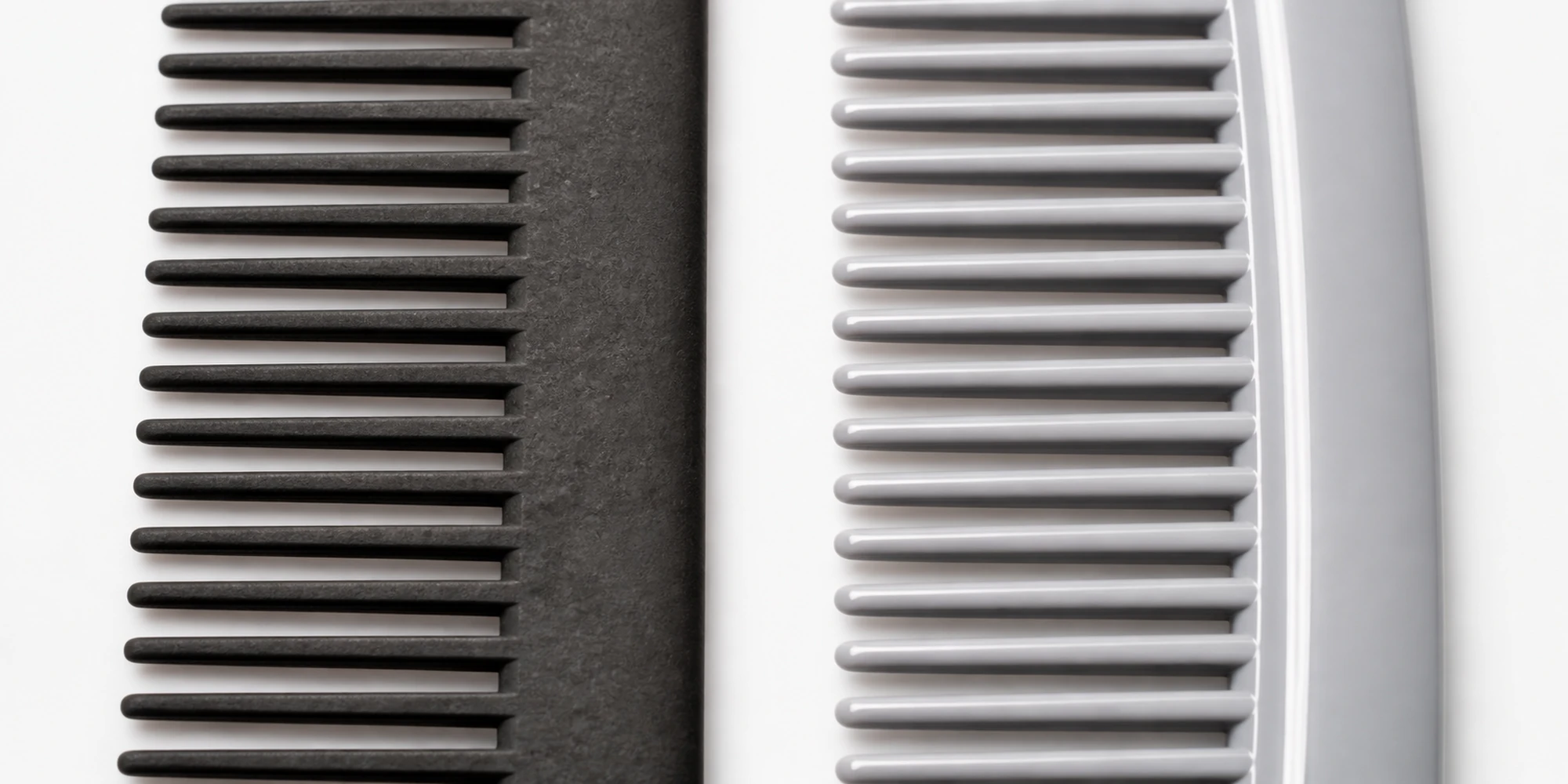
Carbon fiber has inherent anti-static properties, a byproduct of the material’s electrical conductivity characteristics, which reduces the static-driven flyaways and frizz that standard plastic combs can generate during dry styling — particularly relevant for fine hair and low-humidity conditions. The material’s surface finish is also typically smoother at the tooth edge when properly moulded, generating less friction against the hair shaft than standard plastic.
ABS
Standard ABS plastic generates more static during dry combing than carbon fiber, and — as covered in our comb materials guide — the visible seam line that forms along the tooth edge during standard injection moulding can snag hair strands unless the comb undergoes an additional seamless-finishing step after moulding. Seamless-cut ABS combs eliminate this specific issue at a modest cost premium over standard moulded ABS, without approaching carbon fiber’s price point.
Durability and Lifespan
Carbon Fiber
Carbon-fiber-composite combs are generally more durable under repeated flexing and impact than standard ABS, resist warping under heat exposure as covered above, and typically maintain tooth alignment and rigidity over a longer service life — a meaningful factor for professional buyers where a comb sees daily, heavy use across many clients.
ABS
Standard ABS is impact-resistant and holds up reasonably well under normal consumer use, but is more prone to warping under heat exposure, and lower-grade ABS formulations can become brittle over time with repeated flexing, particularly in colder storage or shipping conditions. For consumer-grade daily use at moderate frequency, ABS durability is generally adequate; for high-frequency professional use, it degrades faster than carbon fiber under equivalent use patterns.
Cost and Manufacturing Considerations
Tooling and Per-Unit Cost
Carbon-fiber-composite material costs significantly more per unit than standard ABS resin, and the injection moulding process for carbon-fiber composites often requires more precise tooling and processing control than standard ABS moulding, adding to both tooling investment and per-unit production cost. The exact cost differential varies by carbon fiber percentage in the composite and by manufacturer, but buyers should expect carbon fiber combs to carry a meaningfully higher landed cost than an equivalent ABS SKU — often multiple times the per-unit cost at comparable volumes.
MOQ Considerations
Carbon-fiber-composite comb production is more commonly associated with manufacturers serving the professional and salon supply channel, and MOQs can run higher than standard ABS catalogue items, particularly for custom colours or shapes in the carbon-fiber material. ABS combs, by contrast, are typically available at lower MOQs from a broader base of manufacturers given the material’s ubiquity in the category.
Margin Implications
The higher per-unit cost of carbon fiber supports — and generally requires — a correspondingly higher retail price point to maintain comparable margin percentages. Buyers should model carbon-fiber SKUs against the specific price tier and customer segment that will absorb that retail price, rather than assuming the material upgrade is worth pursuing across an entire product line.
Which Material Fits Which Retail Segment
Mass-Market and Drugstore Retail
ABS is the appropriate default for mass-market and drugstore price points, where consumer price sensitivity is high and the comb is typically a low-consideration, low-frequency purchase. Seamless-finished ABS at this tier delivers adequate performance without the cost structure that carbon fiber would require to remain price-competitive in this channel.
Salon Retail and Professional Supply
Carbon fiber is well suited to the salon retail and professional supply channel, where the customer base — practicing stylists and salon-going consumers purchasing professional-grade tools — is both willing to pay a premium for genuine heat resistance and durability and more likely to use the comb in actual heat-adjacent contexts where the material’s advantage matters functionally, not just as a marketing claim.
Premium Consumer and Boutique Retail
Between these two poles, premium consumer positioning — boutique retail, higher-end beauty retailers, gift-oriented ranges — can support carbon fiber at a price point between mass-market ABS and full professional salon pricing, provided the packaging and positioning genuinely communicate the heat-resistance and durability benefits rather than presenting carbon fiber purely as an aesthetic upgrade. Positioning the material around specific, defensible performance claims — as covered in the certification and claim-substantiation framework in our article on hair brush safety certifications — supports credible premium pricing better than material-name-dropping alone.
Travel and Multi-Purchase Ranges
ABS’s lower cost also makes it the more practical choice for ranges where multiple units per customer is the commercial goal — travel combs, multi-packs, or combs positioned as inexpensive, replaceable accessories rather than durable long-term tools.
A Note on “Carbon Fiber” Labelling Accuracy
Because “carbon fiber” combs are composite materials with variable carbon fiber content rather than a single standardised material, the label alone does not guarantee a specific performance level. A comb with a small percentage of carbon fiber blended into a standard plastic base will not deliver the same heat resistance or durability as a comb with a substantially higher carbon fiber content, even though both may carry the same marketing label.
For B2B buyers, requesting the actual carbon fiber percentage or an equivalent heat-deflection temperature specification from the manufacturer — rather than accepting “carbon fiber” as a sufficient specification on its own — is a meaningful due diligence step, particularly for SKUs where the heat-resistance claim will appear on retail packaging and needs to be genuinely substantiated.
Sourcing Considerations for B2B Buyers
For buyers building a comb range that spans multiple price tiers, carbon fiber and ABS are not competing for the same SKU slot — they serve different tiers of the same range architecture.
Tiered range structure: A well-structured comb range positions ABS (ideally seamless-finished) at the entry and mass-market tier, and carbon-fiber-composite at the premium and professional tier, with each material’s claims and pricing aligned to its genuine performance characteristics rather than uniform positioning across the range.
Specification documentation: For carbon fiber SKUs, requesting documented carbon fiber content percentage and heat-deflection performance data from the manufacturer supports both accurate marketing claims and consistent reorder quality — a variable covered in more depth in our guide on 10 things to check before placing a custom hair brush order, which applies equally to comb sourcing.
Seamless finishing as a mid-tier lever: For buyers wanting a performance step up from standard ABS without the cost jump to carbon fiber, seamless-finished ABS (eliminating the moulding seam line at the tooth edge) is a lower-cost intermediate option worth considering as its own tier.
Channel-matched MOQ planning: Because carbon-fiber MOQs and lead times can differ from standard ABS catalogue items, buyers planning a multi-tier range should confirm MOQ and lead time separately for each material rather than assuming uniform terms across the full range.
Both carbon-fiber-composite and seamless-finished ABS comb formats, across the full range of tooth configurations covered in our types of hair combs guide, are available through OEM and private label manufacturing routes, with carbon fiber content, finishing process, and tooth specification adjustable to range positioning requirements.
Frequently Asked Questions
Is a carbon fiber comb worth the extra cost over ABS plastic?
It depends on the use case and customer segment. For heat-adjacent professional use, frequent daily use, or a premium retail positioning where customers expect and will pay for genuine material upgrades, carbon fiber’s heat resistance and durability justify the cost. For general-purpose, low-frequency, price-sensitive retail, standard or seamless-finished ABS delivers adequate performance at a fraction of the cost.
Can ABS plastic combs be used near heat styling tools?
Not recommended for sustained proximity use. Standard ABS has a heat deflection temperature of roughly 80-100°C, below the temperatures reached near blow dryers and well below flat iron or curling iron proximity heat, and will soften and warp under repeated exposure. Carbon-fiber-composite combs are the more appropriate specification for heat-adjacent use.
Does carbon fiber always mean the same material quality?
No. Carbon fiber combs in this category are typically carbon-fiber-reinforced composites with variable carbon fiber content rather than a standardised material. Buyers and consumers should treat carbon fiber as a category label rather than a guarantee of specific performance, and B2B buyers should request documented carbon fiber percentage or heat-deflection data when sourcing.
What is seamless-finished ABS and is it worth it?
Seamless-finished ABS is standard ABS that has undergone an additional post-moulding process to eliminate the visible seam line along the tooth edge that standard injection moulding produces. This seam can snag hair strands, particularly on fine hair. Seamless finishing adds a modest cost over standard moulded ABS without approaching carbon fiber pricing, making it a reasonable mid-tier option.
Which material is better for fine hair?
Carbon fiber’s inherent anti-static properties and generally smoother tooth-edge finish make it gentler on fine hair, which is more prone to static-driven flyaways and cuticle disturbance from friction. Seamless-finished ABS is a reasonable lower-cost alternative that addresses the friction concern, though it does not match carbon fiber’s anti-static performance.
What MOQ should I expect for carbon fiber combs versus ABS?
ABS combs are typically available at lower MOQs from a broad manufacturer base given the material’s ubiquity. Carbon-fiber-composite combs, more commonly produced by manufacturers serving the professional and salon supply channel, can carry higher MOQs, particularly for custom colours or shapes. Confirming MOQ and lead time separately for each material is advisable when planning a multi-tier range.
Conclusion
Carbon fiber and ABS plastic serve genuinely different roles in a comb range rather than competing head-to-head for the same customer. Carbon fiber’s heat resistance, anti-static performance, and durability justify its higher cost for professional, heat-adjacent, and premium retail positioning. ABS’s low cost, adequate performance for general-purpose use, and broad manufacturer availability make it the appropriate default for mass-market and price-sensitive retail. The stocking decision should follow the target customer segment and use case for each specific SKU, with a tiered range — potentially including seamless-finished ABS as a mid-point — capturing more of the total addressable market than committing to a single material across the board.
For buyers building a material-tiered comb range with documented, defensible specifications at each level, manufacturers such as JunYi Beauty, which produces both carbon-fiber-composite and seamless-finished ABS comb formats with documented material specifications from its Dongguan facility, represent the type of OEM partner suited to ranges where material claims need to hold up to both retail buyer and end-consumer scrutiny.