
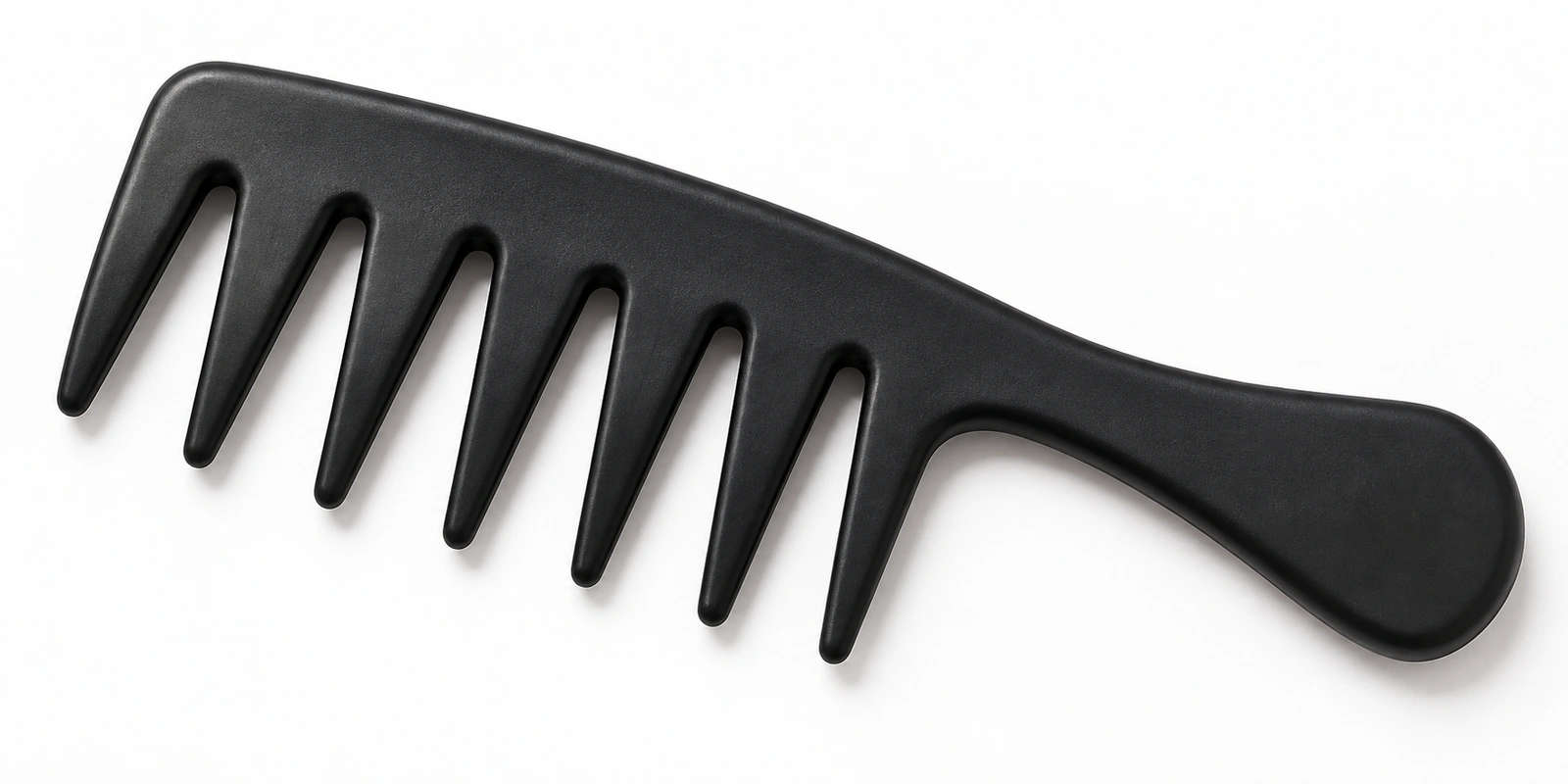
A shark tooth comb is the widest-spaced member of the wide-tooth comb family. Its teeth are larger, thicker at the base, and spaced further apart than those of a standard wide-tooth comb, and they usually taper to a rounded point in a triangular or gently curved profile that gives the tool its name. It exists to solve a specific problem: getting through dense, wet, curly or coily hair on wash day without compressing curl clumps, overloading strands, or snapping hair at its natural weak points.
This guide explains why tooth spacing matters so much for wet curly hair, how a shark tooth comb differs from a standard wide-tooth comb, how to use one without frizz or breakage, which hair types genuinely benefit, and what to specify when sourcing one. For the broader comb category this tool belongs to, see our guide on types of hair combs.
What Makes a Shark Tooth Comb Different
Larger, Wider-Spaced Teeth
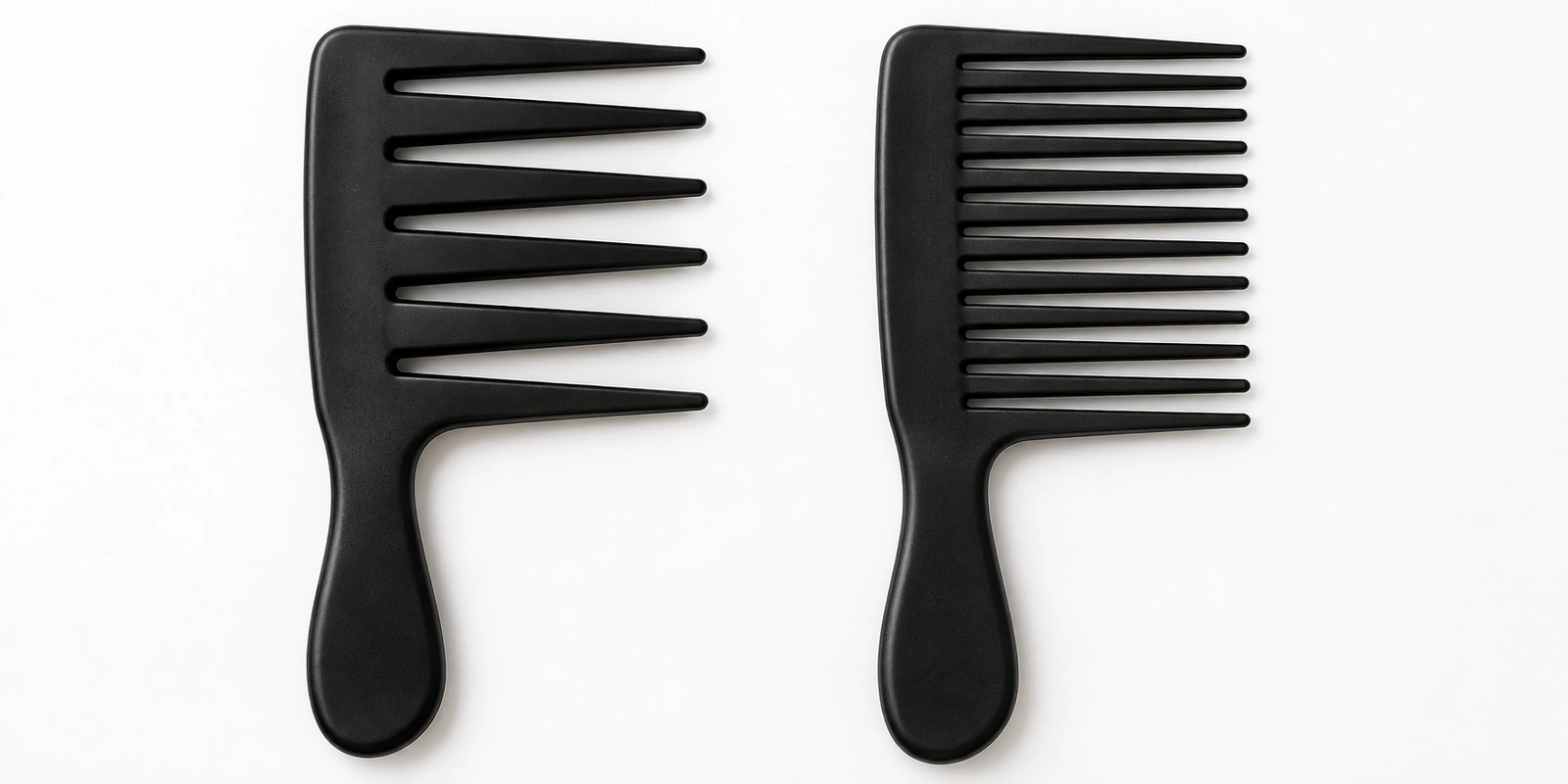
A standard wide-tooth comb typically spaces its teeth around 5 to 8mm apart. A shark tooth comb opens that gap further and uses fewer, larger teeth across the same comb width. There is no industry standard for the term, so the actual spacing varies by manufacturer and should be checked rather than assumed from the product name.
Tapered, Load-Bearing Tooth Profile
The teeth are wider at the base and narrow toward a rounded tip. The wide base keeps each tooth rigid under the weight of dense wet hair, while the tapered tip slides between curl clumps rather than splitting them. A thin, uniform tooth of the same length would flex under load, and a flexing tooth drags hair instead of guiding it.
Grip Built for Wet Use
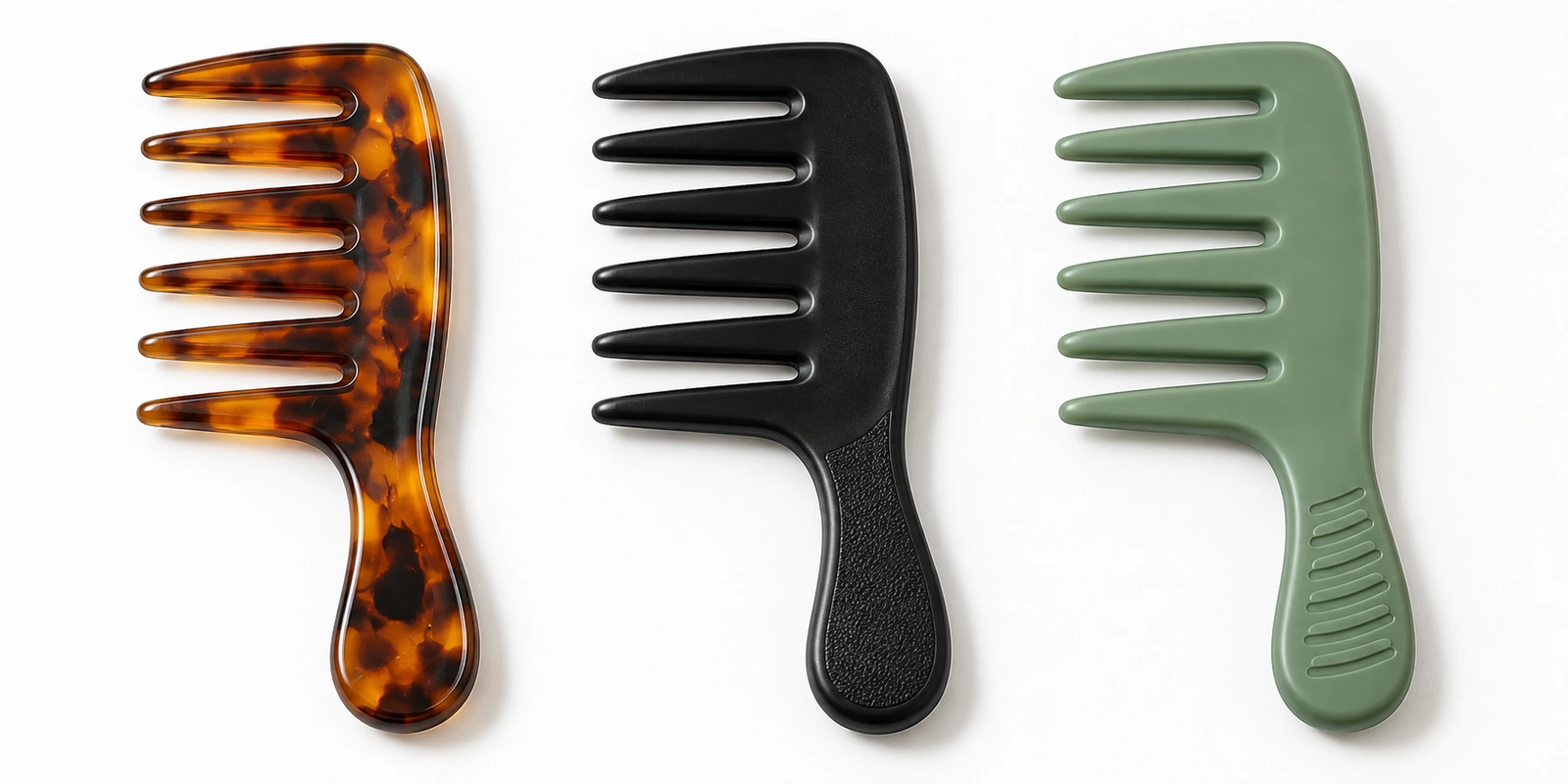
Because the comb is used almost exclusively in the shower or on soaking wet, conditioner-coated hair, many designs use a thicker body and a handle with a textured or contoured grip. This is a practical rather than cosmetic feature, since a slipping comb leads to jerky, uneven strokes.
Why Wet Curly Hair Needs Extra-Wide Teeth
Curl Patterns Create More Knots and More Weak Points
Every bend in a curly strand is a point where neighbouring strands can interlock, so curly and coily hair accumulates tangles faster than straight hair. Those same bends are where the hair shaft is structurally weakest, which is why curly hair tends to break under tension at lower force than straight hair.
Wet Hair Stretches Before It Breaks
Water temporarily disrupts the hydrogen bonds that keep the hair shaft rigid, so wet hair stretches further before breaking but suffers lasting damage when stretched beyond its limit. As covered in our guide on whether it is bad to brush wet hair, the safest wet detangling minimises the tension placed on each strand during each stroke.
Wider Gaps Prevent Compression
The key advantage of extra-wide spacing is what happens between the teeth. In dense hair, a standard wide-tooth comb‘s gaps can fill completely, compressing a large bundle of hair between two teeth and dragging it as a single mass. When that bundle contains a knot, the whole bundle comes under tension at once. Wider gaps let hair pass through without being packed tightly, so knots are met one at a time and tension stays low.
Curl Clumps Survive the Pass
Finer spacing breaks curl clumps apart into individual strands, and individually separated strands dry as frizz rather than defined curls. Larger gaps allow clumps to pass through the comb largely intact, which preserves the natural pattern that curly hair care routines aim to protect.
How to Use a Shark Tooth Comb Correctly
Saturate the Hair With Slip First
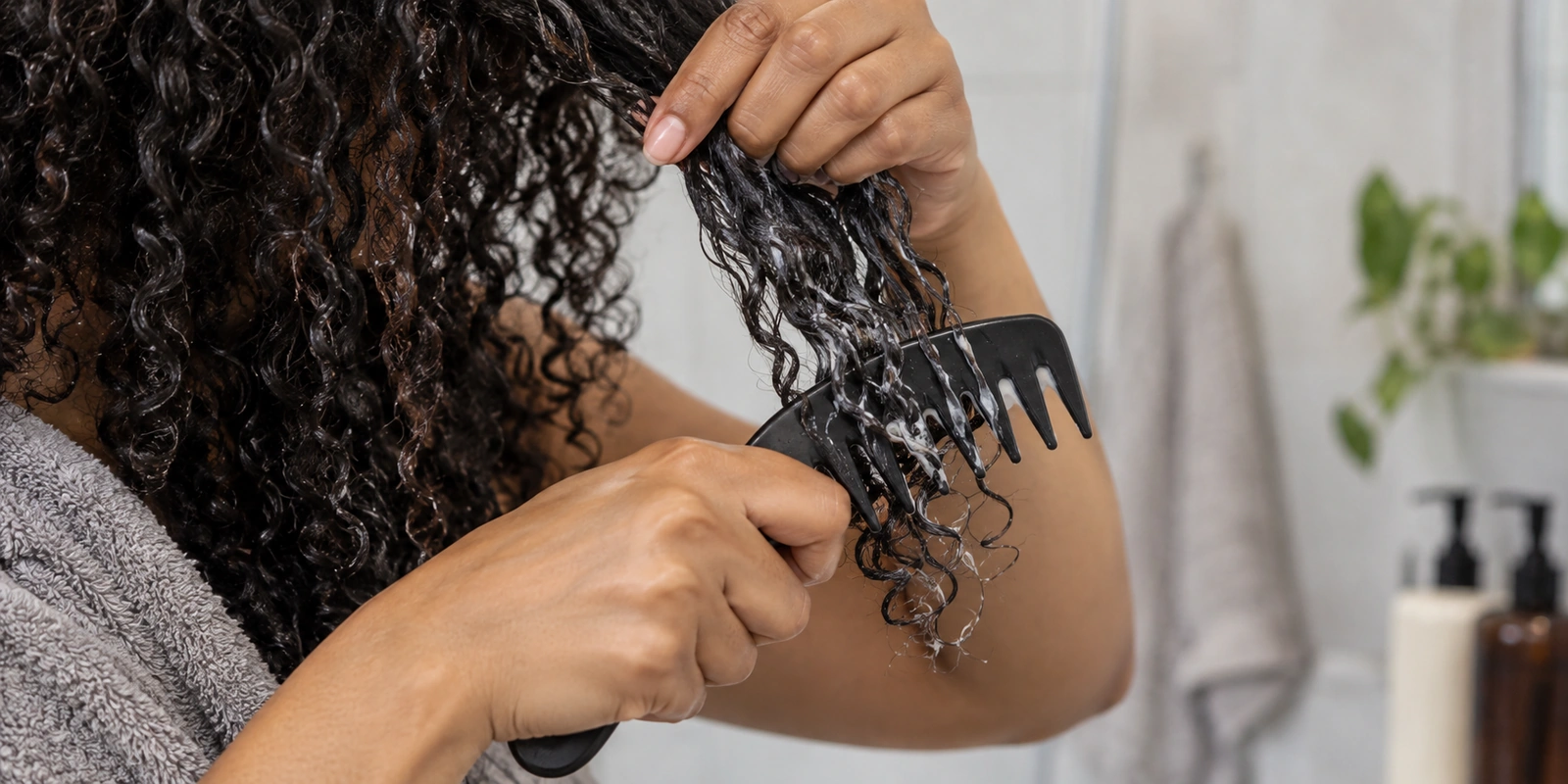
Apply a generous amount of conditioner or a slip-rich leave-in before combing. Product reduces friction between the teeth and the hair and between the strands themselves, and it is what allows the wide teeth to glide rather than snag.
Section Before You Start
Divide the hair into four to eight sections depending on density, and clip away everything except the section being detangled. A comb, however wide, works best on a manageable volume of hair.
Work From the Ends Upward
Comb the last few inches of a section first, then move up in small increments until you reach the root. Starting at the scalp and pulling down drives every small tangle into a single compacted knot at the ends, which is where breakage is most likely.
Hold the Hair Above the Knot
Grip the section between the knot and the scalp with your free hand. This absorbs any pulling force so it does not reach the root, and it gives you control over how much tension the comb applies.
Stop Once the Section Is Clear
Once the comb passes through cleanly, move on. Repeated passes through an already-detangled section separate clumps and invite frizz. From here, definition is a separate step, handled with a curl defining comb, finger-coiling, or twisting.
Which Hair Types Benefit Most
Type 3 Curls
Dense Type 3 curls benefit from extra-wide spacing because it keeps clumps intact and reduces the compression that leads to snapping at curl bends.
Type 4 Coils
Type 4 hair, with its tight coil pattern and high shrinkage, is where a standard wide-tooth comb most often packs hair between its teeth. A shark tooth comb reduces this. Many people with Type 4 hair still finger-detangle first to loosen larger knots and use the comb for the final pass.
High-Density Hair of Any Texture
Density matters as much as curl pattern. Very thick hair, even with a looser wave, benefits from larger gaps simply because there is more hair passing between each pair of teeth.
When It Is Not the Right Tool
For fine or low-density hair, the extra spacing offers little advantage and can feel less controlled. A standard wide-tooth comb or a flexible detangling brush is usually a better fit for this hair.
Shark Tooth Comb vs. Related Tools
Standard Wide-Tooth Comb
The two overlap, and many people with looser curls do well with either. The shark tooth comb pulls ahead on dense, tightly curled hair where a standard comb’s gaps fill up.
Detangling Brush
A flexible detangling brush clears knots in fewer strokes because its pins bend under tension, but it engages more strands per pass than an extra-wide comb. Our Wet Brush vs Tangle Teezer guide compares two common designs. Many routines use the comb for the first pass and a brush for finishing.
Twist Comb
A shark tooth comb handles full-head detangling. A twist comb is a precision tool for sectioning hair that is already detangled. They are sequential steps, not alternatives.
Material and Construction Details That Matter
Seamless Tooth Edges
Injection-moulded combs often leave a seam line along each tooth where the mould halves meet. On wet, product-coated curly hair, that seam can catch strands. Seamless-finished teeth remove this risk, as explained in our comparison of carbon fiber vs ABS plastic combs.
Tooth Cross-Section
A wide base is what keeps a large tooth from flexing in dense hair. Lower-cost combs sometimes copy the shark tooth silhouette with thin teeth that bend under load, which defeats the purpose.
Water Tolerance
Because the comb spends its life in the shower, cellulose acetate and well-specified ABS are practical choices. Untreated wood tends to swell and warp with repeated wetting.
Sourcing Considerations for B2B Buyers
For buyers developing extra-wide-tooth combs, the main risk is a product that looks like a shark tooth comb but does not perform like one.
Specify spacing and tooth dimensions in millimetres: “Shark tooth” is a design description, not a standard. Documenting tooth spacing, base width, and length ensures the finished comb delivers the low-compression performance it is sold on.
Require seamless finishing: State seamless tooth edges explicitly in the specification, since this directly affects snagging on wet curly hair.
Verify rigidity on samples: Test samples on dense, wet hair or a test swatch to confirm teeth do not flex. This is a quick, reliable way to catch under-specified tooling.
Position for the right customer: Label the comb for dense, curly, and coily hair rather than as a universal comb, so fine-hair buyers are not steered into a poor fit.
Design for wet grip: A textured or contoured handle is a low-cost, genuinely useful differentiator in this category.
Shark tooth and extra-wide-tooth combs in seamless-finished acetate and ABS are available through OEM and private label manufacturing routes, with tooth spacing, base width, and handle design adjustable to range requirements.
Frequently Asked Questions
What is a shark tooth comb used for?
It is used to detangle dense, wet, curly or coily hair. Its larger, more widely spaced teeth let hair pass through without compressing between the teeth, which keeps tension per strand low and preserves curl clumps.
How is a shark tooth comb different from a wide-tooth comb?
It has fewer, larger teeth with wider gaps and a tapered profile that is thicker at the base. This makes it better suited to very dense or tightly curled hair, where a standard wide-tooth comb‘s gaps can fill up and compress the hair.
Can I use a shark tooth comb on dry hair?
It is designed for wet hair with conditioner. Combing curly hair dry separates curl clumps and increases frizz and breakage regardless of the comb used.
Will a shark tooth comb cause frizz?
Not on its own. Frizz usually comes from combing dry hair, using too little product, or combing the same section repeatedly. Used on wet hair with slip and stopped once the section is clear, it helps keep curl clumps intact.
Is a shark tooth comb good for fine hair?
Usually not necessary. Fine or low-density hair does not fill a standard wide-tooth comb’s gaps, so the extra spacing adds little and can feel less controlled.
What should I check when buying a shark tooth comb?
Look for documented tooth spacing, seamless tooth edges, teeth with a wide base that do not flex, a water-tolerant material, and a handle that grips well when wet.
Conclusion
A shark tooth comb is built around one idea: in dense, wet, curly hair, the space between the teeth matters as much as the teeth themselves. Wider gaps stop hair from packing into a single tensioned bundle, tapered rigid teeth glide between clumps instead of splitting them, and the result is lower tension per strand and better-preserved curl patterns. The comb delivers most for Type 3 and Type 4 hair and for high-density hair of any texture, and least for fine, low-density hair. Technique remains decisive, with generous slip, sectioning, and ends-first detangling doing as much to prevent breakage as the comb itself.
For brands developing extra-wide-tooth combs with documented spacing and construction rather than silhouette-only design, manufacturers such as JunYi Beauty, which produces seamless-finished wide-tooth and shark tooth combs in acetate and ABS from its Dongguan facility, represent the type of OEM partner suited to ranges where performance claims are backed by measurable specification.