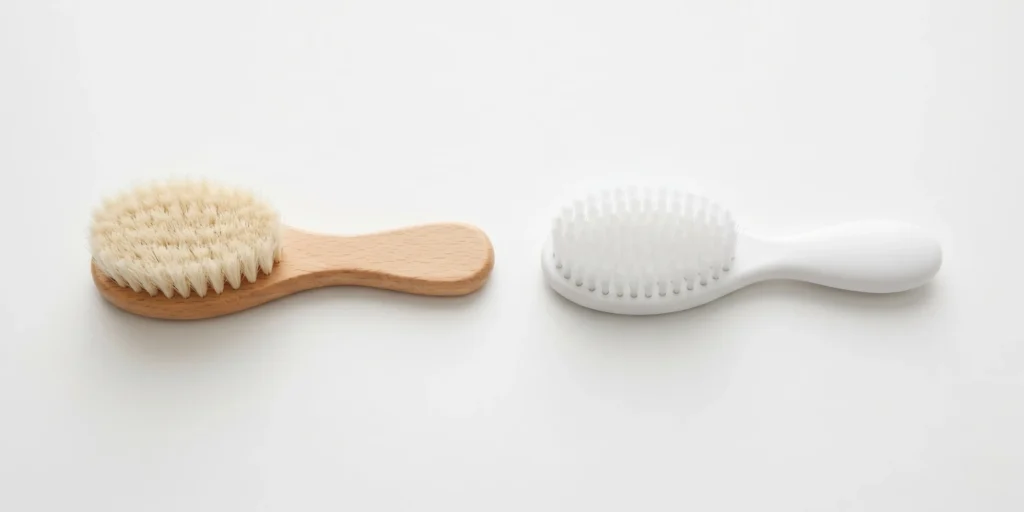
A baby hair brush is not a scaled-down version of an adult brush. Infant scalps are thinner, more sensitive, and more reactive to mechanical contact than adult skin, and the hair itself — whether a newborn has a full head of it or barely any at all — is finer, softer, and more delicate than it will be at any later stage of life. The brush that is appropriate for a newborn is different from the one appropriate for a six-month-old, and both are different from what a toddler with established hair growth needs.
This guide covers the key variables in baby brush selection — bristle material, handle design, safety standards, and age-appropriate specification — as well as practical guidance on cradle cap management, brushing technique, and what to avoid. For brand developers and importers sourcing baby grooming products, it also addresses the specification and compliance considerations specific to the infant personal care segment. A broader framework for bristle types and hair tool selection is available in our guide on how to choose the right hair brush for your hair type.
Why Baby Brushes Are Structurally Different from Adult Brushes
The differences between a correctly specified baby brush and an adult brush are not cosmetic — they reflect genuine structural requirements driven by the physiology of infant skin and hair.
Scalp Sensitivity in Newborns
A newborn’s scalp skin is significantly thinner and more permeable than adult skin. The stratum corneum — the outer protective layer — is thinner and provides less barrier function, making the scalp more reactive to friction, pressure, and any materials that contact it. A bristle that is acceptable on adult skin can cause redness, irritation, or micro-abrasion on a newborn scalp if the stiffness exceeds what the skin can tolerate.
The fontanelles — the soft spots on a newborn’s skull where the cranial bones have not yet fused — also require particular care during brushing. The anterior fontanelle typically remains open until around 18 months, and the posterior fontanelle until around two to three months. Brushing over the fontanelle area requires genuinely soft bristle and light pressure, not simply a brush that is described as soft.
Infant Hair Structure
Newborn hair — including the fine vellus hair present on the scalp — has a smaller diameter and less cortex mass than adult hair. It is more susceptible to breakage under tension and requires less force to detangle than any adult hair type. Even fine adult hair is structurally more robust than newborn hair.
As infants develop through the first two years, hair texture, density, and shaft diameter change — often significantly. A brush appropriate for the sparse, ultra-fine hair of a newborn may not be the right specification for a toddler with thicker, longer hair that requires actual detangling.
Bristle Types for Baby Brushes
Natural Goat Hair Bristle
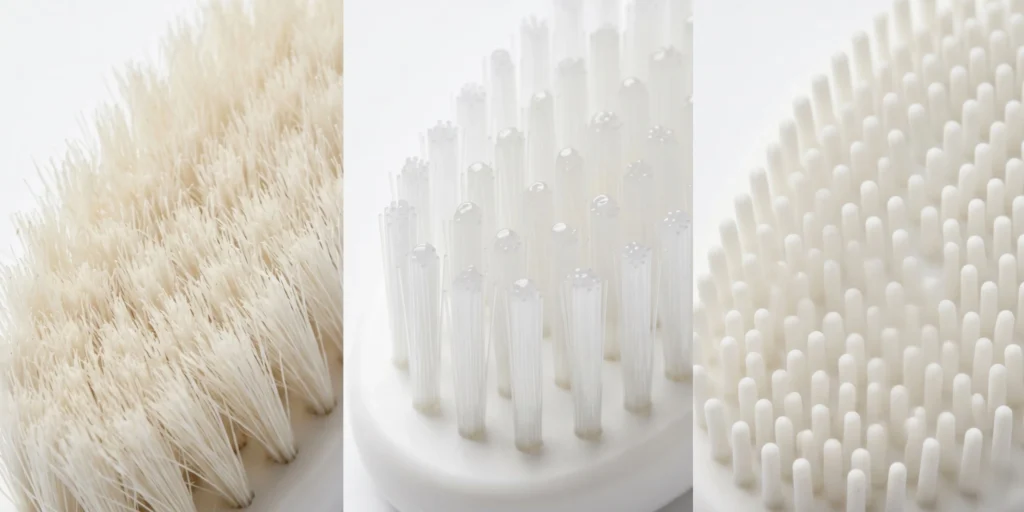
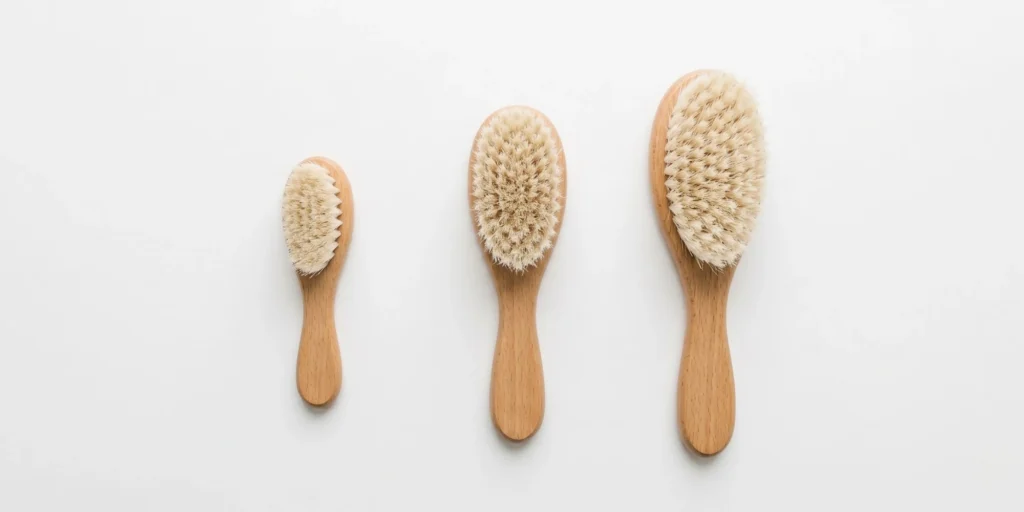
Natural goat hair is the most widely used bristle material in premium baby brush specifications. Goat hair is finer and softer than most grades of boar bristle, making it one of the gentlest natural bristle options available for newborn scalp contact. It redistributes the scalp’s natural oils during brushing — helping to keep the scalp surface moisturised — and its natural keratin composition generates minimal static.
The primary limitation of goat hair bristle is maintenance. Natural bristle absorbs moisture and requires thorough air-drying after washing to prevent mildew and bristle degradation. Goat hair brushes should not be stored face-down or in enclosed spaces while damp. The bristle can also mat or shed over time if not properly maintained — relevant for parents who need a durable, long-lasting tool through the infant and toddler stages.
Soft Natural Boar Bristle
Fine-grade soft boar bristle — the same material used in premium adult fine-hair brushes — is appropriate for baby brush specifications when the grade and softness are correctly specified. Not all boar bristle is equivalent: coarser grades used in adult medium-to-thick hair brushes are too stiff for infant scalp contact. For baby brush applications, the bristle grade must be explicitly specified as soft or extra-soft, with individual bristle diameter within the appropriate range for newborn skin contact.
Boar bristle shares the oil redistribution and low-static properties of goat hair, and is somewhat more durable under regular washing. For brands sourcing baby brush products through OEM manufacturing routes, confirming the specific bristle grade in the product specification — not simply specifying “soft boar bristle” — is essential for consistent production quality.
Soft Nylon Bristle with Rounded Tips
Soft synthetic nylon bristle with rounded ball tips is the most practical specification for parents who prioritise durability and ease of cleaning. High-quality nylon bristle for baby brushes uses finer filament diameters than adult brush nylon, and the ball tips prevent scratching of sensitive scalp skin. Nylon bristle is unaffected by repeated washing, does not mildew, and maintains consistent stiffness across its lifespan.
The tradeoff compared to natural bristle is that nylon does not redistribute scalp oils and generates slightly more static. For most toddler-age brushing — where detangling and styling are the primary functions rather than newborn scalp care — these tradeoffs are functionally insignificant.
Silicone Bristle
Silicone-bristle brushes are used primarily as cradle cap management tools rather than hair brushes in the conventional sense. The flexible silicone nubs provide gentle mechanical exfoliation of the scalp surface without the risk of abrasion from any type of natural or synthetic fibre. Many silicone baby scalp brushes are designed to be used in the bath with water and mild shampoo, making them practical for the wash routine rather than post-wash brushing.
Silicone is non-absorbent, easy to sterilise, and free from the allergen concerns associated with natural animal-derived bristles. For parents managing cradle cap, a silicone scalp brush is a useful supplementary tool alongside a natural or soft nylon bristle brush for post-wash styling.
Age-by-Age Brush Guide
Newborns (0–3 Months)
At this stage, the primary function of a baby brush is scalp stimulation, oil redistribution, and, where relevant, gentle assistance with cradle cap management. Hair volume is typically low and detangling is not a significant concern. The brush specification should prioritise absolute bristle softness over any detangling or styling capability.
Recommended specification: Natural goat hair or extra-soft boar bristle on a small, ergonomic handle that fits comfortably in a parent’s hand for precise pressure control. No nylon pins. No cushion base required — the primary function is surface contact rather than penetration.
Infants (3–12 Months)
As hair density increases and hair length grows, a degree of light detangling capability becomes useful, though bristle softness remains the primary requirement. Some infants develop cradle cap in this period, making the combination of a soft bristle brush and an optional silicone scalp brush relevant.
Recommended specification: Soft goat or boar bristle brush for daily brushing and scalp maintenance. Silicone scalp brush for in-bath use if cradle cap is present. The handle size can begin to scale to a slightly larger form factor as fine motor control in the parent’s hand is less critical — but should remain small relative to adult brushes.
Toddlers (12 Months and Above)
Toddler hair is typically denser, longer, and more likely to tangle than infant hair. At this stage, a brush with some detangling capability — either soft nylon with ball tips or a mixed specification — becomes more appropriate. The scalp is also more robust than in the newborn period, tolerating a slightly broader range of bristle stiffness.
Recommended specification: Soft nylon ball-tip brush or fine mixed bristle for daily detangling and styling. For toddlers with curly or wavy hair, a wide-tooth comb used on damp hair before brushing reduces breakage significantly. The handle can be adapted for both parent use and child self-brushing — ergonomic designs that fit smaller hands encourage the self-care habit without compromising safety.
Cradle Cap: What a Brush Can and Cannot Do
Cradle cap (seborrhoeic dermatitis of the infant scalp) is a common condition in newborns and young infants. It presents as yellowish, flaky or crusty patches on the scalp and is not caused by poor hygiene or lack of brushing. It typically resolves on its own within the first year.
A soft baby brush — particularly with natural bristle — can assist in loosening and removing flaky scales during and after bathing, particularly when used after applying a small amount of baby oil to the scalp to soften the scale. Brushing in gentle, circular motions over the affected area during the bath, and then lightly brushing outward to remove loose scale after rinsing, is the most commonly recommended approach.
What a brush cannot do is treat the underlying condition. Brushing removes surface scale but does not address the fungal or sebum-related factors that contribute to cradle cap. If cradle cap is severe, persistent, or accompanied by redness and apparent discomfort, consulting a paediatrician is appropriate. A baby brush is a supportive grooming tool, not a medical treatment.
Handle Design and Safety Considerations
Handle Material
Baby brush handles are most commonly made from wood, plastic, or silicone-coated materials. Each has different implications for safety and usability.
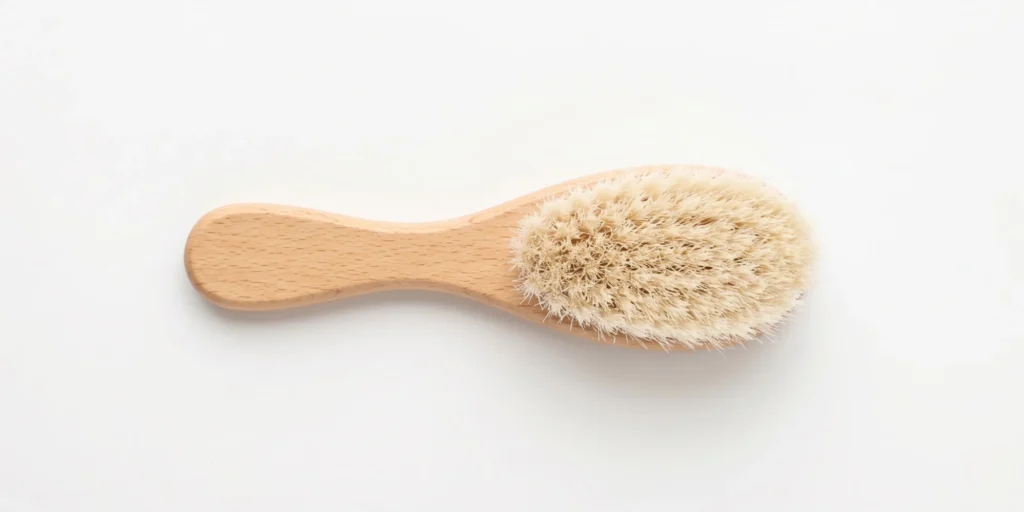
Wooden handles — particularly from FSC-certified hardwoods — offer a natural aesthetic and comfortable grip. The primary concern with wooden handles for baby brushes is the finish: lacquers or varnishes must be non-toxic and free from lead, cadmium, and other regulated substances. For export markets, chemical safety compliance (REACH in the EU, CPSC standards in the US) must be confirmed before production.
Plastic handles need to be BPA-free and manufactured from materials compliant with relevant toy and juvenile product safety standards. ABS plastic is the most common specification for baby brush handles — it is durable, lightweight, and available in a wide range of finishes.
Silicone or rubber-grip handles provide enhanced grip during bath use, where wet hands reduce grip security. For brushes intended for in-bath cradle cap management, a silicone or non-slip grip handle is a meaningful safety feature.
Safety Standards for Baby Brushes
Baby brushes sold in major consumer markets are subject to juvenile product safety standards that differ from adult brush requirements. In the EU, compliance with EN 71 (toy safety standard — relevant where products may be used by or around young children) and REACH chemical compliance are standard requirements. In the US, CPSC regulations and ASTM F963 (Standard Consumer Safety Specification for Toy Safety) apply where the product is marketed for infant use.
Confirming the specific compliance standards required for the target market before placing an order is an essential pre-production step — one of the ten items covered in our complete pre-order checklist for custom hair brush orders.
How to Use a Baby Hair Brush: Practical Guidance
Brushing Frequency
For newborns with little or no hair, once-daily brushing during or after bathing is sufficient for scalp stimulation and cradle cap prevention. For infants and toddlers with established hair growth, brushing once or twice daily is appropriate — more frequent brushing is unnecessary and adds cumulative mechanical contact to a scalp that does not benefit from it.
Technique
Hold the brush with light grip and use the weight of the brush rather than applied pressure to make contact with the scalp. Strokes should be slow and deliberate — the goal is consistent contact rather than speed. For newborns, short strokes from the crown outward are less likely to startle the infant than long, sweeping strokes. For toddlers with longer hair, starting from the ends and working upward toward the roots reduces the tension applied to individual strands during detangling.
Cleaning
Baby brushes should be cleaned more frequently than adult brushes because infant scalp oils and any applied products (baby oil, lotion) accumulate on bristle more quickly than adult scalp sebum. A weekly wash with warm water and a small amount of mild baby shampoo is appropriate for most specifications. Natural bristle brushes should be air-dried bristle-side down on a clean surface to prevent moisture from penetrating the handle joint, which can weaken the bristle set over time.
Sourcing Considerations for B2B Buyers
The baby brush and infant grooming segment is one of the most specification-sensitive and compliance-intensive product categories in the broader hair brush market. Buyers entering this segment face a higher burden of proof on safety compliance than adult brush buyers, and the consequences of non-compliance — product recalls, retailer delistings, reputational damage — are more severe because the end user is an infant.
Bristle safety: Natural bristle sourced for baby brushes should be accompanied by allergen test documentation confirming freedom from common sensitisers. For brands targeting markets with elevated consumer sensitivity to animal-derived materials, synthetic alternatives with equivalent softness are available and should be specified with the same grade-level precision as natural bristle.
Chemical safety: All materials used in baby brush production — bristle, handle, adhesives, finishes — must be tested against the chemical safety requirements of the target market. This includes heavy metals in surface coatings, phthalate content in plastic handles, and formaldehyde in wooden handle lacquers.
Age grading and labelling: Baby grooming products typically carry an age grade on packaging. The age grade determines which safety standards apply, and must be consistent with the product’s actual specification. A brush labelled “from birth” must meet the most stringent applicable standards.
Packaging compliance: Baby product packaging in the EU and US markets requires specific warning language regarding small parts and suffocation hazards where applicable. Polybag packaging used for e-commerce baby products must carry appropriate suffocation warning text in the correct size and language for each target market.
Frequently Asked Questions
What is the best bristle type for a newborn baby brush?
Natural goat hair or extra-soft boar bristle are the most appropriate bristle types for newborn brushes. Both are soft enough for sensitive newborn scalp contact, redistribute natural scalp oils, and generate minimal static. Soft nylon with rounded ball tips is an appropriate alternative for parents who prioritise durability and ease of cleaning.
Can I use a regular adult brush on a baby?
No. Adult brushes — including those marketed as “soft” — are not appropriate for newborn or infant scalp contact. The bristle stiffness and pin pressure of adult brushes exceed what infant scalp skin can tolerate without irritation. Baby brushes are specifically designed with bristle softness, diameter, and density appropriate for infant scalp physiology.
How do I use a baby brush for cradle cap?
Apply a small amount of baby oil to the affected scalp area before bathing to soften the flaky scale. During the bath, use a soft natural bristle or silicone baby brush in gentle circular motions over the area. After rinsing, lightly brush outward to remove loosened scale. Avoid scrubbing or applying pressure — the goal is gentle mechanical loosening, not aggressive removal.
When should I switch from a newborn brush to a toddler brush?
The transition from a newborn brush to a toddler specification is driven by hair development rather than a fixed age. When hair density and length reach the point where the newborn brush cannot work through the hair comfortably — typically between 9 and 18 months depending on the individual child’s hair growth — a brush with slightly more detangling capability is appropriate.
What materials should I avoid in a baby brush?
Avoid brushes with hard or medium-stiffness nylon pins, metal pins of any type, and any bristle or handle material without confirmed compliance documentation for the target market. For synthetic brushes, BPA-free labelling should be accompanied by test documentation rather than relied upon as a self-declared claim.
How often should a baby brush be cleaned?
Once per week with warm water and a small amount of mild baby shampoo is appropriate for most baby brushes. Natural bristle brushes should be air-dried bristle-side down. Silicone scalp brushes can be washed after each bath use and will not degrade from frequent washing.
Conclusion
Baby hair brushes require genuinely different specifications from adult brushes — not simply softer versions of the same product. Bristle type, grade, and diameter, handle material safety, chemical compliance, and age-appropriate performance all need to be addressed at the specification level, not resolved with general soft-brush labelling. The correct brush for a newborn is different from the one appropriate for a six-month-old, and both are different from a toddler brush — and packaging, age grading, and compliance documentation must reflect these distinctions.
For brand developers entering the infant grooming category, the compliance requirements and specification precision demanded by this segment make manufacturer selection and pre-production verification more critical than in the adult brush category. Manufacturers such as JunYi Beauty, which produces soft natural bristle and nylon baby brush formats with adjustable bristle grade, handle material, and compliance documentation support from its Dongguan facility, represent the type of OEM partner suited to brands building baby grooming ranges where safety substantiation and specification integrity are non-negotiable.