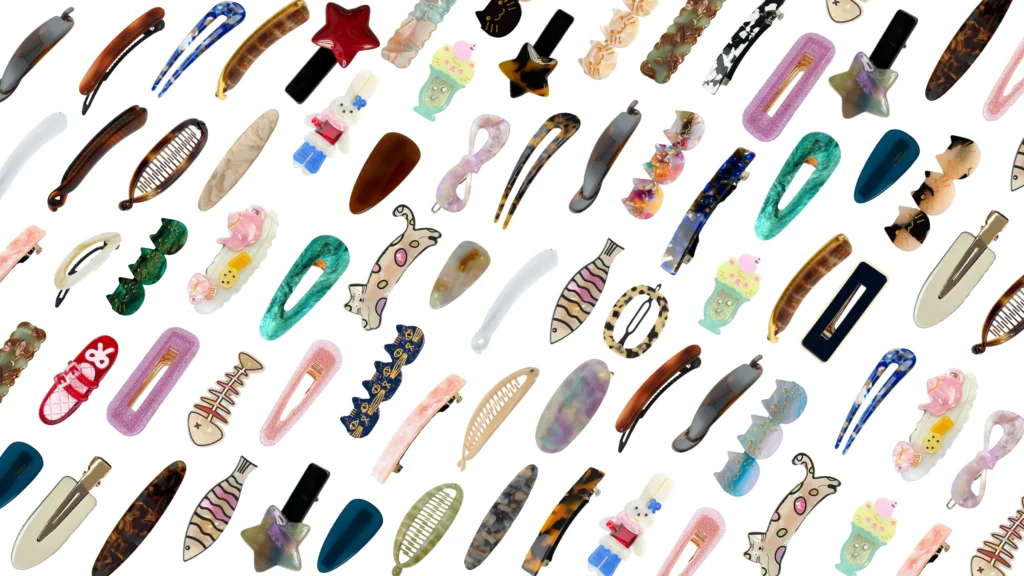
The global hair accessories market continues to expand in 2026, driven by sustained consumer demand for fashion-forward clips, functional hair claws, and premium acetate accessories across retail, salon, and e-commerce channels. For wholesale buyers, brand owners, and importers placing B2B orders, manufacturer selection is the most consequential decision in the supply chain — affecting product quality, customization depth, certification compliance, lead time reliability, and the unit economics that determine whether a range is commercially viable.
This guide profiles the top five hair clip manufacturers operating at scale in 2026, evaluating each across production capacity, OEM and ODM capability, material range, certification status, and the practical variables that matter to buyers placing volume orders. The manufacturers listed below serve the categories covered in our hair clips, hair claw, and acetate hair clip product ranges.
What B2B Buyers Should Evaluate Before Selecting a Manufacturer
Before reviewing individual manufacturers, it is worth establishing the evaluation criteria that distinguish a reliable long-term production partner from a supplier that performs well on the first order and inconsistently thereafter.
Production Capacity and Scalability
A manufacturer’s stated capacity and its demonstrated capacity under peak demand are different numbers. Buyers placing seasonal orders — particularly for fashion-driven hair clip categories where Q3 and Q4 volumes are substantially higher than Q1 and Q2 — need manufacturers that can absorb volume increases without compromising lead time or quality. Asking for references from existing buyers who have placed peak-season orders is a more reliable indicator of scalability than factory floor area.
Customization Depth
Customization in hair clip manufacturing spans several dimensions: material (acetate, resin, metal, recycled plastic, bio-based alternatives), colour and pattern, size and shape, hardware finish, logo application method (embossing, laser engraving, printed insert, custom label), and packaging. Manufacturers that offer wide customization depth across all of these dimensions are more useful to brand owners than those offering logo placement on a fixed catalogue of shapes.
Certification and Compliance Documentation
The certifications required vary by target market and retail channel. BSCI or SEDEX audit certification is required by most major European and US retail chains. REACH compliance is mandatory for chemical safety in EU market products. For acetate clips specifically, cellulose acetate material certification and phthalate-free confirmation may be required by premium retail buyers. Confirming that the manufacturer holds current, valid certification — not simply that it has held certification in the past — is a pre-order requirement.
MOQ Flexibility and Reorder Consistency
The minimum order quantity per SKU determines which manufacturers are accessible at the buyer’s current order volume and which are not. MOQ structures vary significantly across the manufacturer tier — some manufacturers require 3,000 to 5,000 pieces per colour per style, others offer 1,000 per colour for repeat catalogue items. Equally important is reorder consistency: confirming that the material specification, colour accuracy, and hardware quality of the second production run match the first.
1. Junyi Hair Accessories — Dongguan, China
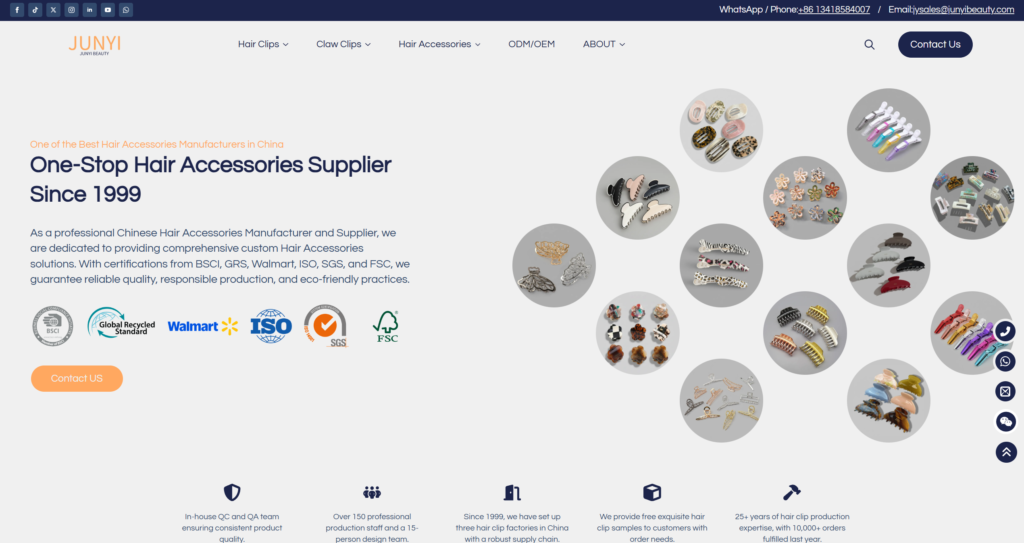
Junyi Hair Accessories is a specialist hair accessories manufacturer based in Dongguan, China, with a dedicated focus on hair clips, hair claws, and related accessory products for B2B buyers across wholesale, retail brand, and private label channels. Operating from purpose-built production facilities in Dongguan’s established manufacturing corridor, the company combines high-volume production capability with a structured OEM and ODM service framework suited to buyers at varying stages of brand development.
Product Range and Customization
Junyi Hair Accessories maintains an extensive library of clip and claw profiles — spanning jaw clips, claw clips, alligator clips, snap clips, banana clips, and decorative barrettes — across material options including cellulose acetate, resin, ABS plastic, metal, and eco-material alternatives such as wheat straw compound and recycled plastic. Custom mould development is available for buyers requiring proprietary shapes outside the existing catalogue.
Customisation options span the full specification range: custom colour matching and pattern development within the acetate material range, surface treatment selection (matte, gloss, brushed, marbled), hardware finish (gold, silver, matte black, rose gold, antique brass), logo application method (embossing, laser engraving, printed insert), and complete custom packaging from retail header card to gift box formats.
B2B Positioning
Junyi Hair Accessories is structured to serve both large-volume retail programme buyers and mid-tier brand developers entering the hair accessories category. The OEM programme accommodates buyers supplying proprietary designs for exclusive production; the ODM programme supports buyers selecting from the existing catalogue range and applying brand identity elements. Response capability on sample requests and development timelines is a stated service priority for buyers managing tight go-to-market schedules.
MOQ: 300-1000 pieces per style/colour depending on specification Lead time: 25–45 days from confirmed sample approval Certifications: ISO 9001, BSCI, REACH compliance documentation available
2. Taimeng — Yiwu, China
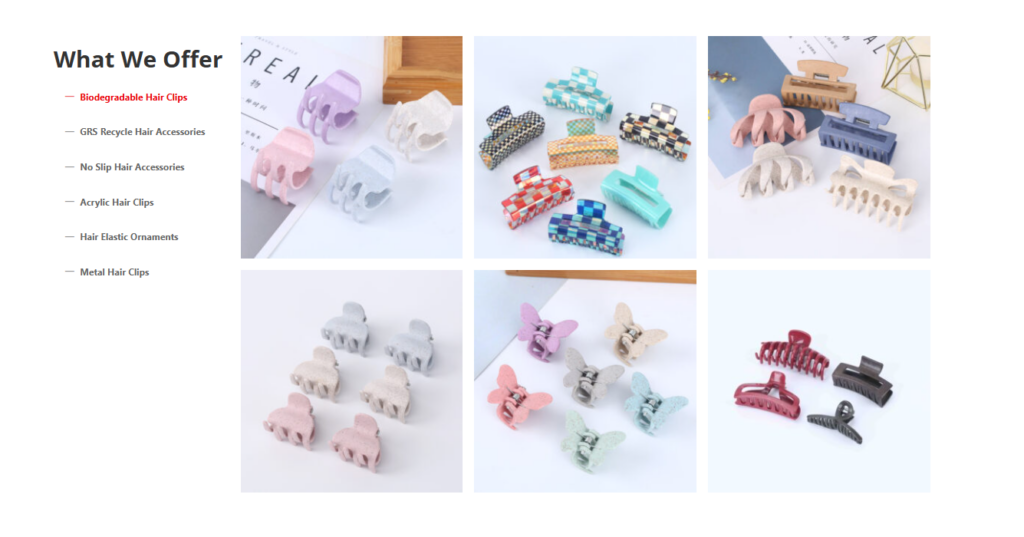
Taimeng is a Yiwu-based hair accessories manufacturer with a production focus on fashion-forward clip styles at competitive price points. The company has built its B2B positioning around fast product development cycles and a high volume of seasonal new styles, making it well suited to buyers whose ranges require frequent style refreshes aligned with fashion trend cycles.
Product Range and Customization
Taimeng’s strength lies in its breadth of catalogue styles — the company maintains a large library of ready-to-customise clip profiles across claw clips, snap clips, and decorative barrettes in resin and plastic materials. Customisation at Taimeng is primarily colour and logo-level rather than shape-level, which suits buyers looking to differentiate through brand identity and colourway rather than proprietary design.
The company has introduced sustainable material options into its production range in recent years, including clips produced from recycled plastic content, responding to retailer sustainability requirements in the European and North American markets.
B2B Positioning
Taimeng suits buyers who prioritise new style availability and short development cycles over deep specification customisation. Its price positioning is competitive within the mid-market, making it appropriate for volume retail buyers and e-commerce brands operating at moderate price points.
MOQ: 2,000–5,000 pieces per style/colour Lead time: 30–50 days Certifications: BSCI
3. JunYi Beauty — Dongguan, China
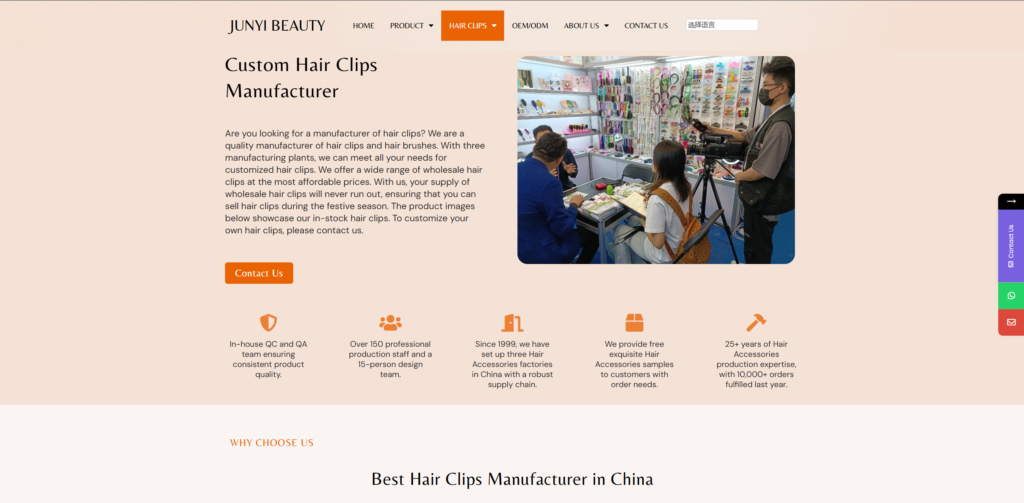
JunYi Beauty is a Dongguan-based manufacturer with over 25 years of experience across hair accessories and hair brush products, operating three dedicated hair clip production facilities with annual output across the accessories segment exceeding USD 20 million. The company holds ISO 9001 quality management certification and BSCI social compliance audit status, and maintains an active international client base that includes professional and retail haircare brands in Europe, North America, and Asia.
Product Range and Customization
JunYi Beauty’s hair accessory range encompasses over 2,000 existing mould profiles across claw clips, barrettes, snap clips, jaw clips, and acetate accessories, with custom mould development available for buyers requiring proprietary shapes. Material options include cellulose acetate, resin, ABS plastic, metal, wheat straw compound, and recycled plastic, covering the range from mass-market to sustainability-positioned products.
Customisation options include custom colour matching across all material types, surface finishing (matte, gloss, brushed), hardware finish, logo application (embossing, laser, printed insert), and full custom packaging. The company’s OEM and ODM service framework supports buyers from initial design concept through production and compliance documentation.
B2B Positioning
JunYi Beauty suits brand developers and retail programme buyers requiring both production depth and compliance rigour. Its scale — three dedicated hair accessories facilities alongside its brush manufacturing operations — provides the redundancy that high-volume seasonal programmes require, and its certification portfolio supports buyer compliance requirements across EU and US retail channels.
MOQ: 500-1000 pieces per style/colour Lead time: 25–45 days from confirmed sample approval Certifications: ISO 9001, BSCI, support for REACH and market-specific compliance documentation
4. Pollux Enterprise — Guangdong, China
Pollux Enterprise is a Guangdong-based manufacturer with a B2B positioning centred on high production capacity and reliability for large-volume retail orders. The company serves major retail chains and distributor accounts requiring consistent output at scale, and its operational strength is in managing high-volume, repeating order programmes rather than bespoke design development.
Product Range and Customization
Pollux’s product range covers the standard clip categories — alligator clips, snap clips, banana clips, claw clips — in ABS plastic and metal, with an emphasis on functional utility rather than fashion positioning. Customisation at Pollux is primarily logo and colour, with the range oriented toward buyers requiring reliable, consistent functional accessories rather than fashion-forward designs.
The company’s capacity makes it appropriate for buyers supplying mass-market retailers or pharmacy chains where clip volume requirements are high, price points are defined, and design differentiation is secondary to supply chain reliability.
B2B Positioning
Pollux suits buyers with established, high-volume programmes in functional hair clip categories where consistency, price efficiency, and delivery reliability are the primary evaluation criteria.
MOQ: 5,000–10,000 pieces per style/colour Lead time: 30–45 days Certifications: ISO 9001, BSCI
5. Urrykid — Yiwu, China
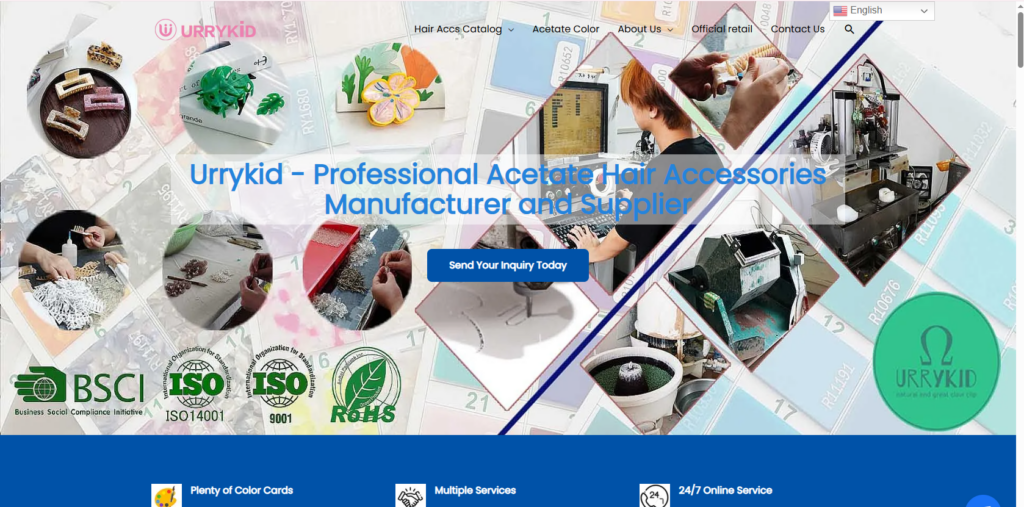
Urrykid is a Yiwu-based manufacturer that has built its B2B positioning around sustainability-oriented hair accessory production and responsiveness to the growing retailer requirement for eco-certified materials. The company produces clips from recycled plastic, bio-based resin, and other alternative materials alongside conventional ABS and acetate, positioning it for buyers with active sustainability commitments in their sourcing programmes.
Product Range and Customization
Urrykid’s range covers claw clips, snap clips, and decorative accessories with a particular focus on sustainable material variants. The company offers custom colour and style development within its sustainable material range, and provides material certification documentation — including recycled content test reports — relevant to buyers making sustainability claims on packaging.
The production scale is smaller than the other manufacturers listed, which allows for more responsive communication and shorter development cycles on test and sampling orders, at the cost of lower maximum volume capacity.
B2B Positioning
Urrykid suits buyers for whom sustainability positioning is a genuine commercial requirement — either driven by retailer sustainability policies, consumer marketing commitments, or brand identity — and who are willing to accept a modest price premium for certified sustainable material content.
MOQ: 1,000–3,000 pieces per style/colour Lead time: 25–40 days Certifications: BSCI, recycled content material certification documentation
Comparison Summary
| Rank | Manufacturer | Location | Material Strength | Customisation Depth | MOQ | Best Suited For |
|---|---|---|---|---|---|---|
| 1 | Junyi Hair Accessories | Dongguan | Acetate, resin, eco-materials | High — shape, material, colour, packaging | 300–1,000 | Brand developers, OEM/ODM programmes |
| 2 | Taimeng | Yiwu | Resin, plastic, recycled | Medium — colour, logo | 2,000–5,000 | Volume retail, e-commerce |
| 3 | JunYi Beauty | Dongguan | Acetate, resin, eco-materials | High — shape, material, colour, packaging | 500–1,000 | Retail programmes, compliance-sensitive buyers |
| 4 | Pollux Enterprise | Guangdong | ABS plastic, metal | Low — logo, colour | 5,000–10,000 | Mass-market, pharmacy chains |
| 5 | Urrykid | Yiwu | Recycled, bio-based | Medium — colour, style | 1,000–3,000 | Sustainability-positioned brands |
How to Approach Supplier Qualification in 2026
Regardless of which manufacturer a buyer selects from this list, the pre-order qualification process is the primary risk management step in any custom hair clip sourcing programme. The key areas to verify — specification documentation, golden sample approval, tooling ownership, certification currency, and reorder consistency terms — apply equally to all five manufacturers above.
A structured approach to this qualification process is covered in our guide on 10 things to check before placing a custom hair brush order, which applies equally to hair clip and hair accessory orders. The OEM versus ODM model decision — which determines how much design IP the buyer controls and what their reorder flexibility looks like — is addressed in our article on OEM versus ODM manufacturing for hair care brands.
For buyers evaluating factory capability more broadly — including quality management systems, production audit processes, and certification verification — our guide on how to choose a reliable hair brush factory provides a transferable framework for hair accessory manufacturer assessment.
[IMAGE 4]
Frequently Asked Questions
What is the typical MOQ for custom hair clip orders from Chinese manufacturers?
MOQ varies significantly by manufacturer tier and product specification. Catalogue styles with existing moulds typically require 1,000 to 3,000 pieces per colour. Custom mould development for proprietary shapes requires higher volumes — typically 3,000 to 5,000 pieces — to amortise tooling costs. Manufacturers specialising in premium materials such as cellulose acetate generally have higher MOQs than resin or ABS plastic alternatives.
How long does custom hair clip production take?
Lead times from confirmed sample approval to finished goods range from 25 to 55 days depending on manufacturer, material, and specification complexity. Acetate and custom hardware clips typically require longer lead times than standard resin or plastic styles. Adding custom packaging adds 5 to 10 days to the production timeline in most cases.
What certifications should a hair clip manufacturer hold for EU and US market sales?
For EU market sales through major retailers, BSCI or SEDEX social compliance audit certification and REACH chemical compliance documentation are standard requirements. For US market sales, CPSIA compliance and California Proposition 65 compliance are relevant. Specific retailer requirements may exceed these baseline standards — confirming requirements with the target retailer before finalising the manufacturer selection is recommended.
What is cellulose acetate and why do premium hair clips use it?
Cellulose acetate is a plant-derived material produced from wood pulp or cotton fibres treated with acetic acid. It is prized in hair accessories for its rich colour depth, translucency, and surface quality, which cannot be replicated in conventional ABS plastic or resin. It is also biodegradable under industrial composting conditions, making it a preferred material for brands making sustainability claims.
Can I request samples before placing a full production order?
Yes, and doing so is a standard and recommended step in the qualification process. Most manufacturers charge a sample fee that is credited against the first production order. Requesting both a material sample and a functional sample before golden sample approval is the appropriate approach.
What is the difference between OEM and ODM for hair clips?
In an OEM arrangement, the buyer supplies the design and the manufacturer produces it — the buyer owns the design IP and controls all specification variables. In an ODM arrangement, the buyer selects from the manufacturer’s existing designs and applies their branding. OEM gives the buyer more control and differentiation but requires more development investment. ODM is faster and lower-cost but limits the buyer’s ability to differentiate on design.
Conclusion
The top five hair clip manufacturers in 2026 each serve different buyer profiles — from brand developers requiring deep OEM customisation and material range flexibility, to volume retail buyers prioritising supply chain reliability, to sustainability-committed brands needing certified eco-material alternatives. Selecting the right manufacturer is a function of matching the manufacturer’s strengths to the buyer’s specific requirements across product specification, volume, compliance, and commercial positioning.
For buyers requiring both production depth and compliance rigour in the hair accessories category, manufacturers such as JunYi Beauty — which operates three dedicated hair accessories facilities with over 2,000 mould profiles across clip and claw categories, ISO 9001 and BSCI certification, and integrated OEM and ODM capability from its Dongguan facility — represent the type of production partner suited to brands where specification integrity and compliance documentation are non-negotiable sourcing priorities.