Wet Brush vs Tangle Teezer: Which Detangles Better?
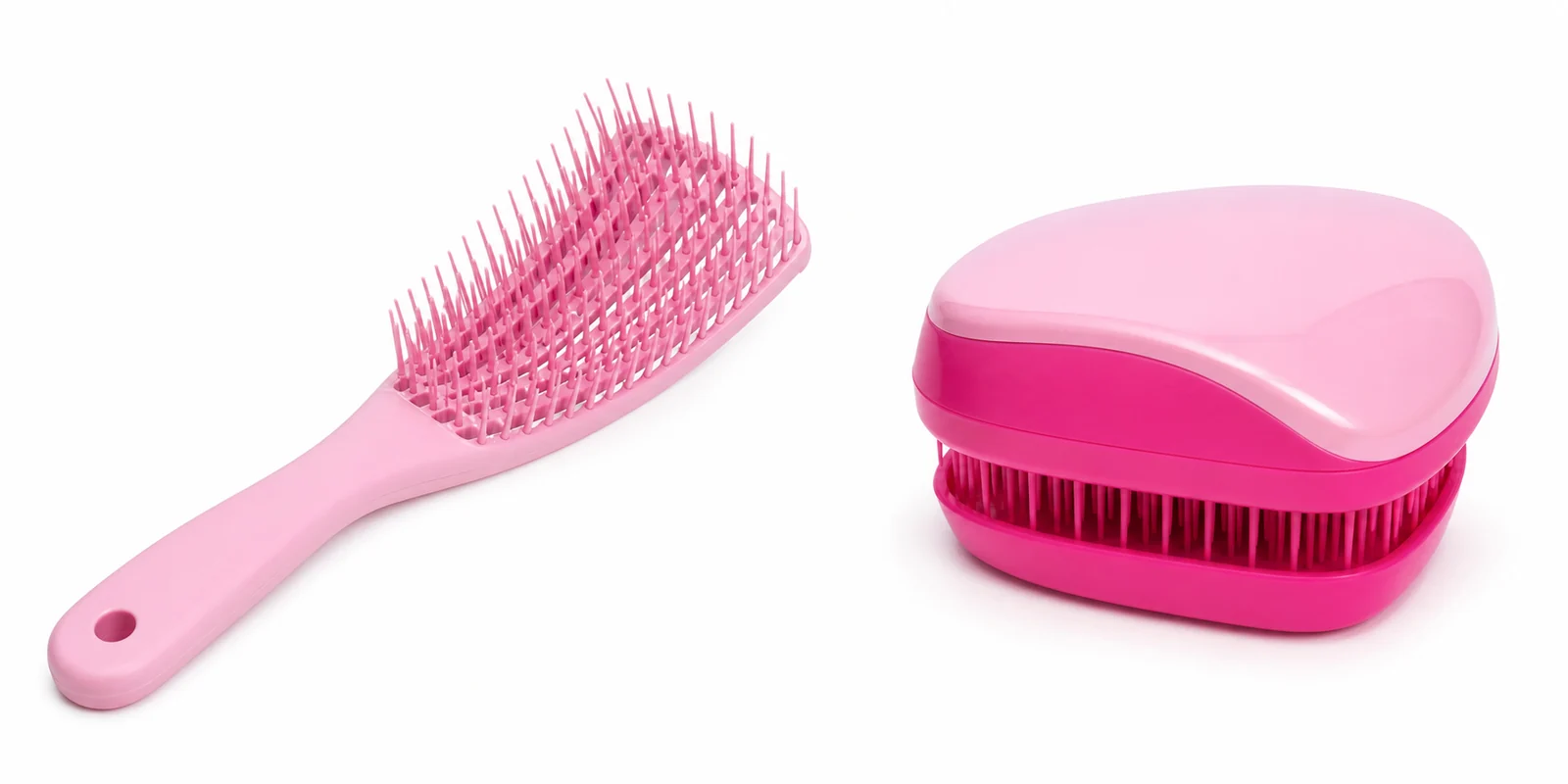
Wet Brush and Tangle Teezer are the two most recognised names in the detangling brush category, and both have built loyal followings on a similar premise: flexible bristles that work through knots without the breakage caused by rigid brushes. The two brands take genuinely different mechanical approaches to that shared goal, and the differences produce measurably different results depending on hair type, knot severity, and whether the hair is wet or dry.
This guide compares the two on bristle mechanics, detangling performance across hair types, wet versus dry use, durability, and price, so the choice can be based on how the tools actually behave rather than brand reputation alone. For the broader mechanics of why wet hair needs a different tool than dry hair, see our guide on whether it is bad to brush wet hair.
How Each Brush Is Built
Wet Brush’s IntelliFlex Bristle System
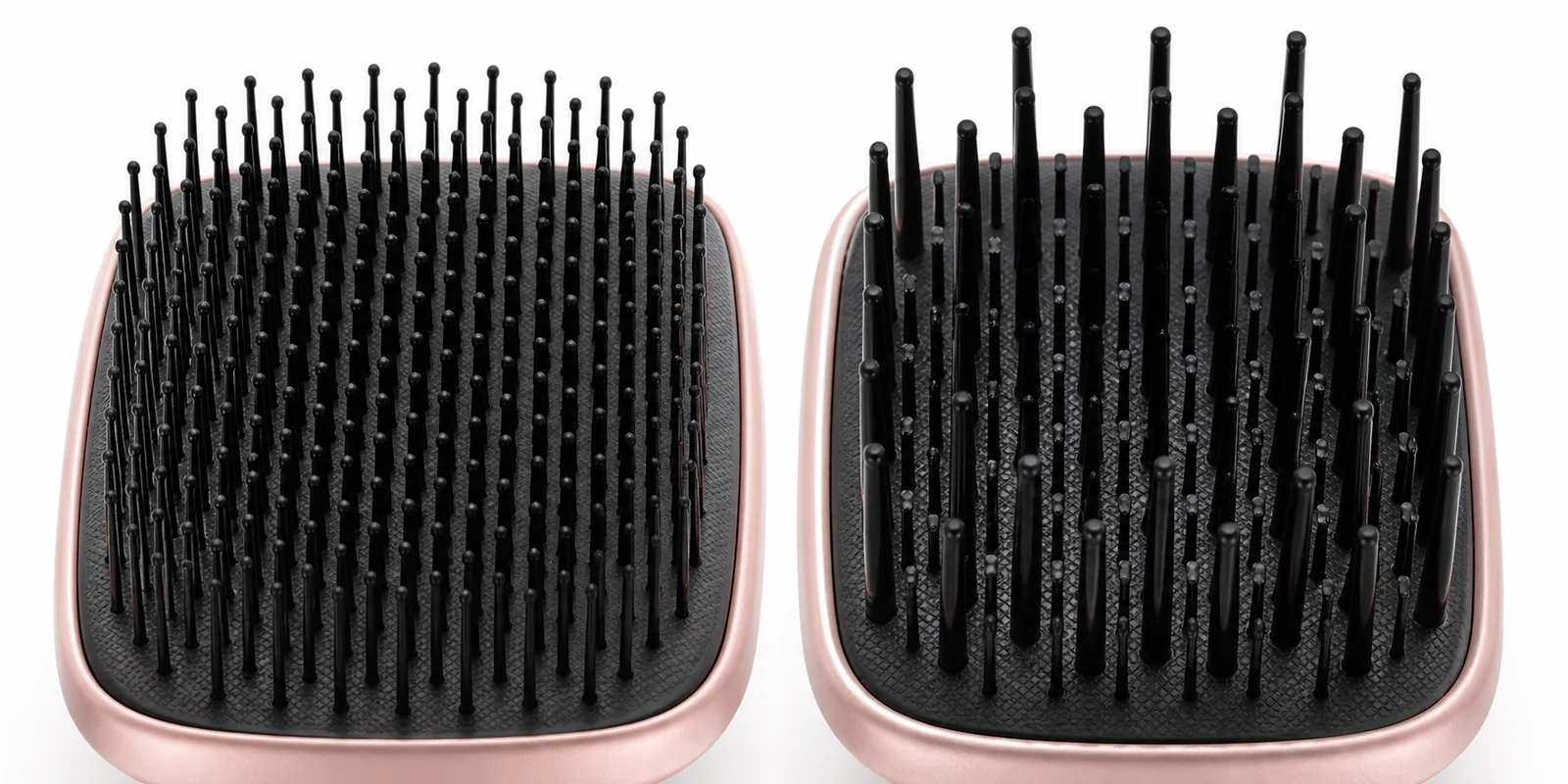
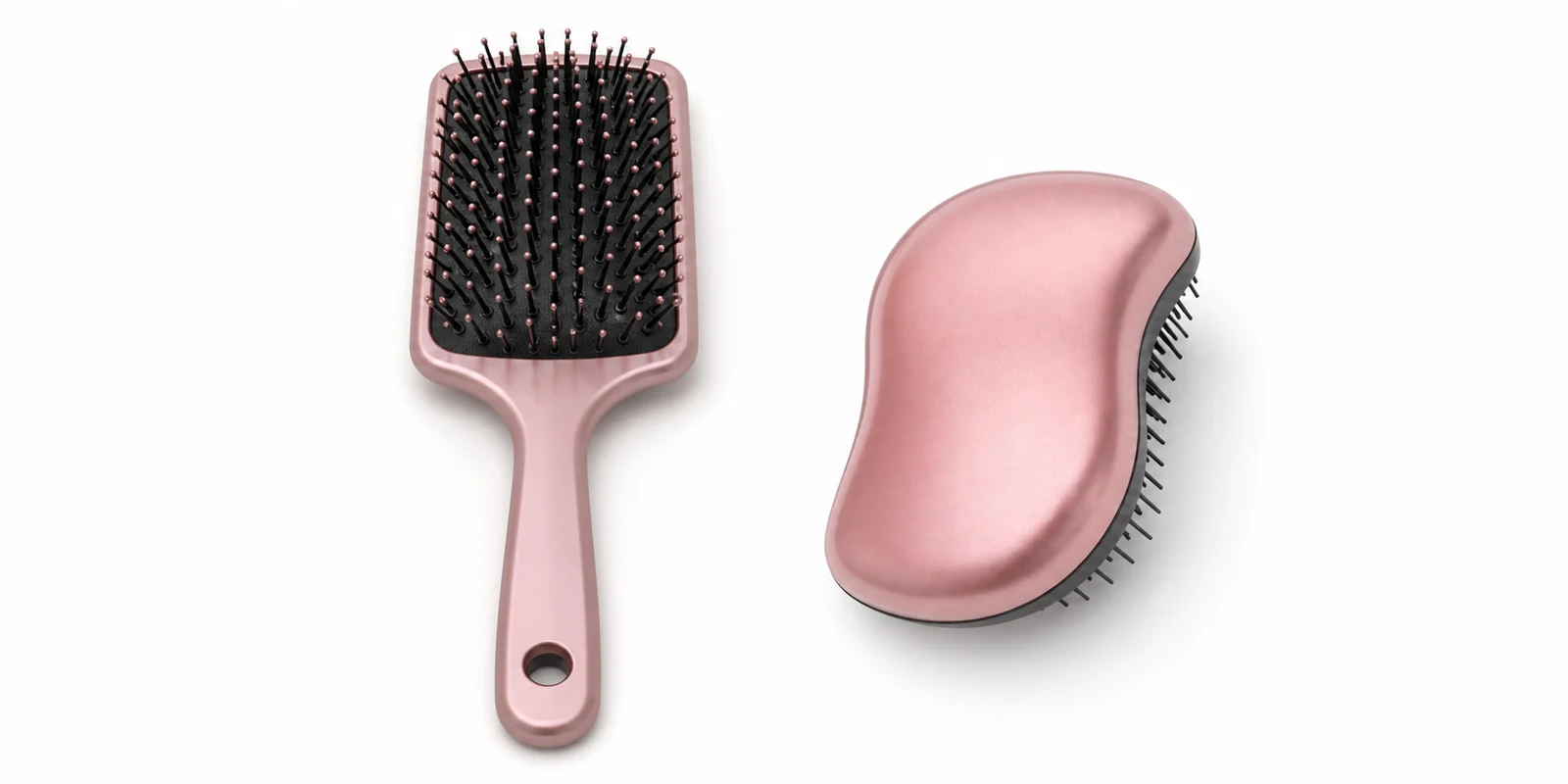
Wet Brush uses what it calls IntelliFlex bristles — thin, flexible nylon pins arranged in a dense, evenly spaced pattern set into a firm cushioned base. The individual pins are noticeably thinner and more pliable than standard nylon brush pins, allowing each one to bend independently as it meets resistance from a knot. The base cushion has minimal give compared to the bristle flex itself; most of the shock absorption happens at the pin level.
Tangle Teezer’s Two-Tier Bristle System
Tangle Teezer’s signature design uses a two-tier bristle configuration: longer teeth that penetrate through the outer layer of hair to reach tangles closer to the scalp, and shorter teeth that work through the surface layer at the same time. The teeth are firmer and less individually flexible than Wet Brush’s pins, but the two-tier height difference is designed to distribute detangling work across both layers of the hair mass simultaneously rather than relying on pin flex alone. Most Tangle Teezer models also have no handle — the brush head is held directly in the palm.
Detangling Performance by Hair Type
Fine and Thin Hair
Wet Brush’s finer, more flexible pins generally cause less pulling on fine hair, since each pin bends readily rather than dragging through a knot with resistance. Tangle Teezer’s firmer two-tier teeth can feel more aggressive on fine strands, particularly the longer under-layer teeth, though the brand’s “fine and fragile” model uses softer, more closely spaced teeth specifically calibrated for this hair type. Out of the box, standard Wet Brush models tend to be the gentler choice for fine hair; Tangle Teezer requires selecting the correct model variant to match. The broader specification framework for fine hair is covered in our guide on the best hair brush for fine and thin hair.
Medium Hair
Both brushes perform well on medium hair with typical knot levels. Wet Brush clears surface tangles quickly with its dense, even pin pattern. Tangle Teezer’s two-tier system has a slight edge on medium-to-thick sections because the longer teeth reach knots at the base of the section while the shorter teeth clear the surface in the same stroke, reducing the number of passes needed.
Thick and Coarse Hair
Tangle Teezer’s two-tier design shows its clearest advantage on thick hair. The longer under-layer teeth penetrate through dense sections to reach knots that Wet Brush’s more uniform pin height can struggle to access in a single pass, particularly at the nape and lower layers where hair mass is greatest. Wet Brush still detangles thick hair effectively, but often requires more repeated strokes to fully clear dense sections compared to Tangle Teezer.
Curly and Coily Hair
This is where the two diverge most in real-world reviews. Wet Brush’s flexible pins tend to glide through curl clumps without significantly disrupting curl pattern, which is why it is widely recommended for wash-day detangling on Type 3 and 4 hair when used on wet, conditioner-saturated sections. Tangle Teezer’s firmer, two-tier teeth can catch and separate curl clusters more aggressively, which some curly-hair users find produces more effective knot removal and others find disrupts curl definition more than they want. Both brands make curly-specific models with adjusted tooth spacing, and the standard model is not necessarily the right comparison point for this hair type. The general approach to detangling curly hair — wet, with product, and the appropriate tool — is covered in our guide on types of hair combs, which includes the wide-tooth comb alternative for very dense curl patterns.
Colour-Treated and Damaged Hair
Both brushes are commonly recommended for damaged or colour-treated hair over rigid alternatives, since flexible bristle reduces the mechanical stress that accelerates breakage on compromised cuticle. Wet Brush’s softer flex generally produces slightly less tension on fragile strands during detangling; Tangle Teezer’s firmer teeth clear knots faster but with marginally more pulling sensation on very fragile hair. For severely damaged hair, gentler is usually the better default, which favours Wet Brush, though the difference is smaller than the marketing around either brand suggests.
Wet Hair vs. Dry Hair Use
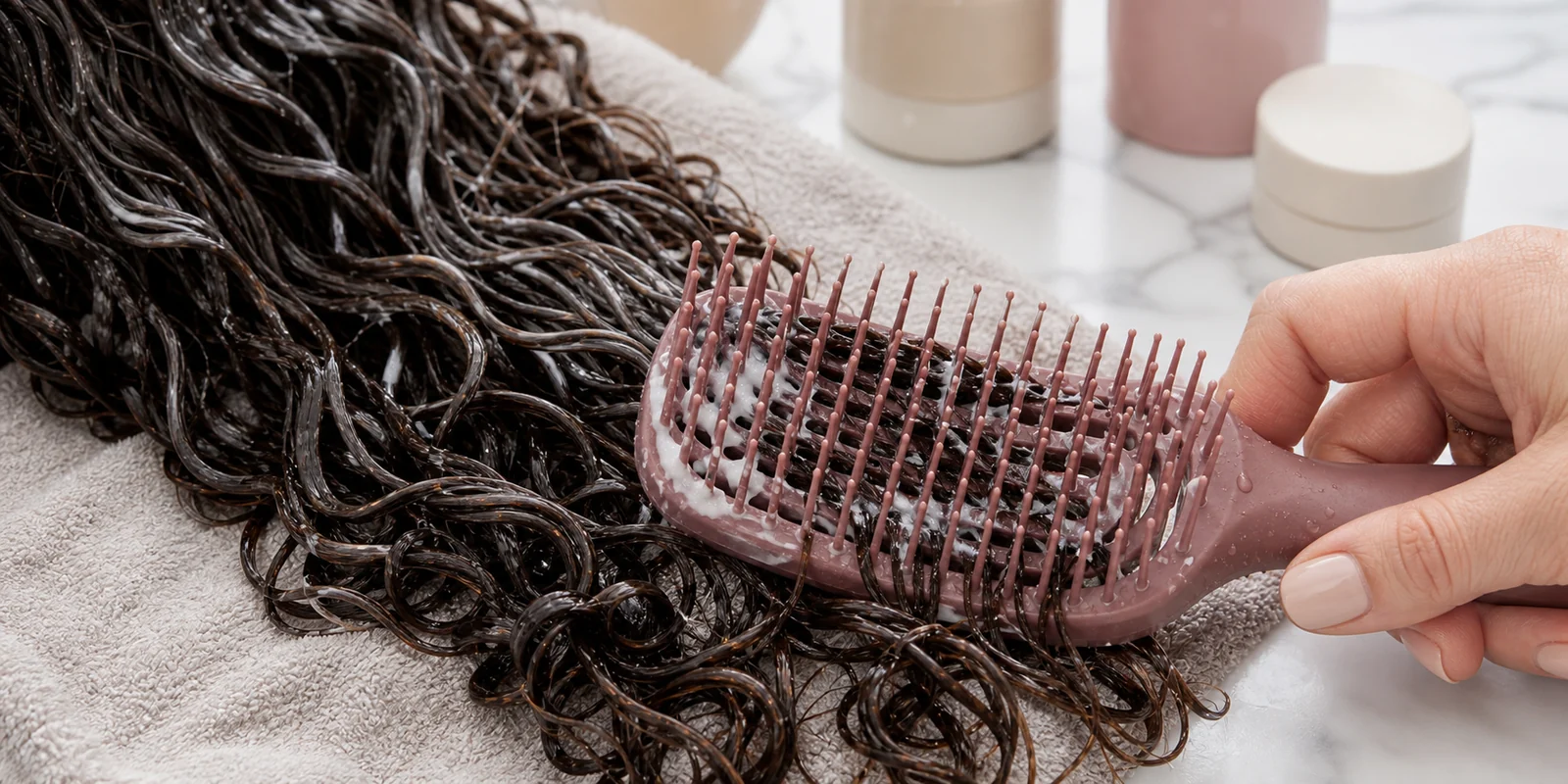
Both brushes are marketed for use on wet hair, which is the primary use case that separates this category from rigid boar bristle or hard nylon brushes. Neither brush is designed to replace a smoothing or finishing brush on dry hair — both are detangling tools first.
On wet hair: Both perform their intended function. Wet Brush’s flex reduces peak tension at each knot; Tangle Teezer’s two-tier system clears knots in fewer strokes. For soaking-wet, heavily tangled hair — the state hair is often in straight out of the shower — either is a significant improvement over a rigid brush, and the choice between them is closer to a matter of preference than a clear performance gap.
On dry hair: Both can be used on dry hair for light detangling, though the general principle that dry detangling carries somewhat lower risk than wet detangling for straight and wavy hair — and higher risk for curly hair — applies regardless of which of these two tools is used. The full wet-versus-dry framework is covered in our article on whether it is bad to brush wet hair.
Handle Design and Grip
Wet Brush models typically include a handle — either a standard paddle-style handle or, in some lines, no handle at all depending on the specific product. The handled versions give more leverage and control, particularly useful for parents detangling a child’s hair or for users with limited hand strength.
Tangle Teezer’s original and most popular models are handleless, designed to be held directly in the palm with the brush head cupped in the hand. This gives a close, controlled feel for precise section work but requires more wrist movement than a handled brush and can feel less natural to users accustomed to a traditional brush grip. Tangle Teezer does offer handled variants in some product lines for users who prefer the traditional grip.
Durability and Materials
Both brands use nylon bristle construction, and the pin material itself does not typically fail under normal use. The more common durability issue on both brands is bristle splaying or bending out of shape after extended heavy use, particularly on thick or consistently tangled hair where the pins absorb repeated flex stress.
Wet Brush’s cushioned base is generally reported as holding up well over time, with the bristle pattern remaining intact through months of regular use. Tangle Teezer’s firmer teeth are somewhat more prone to visible splaying on the longer under-layer teeth specifically, since these bear more of the mechanical load when working through dense sections. Neither issue is common enough to be a primary purchasing factor for most users, but it is worth noting for anyone detangling very thick or consistently knotted hair daily.
Price and Value
Wet Brush and Tangle Teezer sit in a similar price bracket at the retail level, both positioned above basic drugstore detangling brushes and below premium salon-exclusive tools. Wet Brush’s range includes more budget-accessible entry models alongside its premium lines; Tangle Teezer has maintained a more consistently premium price position across its range with less variation between entry and flagship models.
Neither brand represents poor value at typical retail pricing given the detangling performance and reduced breakage both deliver compared to rigid brushes. The price difference between the two brands at comparable product tiers is generally modest, and the choice is better made on the mechanical fit for your hair type than on price alone.
Which One Should You Choose
Choose Wet Brush if: your hair is fine to medium, you have curly or coily hair and want a gentler wash-day detangler, you prioritise the softest possible pull-through feel, or you want a handled grip option.
Choose Tangle Teezer if: your hair is medium to thick with frequent deep knots, you want fewer strokes to fully clear dense sections, or you prefer the compact handleless grip for precise section work.
For very tangled or matted hair regardless of brand: start with fingers or a wide-tooth comb to break up the worst of the tangle before introducing either brush, and always work from ends to roots with conditioner or detangling spray applied. Neither tool substitutes for correct technique — the mechanical advantage either brush offers is only realised when combined with gentle, sectioned, ends-first detangling.
Sourcing Considerations for B2B Buyers
For buyers evaluating detangling brush ranges, the Wet Brush and Tangle Teezer mechanical approaches represent two distinct, commercially proven specification directions rather than one being objectively superior to the other.
Uniform flexible-pin construction (the Wet Brush approach) suits ranges targeting fine-to-medium hair and curly-hair wash-day positioning, where gentleness is the primary claim. Pin gauge, density, and cushion base firmness are the key specification variables to calibrate for this approach.
Two-tier tooth height construction (the Tangle Teezer approach) suits ranges targeting medium-to-thick hair and faster single-pass detangling as the primary claim. Tooth height differential, tooth stiffness, and base rigidity are the key variables here.
Both approaches require the flexible or tapered tooth geometry that distinguishes genuine detangling brushes from standard nylon pin brushes — the pin engineering, not just the marketing category, determines whether a product actually reduces breakage relative to a rigid alternative. This distinction is covered in the wet-hair tool section of our guide on how to choose the right hair brush for your hair type.
Both flexible-pin and two-tier detangling brush formats, across handled and handleless configurations, are available through OEM and private label manufacturing routes, with pin gauge, tooth height, density, and base construction adjustable to range positioning requirements.
Frequently Asked Questions
Is Wet Brush or Tangle Teezer better for curly hair?
Wet Brush’s more flexible, uniform pins tend to glide through curl clumps with less disruption to curl pattern, making it a common wash-day recommendation for Type 3 and 4 hair. Tangle Teezer’s firmer two-tier teeth clear knots effectively but can separate curl clusters more aggressively. Both brands offer curly-specific model variants with adjusted tooth spacing that outperform their standard models on this hair type.
Which brush is gentler on fine hair?
Wet Brush’s thinner, more flexible pins generally produce less pulling on fine hair in standard models. Tangle Teezer’s “fine and fragile” variant uses softer, more closely spaced teeth calibrated specifically for fine hair and performs comparably to Wet Brush when that specific model is used rather than the standard version.
Can I use these brushes on wet hair every day?
Yes, both are designed primarily for wet-hair detangling and are a safer choice than rigid brushes for daily wet detangling. Using conditioner or a detangling spray for slip, working from ends to roots, and using gentle pressure remain important regardless of which brush is used.
Do Wet Brush and Tangle Teezer work on dry hair too?
Both can be used on dry hair for light detangling, though neither is designed as a dry-hair smoothing or finishing brush. For dry-hair maintenance and shine, a boar bristle or mixed bristle paddle brush is the more appropriate tool once knots have been cleared.
Which brush lasts longer?
Both hold up well under normal use. Wet Brush’s cushioned base and uniform pins are generally reported to maintain shape reliably over months of regular use. Tangle Teezer’s longer under-layer teeth are somewhat more prone to visible splaying under heavy daily use on thick hair, though this is not a common complaint at typical use levels for either brand.
Is a detangling brush better than a wide-tooth comb for curly hair?
For most curly hair, a wide-tooth comb applies force to fewer strands per pass than even a flexible detangling brush, making it the lower-risk option for very dense or heavily matted curl patterns. A flexible detangling brush like Wet Brush is a reasonable middle ground for curly hair that is only moderately tangled. The choice often comes down to knot severity and personal preference rather than one tool being universally correct.
Conclusion
Wet Brush and Tangle Teezer solve the same problem — detangling without the breakage caused by rigid brushes — through genuinely different bristle engineering. Wet Brush’s uniform, highly flexible pins favour gentleness and suit fine, medium, and curly hair particularly well on wash day. Tangle Teezer’s two-tier tooth height favours detangling efficiency on medium-to-thick hair with frequent deep knots. Neither is a universal winner; the right choice depends on hair type, knot severity, and how much you value a soft pull-through feel versus fewer strokes to clear a section.
For brands building detangling brush ranges around either mechanical approach — or offering both to serve a broader hair-type spread — manufacturers such as JunYi Beauty, which produces flexible-pin and two-tier detangling brush formats with configurable pin gauge, tooth height, and base construction from its Dongguan facility, represent the type of OEM partner suited to ranges built on genuine detangling mechanics rather than category labelling alone.