Heat resistance in hair brushes is one of the least understood specification variables in the category, and one of the most consequential for consumers who blow-dry, straighten, or heat-style regularly. A brush that lacks appropriate heat resistance in the components most exposed to hot air or contact with heated tools will degrade, melt, warp, or off-gas under normal use conditions — reducing the brush’s effective lifespan, potentially transferring residue to the hair, and in some cases exposing the user to plastic decomposition byproducts.
For consumers making purchase decisions about styling brushes, and for B2B buyers building hair brush ranges that include blow-dry brushes, round brushes, or heat-styling tools, understanding which materials genuinely resist heat and which are marketed as heat-resistant without meeting the underlying specification is critical to both product performance and consumer safety.
Why Heat Resistance Matters in Hair Brush Design
Heat exposure in normal styling use ranges from moderate to substantial. A domestic hair dryer typically produces air temperatures of 60–110°C at the nozzle. Professional blow-dryers reach higher — 120–140°C at maximum settings. Flat irons and curling irons reach 180–230°C on their heated surfaces, and brushes used near or in contact with these tools during styling may experience temperatures approaching the surface temperature of the styling appliance.
For brushes used exclusively for cold styling — daily maintenance brushing, dry finishing without heat — heat resistance is not a relevant variable. Bristle type, cushion base, and mechanical performance matter far more than heat tolerance.
For brushes used during blow-dry styling, however — round brushes, paddle brushes used with a dryer, and blow-dry brush hybrids — heat resistance becomes a functional specification that determines both the brush’s lifespan and its safety in normal use. A round brush barrel that softens or warps at 100°C is not fit for purpose regardless of its cosmetic appearance or bristle configuration.
Where Heat Resistance Matters in a Brush
Different components of a brush experience different thermal loads during use, and the heat resistance requirement for each is different.
Bristle Material
Bristle experiences the highest sustained heat exposure during blow-dry styling because it is in direct contact with the hair section being dried and closest to the airflow. Natural boar bristle tolerates moderate heat well but can singe or become brittle under sustained exposure to high blow-dryer temperatures. Standard nylon bristle softens at approximately 80–100°C and can deform permanently under professional-grade blow-dryer heat. Heat-resistant nylon variants — specifically formulated for thermal styling applications — maintain shape and stiffness up to 150–180°C.
For round brushes and blow-dry brushes, bristle heat resistance is one of the most functionally important specification variables. Bristle that deforms under heat produces uneven tension during styling, which translates directly to uneven styling results and a compromised styling experience.
Barrel and Base Material
The brush barrel or base — the structural body that holds the bristles — is exposed to conducted heat from the bristles and radiant heat from the surrounding air. For round brushes, the barrel is particularly exposed because it sits within the airflow of the dryer during use.
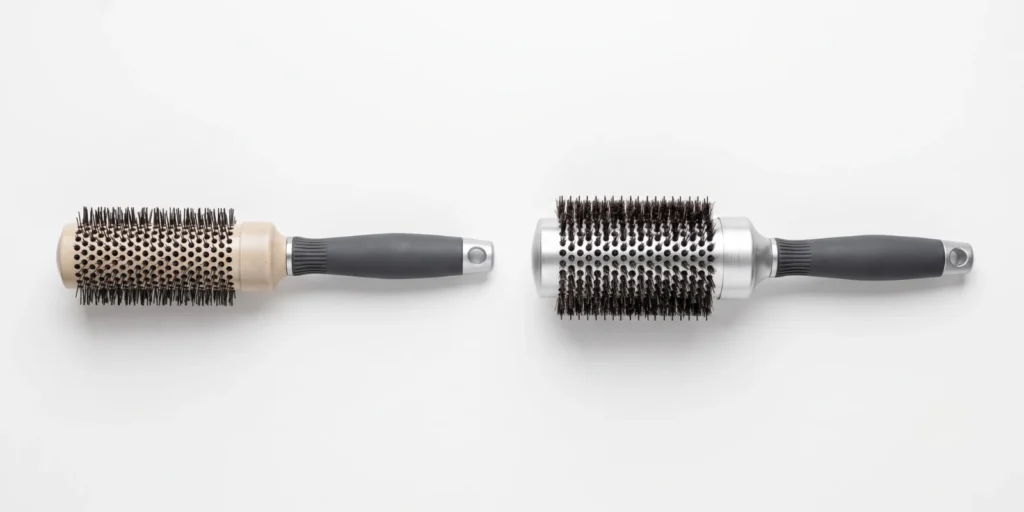
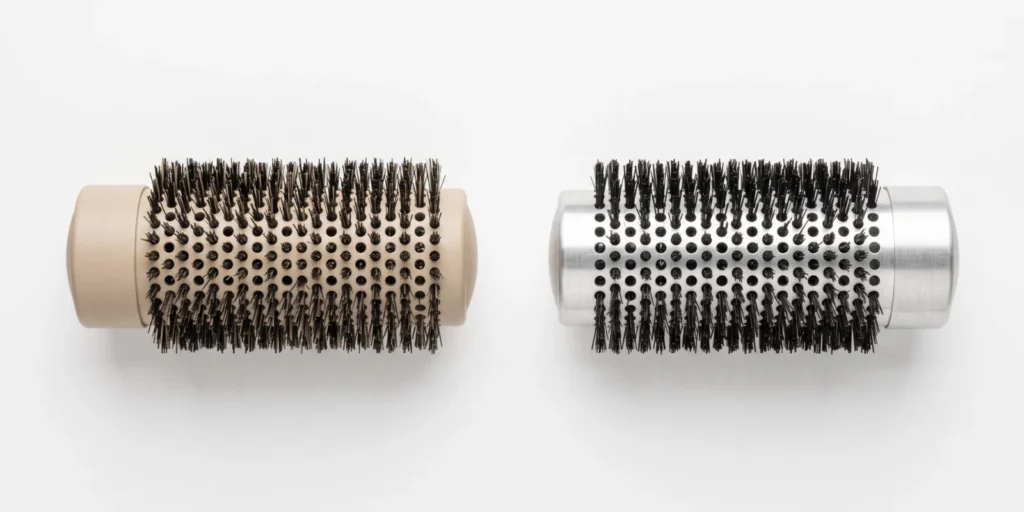
Standard ABS plastic (a common cost-efficient plastic used in general-purpose brushes) has a heat deflection temperature of approximately 80–100°C. This is inadequate for professional-grade blow-dry use, where sustained temperatures at the brush surface routinely exceed this range. Ceramic barrels, aluminium barrels, and heat-resistant thermoplastic composites are the appropriate material specifications for round brushes intended for blow-dry styling.
Handle Material
Handle material typically experiences the lowest heat exposure because the user’s hand is between the styling appliance and the handle. However, handles used in professional styling environments — where multiple heat sources may be in close proximity for extended periods — should also meet heat resistance requirements to prevent handle degradation and thermal transfer to the user’s hand.
Wooden handles have naturally good heat resistance. Aluminium handles conduct heat rapidly and can transfer heat to the user’s hand at professional temperatures. Heat-resistant polymer handles balance thermal insulation and grip texture.
Materials Genuinely Suited to Heat Styling
Ceramic
Ceramic is one of the most heat-resistant materials used in hair brush manufacturing. Ceramic barrels and ceramic-coated components tolerate temperatures well above the maximum output of consumer blow-dryers, and they distribute heat evenly across the contact surface — reducing the risk of localised over-heating that damages the hair cuticle.
Ceramic barrels in round brushes are also thermally retentive — they absorb heat from the dryer and continue to transfer that heat to the hair section after the dryer has moved past. This provides more efficient blow-dry styling with less total heat exposure to any given hair section.
The tradeoff is that ceramic components add cost and weight to the brush. For premium round brushes, this cost is justified by the performance benefit. For entry-level brushes, ceramic-coated components — where a plastic core is coated with a ceramic surface — provide some of the heat distribution benefit at reduced cost, though with less thermal retention than solid ceramic.
Tourmaline
Tourmaline is a mineral incorporated into some heat-styling brushes for both its ion-emitting properties (covered in our article on what ionic hair brushes actually are) and its heat tolerance. Tourmaline-infused ceramic composites tolerate professional blow-dryer temperatures without degradation and add the ionic emission benefit under heat activation.
For premium round brushes and blow-dry brushes positioned around ionic performance, tourmaline-ceramic composite barrels are the specification that delivers on both the heat resistance and ionic emission claims.
Aluminium
Aluminium barrels are widely used in professional round brushes because aluminium has excellent heat conduction and heat retention properties. An aluminium barrel heats up quickly under blow-dryer airflow and transfers heat efficiently to the hair section — creating a more effective styling result with less total dryer exposure time.
The tradeoff is that aluminium heats faster than the user’s hand may find comfortable during extended styling sessions, and aluminium barrels can retain heat for some time after the dryer has been switched off. Professional stylists tolerate this; consumer users may find it unfamiliar.
Heat-Resistant Nylon (Heat-Set Nylon)
For bristle applications, heat-resistant nylon — specifically formulated to maintain stiffness and shape under elevated temperatures — is the appropriate specification for round brushes and blow-dry brushes. Standard nylon (unspecified grade) softens at temperatures reached during normal blow-dry use; heat-set nylon maintains functional stiffness up to 150–180°C.
When specifying bristle for heat styling applications, requesting “heat-resistant nylon” rather than accepting generic “nylon” is a meaningful distinction. Manufacturers using generic nylon in products marketed for heat styling produce brushes that degrade rapidly under actual use conditions.
Natural Boar Bristle (Moderate Heat)
Natural boar bristle tolerates moderate heat well — the keratin protein composition is thermally stable at temperatures up to approximately 130–150°C. Sustained exposure above this range causes the bristle to become brittle and singed. For round brushes used in domestic blow-dry styling at moderate temperature settings, boar bristle performs well; for professional-grade heat styling at maximum settings, mixed bristle with heat-resistant nylon pins alongside the boar bristle is often the more appropriate specification.
Materials That Are Not Suitable for Heat Styling
Understanding which materials to avoid is as practically important as knowing which to select.
Standard Injection-Moulded ABS Plastic
ABS plastic (Acrylonitrile Butadiene Styrene) is the dominant material in general-purpose consumer hair brushes because of its cost, mouldability, and impact resistance. It is not appropriate as the primary barrel or base material for brushes intended for heat styling. Its heat deflection temperature (80–100°C) is below the sustained temperatures reached during normal blow-dry use, and it will soften, warp, and eventually deform under repeated heat exposure.
Brushes marketed for heat styling with ABS barrels rely either on the brief nature of contact heating (accepting that the brush will degrade over time) or on user misuse tolerance rather than genuine specification integrity. For durable, functional heat-styling brushes, ABS is not the appropriate barrel material.
PS (Polystyrene) Plastic
Polystyrene is less commonly used in hair brushes but appears in some cheaper products. It has lower heat resistance than ABS (heat deflection around 70–95°C) and is even less suitable for heat styling applications. It also becomes brittle under thermal cycling. Any brush with a polystyrene barrel or base should not be used for heat styling regardless of marketing claims.
Standard Rubber Handle Grips
Rubber grips used on some brush handles for improved grip may degrade under sustained thermal exposure. For brushes intended for heat styling, silicone-based grip materials (which have significantly better heat tolerance than rubber) are the appropriate specification.
Untreated Wooden Handles Near Flame or Extreme Heat
Wooden handles have naturally good heat resistance in normal blow-dry use, but untreated or lacquered wooden handles used in extreme proximity to flat irons or curling irons at maximum temperatures can experience surface finish degradation or, in rare cases, ignition risk with fine wood dust or splinters at localised high heat.
For professional styling brushes used near very hot appliances, heat-treated or specifically finished wooden handles — or heat-resistant polymer alternatives — are the appropriate specification.
Identifying Genuinely Heat-Resistant Brushes
For consumers evaluating heat-styling brushes, several specification indicators distinguish genuinely heat-resistant products from those marketed as such without meeting the underlying specification.
Ceramic, Aluminium, or Tourmaline Barrel Specification
Round brushes and blow-dry brushes with barrels explicitly specified as ceramic, aluminium, or tourmaline-ceramic composite meet the barrel heat resistance requirement. Products where the barrel material is unspecified or described only as “professional” or “heat-resistant” without material detail are likely to be standard plastic.
Heat-Resistant Nylon Bristle Specification
Bristle specified as “heat-resistant nylon,” “heat-set nylon,” or “thermal-resistant nylon” indicates a genuine heat tolerance specification. Products where bristle is described only as “nylon” without qualification are typically standard grade.
Manufacturer Documentation
For B2B buyers and discerning consumers, requesting the maximum operating temperature rating for the specific product provides objective specification detail. Manufacturers who cannot provide this detail — or who provide vague responses — are typically working with materials that do not have specific thermal ratings.
Weight and Feel
Ceramic, aluminium, and tourmaline-composite barrels are noticeably heavier than plastic barrels of equivalent size. A “professional round brush” that feels notably light for its size is likely to have a plastic barrel regardless of marketing description.
Brand Positioning and Price Position
Genuinely heat-resistant styling brushes with quality material specifications generally command higher price points than general-purpose consumer brushes. Extreme value pricing on products marketed as professional heat-styling tools should be treated skeptically — the material cost differential between standard plastic and genuine heat-resistant components makes true premium performance at budget pricing structurally difficult.
Heat Resistance in Combined Products
Some brush categories combine heat resistance requirements with other specifications:
Ionic Hot Air Brushes (One-Step Brush Dryers)
Combined dryer and round brush products generate heat directly from the tool itself. The bristle, barrel, and internal components must all meet heat resistance specifications appropriate to the maximum output temperature of the built-in heating element. Consumers purchasing these products should confirm that specification detail matches marketing claims — an ionic hot air brush with a plastic barrel and standard nylon bristle will degrade quickly under actual use.
Straightening Brushes
Electrically heated straightening brushes have heated plates or bristles that reach flat iron temperatures (up to 230°C). These are appliances rather than passive brushes, and every component in contact with the heat source must be specifically rated for those temperatures. Consumer safety considerations apply — these products should carry appropriate electrical safety certifications for the target market alongside heat resistance specifications.
Blow-Dry Brushes with Wet-Hair Rating
Some blow-dry brushes are rated for use on wet or damp hair. Wet-hair use combined with heat exposure creates additional stress on materials — thermal cycling between wet contact and heat can accelerate degradation in materials not specifically rated for this use pattern. Products used regularly on wet hair during blow-drying should carry specific wet-heat cycle ratings.
The general framework for wet-hair brushing risks and appropriate tool selection is covered in our article on whether it is bad to brush wet hair — heat resistance is one specification dimension, and the wet-hair mechanical vulnerability of the hair itself is a separate consideration that applies regardless of tool specification.
Sourcing Considerations for B2B Buyers
For buyers building heat-styling brush ranges, the material specification decisions determine both the performance credibility of the product at retail and the returns and complaints profile over the product lifecycle.
Barrel Material Specification
For round brushes and blow-dry brushes, the barrel material should be explicitly documented in the specification sheet — ceramic, aluminium, tourmaline-ceramic composite, or a specific heat-resistant thermoplastic with documented heat deflection temperature. Accepting a general “plastic barrel” specification for products marketed as heat-styling tools produces the durability and performance failures that generate returns.
Bristle Grade for Heat Applications
Bristle for heat-styling brushes should be specified as heat-resistant nylon (with documented heat rating) or, for boar bristle applications, appropriate grade for the intended temperature range. Boar-nylon mixed bristle for heat styling should combine appropriate boar grade with heat-resistant nylon pins — not standard bristle grades that will degrade under normal use conditions.
Certification and Safety Compliance
Heat-styling brushes are subject to the same chemical safety compliance requirements as other hair brushes — REACH, Proposition 65 — with additional considerations around off-gassing under heat. Some plastics that meet chemical safety compliance at room temperature may release restricted compounds under sustained thermal exposure. Material selection should account for both baseline compliance and thermal cycling behaviour. The certification framework is covered in our article on hair brush safety certifications.
For electrically heated products (straightening brushes, hot air brushes with integrated heating), electrical safety certifications specific to the target market apply — CE marking for EU, ETL or UL for US, and market-specific requirements elsewhere. These are separate from the material heat resistance specification and both are required for compliant product placement.
Positioning and Claim Accuracy
Marketing claims about heat resistance should reflect the actual specification of the product. Claims of “professional heat-resistant” performance on products with standard ABS barrels and unspecified nylon bristle create the expectation mismatches that drive negative reviews and regulatory challenge in markets with active consumer protection enforcement. Defensible positioning references specific material specifications and documented operating temperature ranges rather than general performance claims.
Both heat-resistant round brushes and blow-dry brush formats with appropriate barrel and bristle specifications are available through OEM and private label manufacturing routes, with barrel material, bristle grade, and handle construction adjustable to range positioning requirements.
Frequently Asked Questions
Can I use any brush during blow-drying?
No. Standard consumer brushes with ABS plastic barrels and unspecified nylon bristle are not designed for sustained heat exposure and will degrade under normal blow-dry use. For blow-drying specifically, brushes with ceramic, aluminium, or tourmaline-composite barrels and heat-resistant nylon or boar bristle are appropriate. Using a non-heat-rated brush during blow-drying accelerates its degradation and may transfer decomposition residue to the hair.
What temperature does a hair brush need to withstand for blow-drying?
Domestic hair dryers produce air temperatures at the nozzle of 60–110°C. Professional dryers reach 120–140°C. A brush intended for domestic blow-dry use should tolerate sustained exposure to at least 100–110°C without deformation. A brush intended for professional use should tolerate at least 130–150°C. Ceramic and aluminium components typically exceed these requirements by a large margin.
Is ceramic better than aluminium for a round brush?
Both are appropriate heat-resistant materials with different performance characteristics. Ceramic heats more gradually and retains heat longer, producing efficient styling with slower brush temperature rise. Aluminium heats rapidly and transfers heat efficiently but also cools more quickly when the dryer is not directed at it. Both perform well in professional use; the choice is one of styling preference rather than clear performance superiority.
Can heat damage a boar bristle brush?
Yes, at sustained high temperatures. Boar bristle tolerates moderate blow-dry heat well but becomes brittle and singed under sustained exposure at high professional-grade settings. For consumers using boar bristle round brushes with domestic dryers at moderate settings, degradation is slow. For professional use or maximum-setting domestic use, mixed bristle with heat-resistant nylon alongside boar is often the more durable specification.
How can I tell if a hair brush is genuinely heat-resistant?
Check for specific material specifications rather than general marketing claims. Ceramic, aluminium, or tourmaline-composite barrels are genuinely heat-resistant. Heat-resistant nylon bristle (specified as heat-set or thermal-resistant) is genuinely rated for heat use. Weight is a practical indicator — heat-resistant components are heavier than plastic equivalents. Manufacturer or brand-provided operating temperature specifications are the most objective indicator of genuine heat tolerance.
What happens if I use a non-heat-resistant brush with a hair dryer?
The brush will degrade over time under sustained heat exposure. Standard plastic barrels may soften and warp, changing shape and losing structural integrity. Standard nylon bristle may deform, losing stiffness and producing uneven tension during styling. In extreme cases, plastic decomposition may release small amounts of residue or compounds under heat. The brush lifespan is significantly reduced compared to a properly heat-resistant equivalent used in the same application.
Conclusion
Heat resistance in hair brushes is not a single specification — it is a set of material choices across bristle, barrel, and handle that together determine whether a brush will perform reliably under heat exposure. Ceramic, aluminium, and tourmaline-ceramic composite barrels combined with heat-resistant nylon or appropriately-graded boar bristle produce brushes that meet the demands of daily blow-dry styling and professional heat use. Standard ABS plastic and unspecified nylon do not, regardless of how the product is marketed.
For consumers investing in heat-styling brushes, the material specification is worth the additional cost — durable performance and safety in normal use justify the premium over budget alternatives that will degrade quickly. For brand developers and B2B buyers building heat-styling brush ranges, the specification integrity of the range determines both retail credibility and long-term brand reputation in a category where consumer expectations are set by the marketing claim and delivered by the underlying material.
Manufacturers such as JunYi Beauty, which produces round brushes and blow-dry brushes with configurable ceramic, aluminium, and tourmaline-composite barrel options combined with heat-resistant nylon and mixed boar bristle specifications from its Dongguan facility, represent the type of OEM partner suited to brands where heat-styling performance is a core product claim rather than a marketing extension of general-purpose brush specifications.