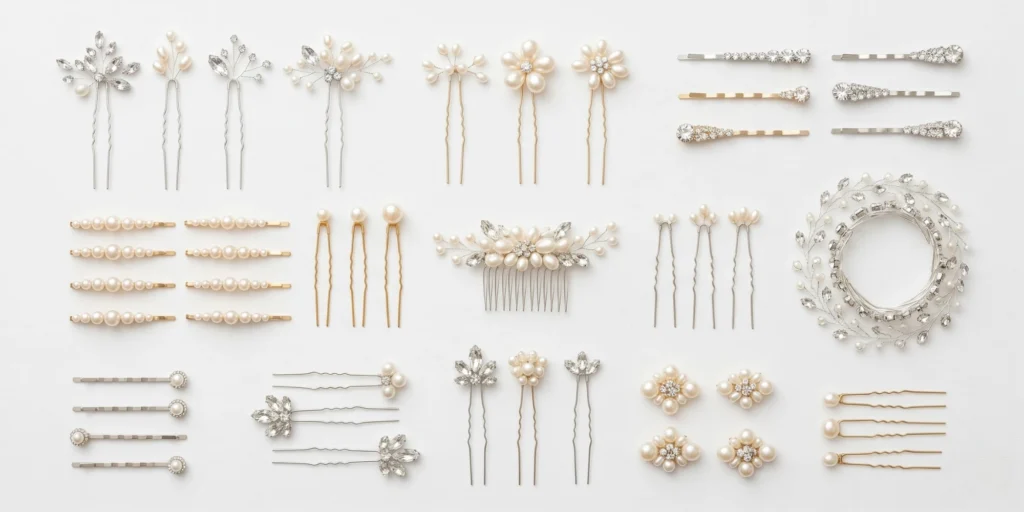
A wedding updo is a structured bridal hairstyle that uses pins, clips, elastics, and styling products to hold the hair in place for several hours. The number of hair pins needed for a wedding depends on hair length, hair density, the updo structure, the type of pins used, and whether the style includes extensions or accessories.
For simple reference, many wedding updos use around 20–40 hair pins, while thicker hair, braided structures, and low chignons may require 40–70 pins. Consumers often search for how many hair pins for wedding styling because loose sections, visible pins, or scalp discomfort can affect the final result.
For buyers comparing bridal accessories, hair pins are also part of a broader category of hair clips and styling accessories used by salons, bridal stylists, beauty retailers, and OEM accessory brands.
How Many Hair Pins Are Usually Needed for a Wedding Updo?
Most wedding updos require more pins than everyday hairstyles because the style must remain stable during movement, photography, dancing, humidity, and long wear time. A casual bun may need fewer than 10 pins, but a bridal updo often needs layered internal support.
As a general estimate:
- Simple half-up bridal style: 10–20 pins
- Loose low bun: 20–35 pins
- Classic chignon: 30–50 pins
- Braided updo: 35–60 pins
- Thick hair or extension-based updo: 50–80 pins
The exact number also depends on pin type. A strong U-shaped pin can hold a larger section than a small bobby pin, while decorative pearl pins are usually used for visual detail rather than structural support.
The goal is not to use the highest possible number of pins. A well-built wedding updo uses enough pins to distribute tension evenly, hide support points, and prevent slipping without creating pressure on the scalp.
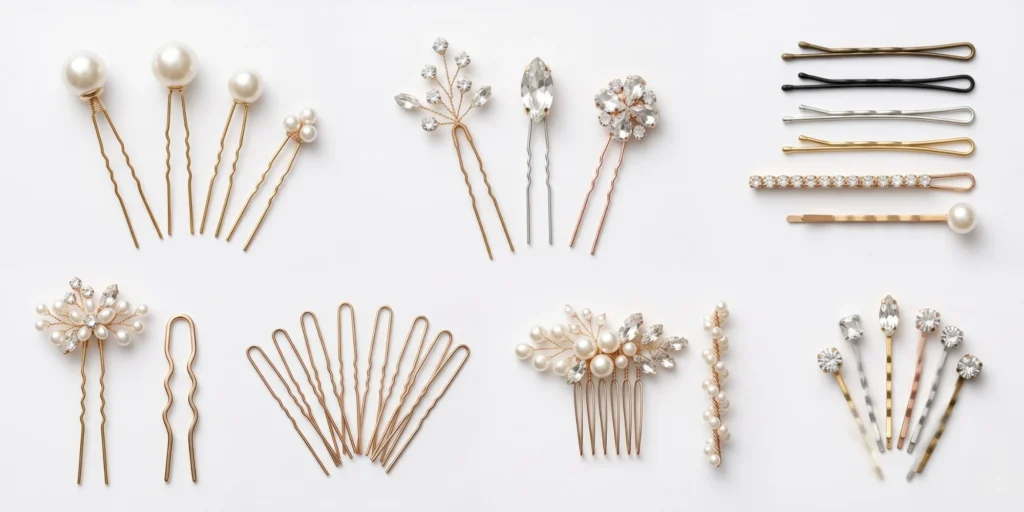
Hair Pin Quantity by Wedding Hairstyle Type
The following table outlines common pin ranges for different wedding updo styles. These ranges are estimates for medium-length to long hair and may increase for very thick hair or added extensions.
| Wedding Hairstyle Type | Estimated Pin Count | Main Pin Function | Notes |
|---|---|---|---|
| Half-up twist | 10–20 | Anchor side sections | Often paired with small clips |
| Loose low bun | 20–35 | Secure volume | Needs hidden support |
| Classic chignon | 30–50 | Shape and hold | Requires layered pinning |
| Braided updo | 35–60 | Hold braid sections | More anchor points needed |
| French twist | 25–45 | Vertical support | U-pins often useful |
| Updo with extensions | 50–80 | Balance extra weight | Needs stronger structure |
| Updo with veil | 40–70 | Support veil comb | Extra anchor area required |
For bridal stylists, these numbers are planning ranges rather than fixed formulas. The final count should be adjusted after testing the hair’s grip, checking the balance of the style, and confirming whether a veil, comb, tiara, or floral accessory will be added.
Consumers preparing for a trial appointment may bring more pins than expected. Extra pins are useful for adjustments during photography, ceremony transitions, and evening events.
Hair Length, Density, and Texture Affect Pin Count
Hair length is one of the clearest factors. Short to medium hair usually needs fewer pins because there is less weight to anchor. Long hair often needs more pins because the stylist must fold, twist, wrap, and secure multiple sections.
Hair density matters as much as length. Fine hair may need fewer pins, but the pins must grip carefully without sliding. Thick hair may require many more anchor points because each section carries more weight.
Texture also changes the number of pins needed:
Fine or thin hair
Fine hair may need 15–35 pins for many bridal updos. The challenge is not usually weight but grip. Small bobby pins, mini U-pins, texture spray, and hidden elastics can help create hold without overloading the style.
A related guide on choosing a brush for fine and thin hair explains why delicate hair types often need gentler tools before styling.
Thick or coarse hair
Thick hair often needs 40–80 pins, especially for low buns, braided updos, or extension-supported styles. Larger U-shaped pins, strong bobby pins, and section-by-section anchoring are usually more effective than adding many small pins randomly.
Curly or textured hair
Curly hair may need fewer visible pins because natural texture can improve grip. However, the updo may still require 30–60 pins if the style involves sculpted sections, volume control, or accessory placement.
Hair Pins, Bobby Pins, U-Pins, and Decorative Pins
Not all hair pins perform the same function. Wedding updos usually combine several pin types instead of relying on one product.
Bobby pins
Bobby pins are flat, narrow pins used to secure small sections and control direction. They are useful around the sides, nape, and hidden anchor points. For bridal styling, bobby pins are often selected in colors close to the hair shade.
U-shaped hair pins
U-pins are useful for buns, chignons, and French twists. They can hold larger sections without flattening the shape. Many stylists use U-pins after the basic structure is formed because they secure volume while keeping the updo soft.
Hair sticks and combs
For some traditional or minimalist wedding looks, hair sticks and combs may replace part of the pin structure. However, they usually need hidden pins underneath for long wear time. Buyers comparing different styling tools may also review hair brush vs hair comb to understand how tool selection affects preparation before pinning.
Decorative bridal pins
Pearl pins, crystal pins, floral pins, and metal accent pins are mainly decorative. They can add limited support, but they should not be treated as the main structure for a wedding updo. For stable styling, decorative pins are usually inserted after the structural pins are already in place.
How Many Pins Are Needed for a Veil or Bridal Hair Accessory?
A wedding veil changes the pin count because it adds weight and movement. A veil comb can pull on the updo when the bride walks, turns, sits, hugs guests, or removes the veil after the ceremony.
For a veil, stylists often add 8–20 extra pins around the anchor point. The number depends on veil length and weight:
- Short veil: 5–10 extra pins
- Fingertip veil: 8–15 extra pins
- Cathedral veil: 15–25 extra pins
- Heavy embellished veil: 20+ extra pins
The veil should not rely only on the comb teeth. The safest structure usually includes crossed bobby pins or U-pins beneath the veil comb. This creates a stronger base and reduces pressure on one section of hair.
Bridal hair claws, combs, and decorative clips can also influence the pin count. Some structured accessories reduce the need for small pins, while heavier metal or acetate pieces may require extra support. The product category of hair claw accessories is often used for casual styling, but wedding versions need more careful weight and grip evaluation.
Common Mistakes When Estimating Hair Pins for a Wedding
One common mistake is assuming that more pins always mean a stronger updo. Too many pins in one area can create pressure, visible bumps, or discomfort. Strong bridal styling depends more on sectioning, anchor points, and pin placement than total quantity alone.
Another mistake is using only decorative pins. Pearl or rhinestone pins may look suitable for bridal styling, but they are often too smooth or too short to hold the core structure. They should be added after the internal support is secure.
A third mistake is choosing pins that do not match the hair type. Fine hair may need smaller, tighter pins. Thick hair may need longer U-pins or stronger bobby pins. Curly hair may need pins that can hold volume without flattening the shape.
Pin color is also important. Black pins can be visible in blonde or light brown hair, while gold pins may stand out in dark hair unless intentionally used as a design detail. Bridal stylists often prepare multiple shades to match the client’s hair.
Finally, trial styling should not be skipped. A wedding updo that looks stable for 10 minutes may loosen after several hours. Trial sessions help identify whether the pin count, pin type, and accessory placement need adjustment.
Sourcing Considerations for B2B Buyers
For B2B buyers, the question of how many hair pins for wedding styling connects directly to product assortment planning. Bridal pins are rarely sold as single-use items only. They are usually packaged as sets, salon kits, retail cards, or decorative accessory collections.
A useful bridal hair pin assortment may include:
- Standard bobby pins in multiple hair colors
- U-shaped bun pins in different lengths
- Pearl or crystal decorative pins
- Stronger pins for thick hair
- Smaller pins for fine hair
- Packaging suitable for retail or salon use
Retail brands may separate structural pins from decorative wedding pins, while salon suppliers may prefer larger mixed kits. OEM buyers should evaluate pin strength, coating smoothness, rust resistance, tip finishing, and packaging format before ordering.
Material and compliance can also matter. For metal pins, plating consistency and surface smoothness affect comfort and durability. For packaging and recycled material claims, standards such as the Global Recycled Standard may be relevant when brands make sustainability claims. For social responsibility expectations, amfori BSCI audit information is commonly reviewed by international buyers.
For factory-direct development, an OEM and ODM service page should clarify mold options, material choices, finishing methods, packaging support, sampling process, and bulk production control. Buyers sourcing bridal hair pins should also consider whether the supplier produces related categories such as combs, clips, and claw accessories, since coordinated product lines are common in bridal and beauty retail.
Frequently Asked Questions
How many hair pins are needed for a simple wedding updo?
A simple wedding updo usually needs around 20–35 hair pins. The number may be lower for fine or medium hair and higher for thick hair. A loose bun or half-up twist may also require fewer pins than a structured chignon.
Are bobby pins or U-pins better for a wedding updo?
Bobby pins are useful for tight anchor points and small sections, while U-pins are useful for buns, chignons, and volume control. Most wedding updos use both types. The combination creates better hold than relying on one pin style.
How many pins are needed if the bride wears a veil?
A veil often requires 8–20 extra pins around the comb or attachment point. Heavy or long veils may need more support. The veil should be anchored into a stable base rather than placed only into loose hair.
Do decorative pearl pins hold a wedding updo?
Decorative pearl pins can add limited hold, but they are mainly used for visual detail. The core structure should be secured first with bobby pins, U-pins, elastics, or hidden anchors. Decorative pins can then be inserted without carrying the full weight of the hairstyle.
Should extra hair pins be prepared on the wedding day?
Extra pins are recommended because bridal hair may loosen during photography, transportation, weather changes, or veil removal. Stylists often prepare more pins than the estimated count so they can adjust the updo without changing the overall design.
What should B2B buyers check when sourcing bridal hair pins?
B2B buyers should check pin strength, coating smoothness, tip safety, color consistency, rust resistance, packaging options, and production quality control. For bridal assortments, mixed pin types and multiple hair colors are often more useful than one-size-only packs.
Conclusion
The number of hair pins needed for a wedding updo usually ranges from 20 to 70, depending on hair length, density, texture, updo style, and bridal accessories. Simple styles may require fewer pins, while thick hair, veils, extensions, and braided structures require stronger internal support.
For buyers and bridal product planners, hair pin quantity is also a sourcing question. Pin type, material, coating, packaging, and accessory coordination all affect how the product performs in wedding styling. Manufacturers such as JunYi Beauty, which produces hair accessories and related OEM categories from its Dongguan facility, represent the type of production partner suited to brands developing bridal styling assortments.