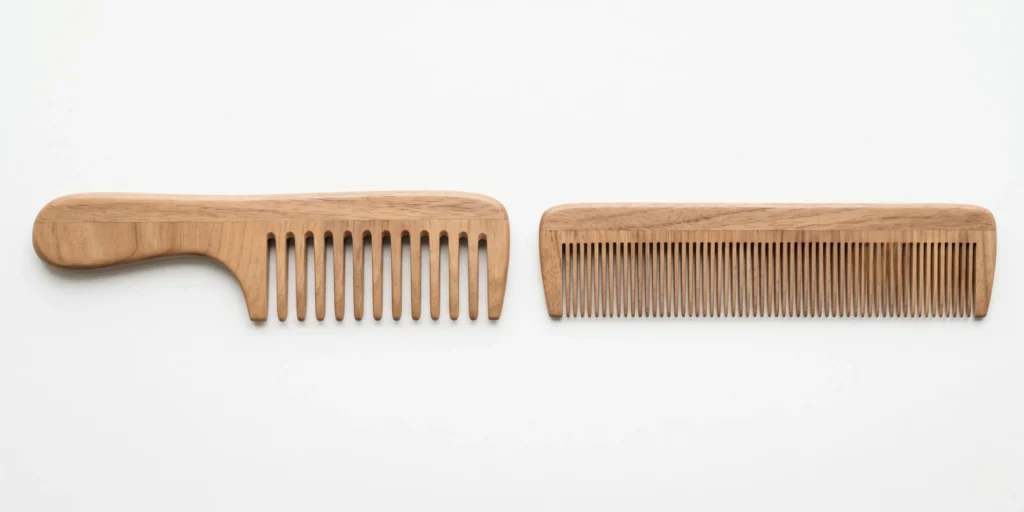
The difference between a wide tooth comb and a fine tooth comb is not simply a matter of preference — it is a functional distinction that determines whether the tool detangles, smooths, or damages the hair depending on the condition and type of hair it is used on. Using the wrong comb at the wrong stage is one of the most consistent and least recognised causes of breakage, frizz, and styling failure in daily hair care.
This guide covers what each comb type actually does mechanically, which hair types and conditions each is suited to, when to use each within the hair care routine, the material variables that affect performance, and how the two tools can work together rather than in competition. For a broader overview of every comb type and where each fits in the full range of grooming tools, see our complete guide on types of hair combs.
The Mechanical Difference Between Wide and Fine Tooth Combs
Before comparing performance outcomes, it is useful to understand what each comb is physically doing to the hair during each pass.
Wide Tooth Comb Mechanics
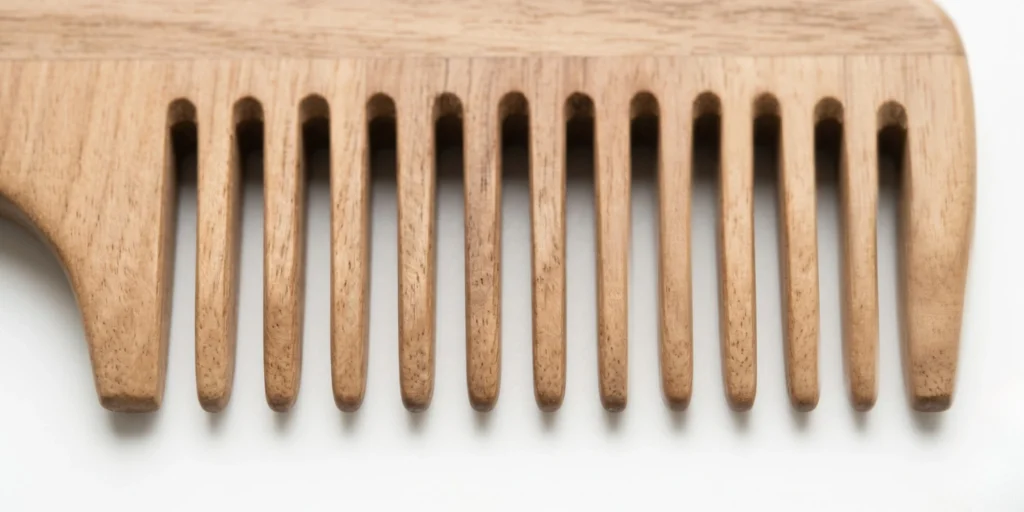
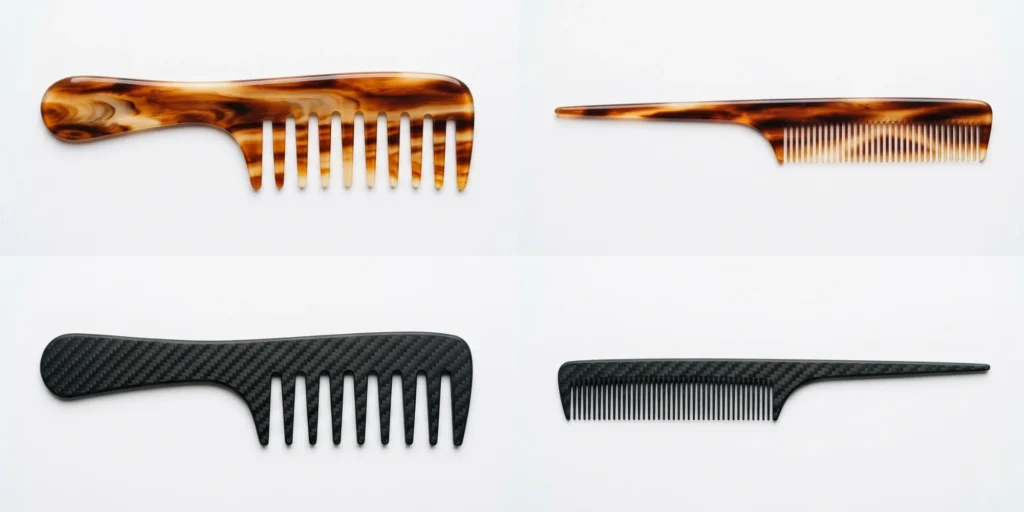
A wide tooth comb has teeth spaced typically 5mm to 8mm apart, sometimes wider for very dense or coily hair applications. This spacing means each pass of the comb engages a relatively small number of hair strands simultaneously — the comb moves through sections of the hair mass rather than across the full surface simultaneously. The result is low contact point density per stroke: each tooth touches fewer strands, and the force applied per strand is distributed across fewer simultaneous contact points.
This low contact density is the structural reason wide tooth combs cause less mechanical damage during detangling. When a tooth encounters a knot, the force applied to resolve that knot is concentrated on a small number of strands rather than amplified across a dense surface of simultaneous contacts. On wet hair — where strands are swollen and the cortex is temporarily weaker — this difference in force distribution is the primary variable that separates safe detangling from damaging detangling.
Fine Tooth Comb Mechanics
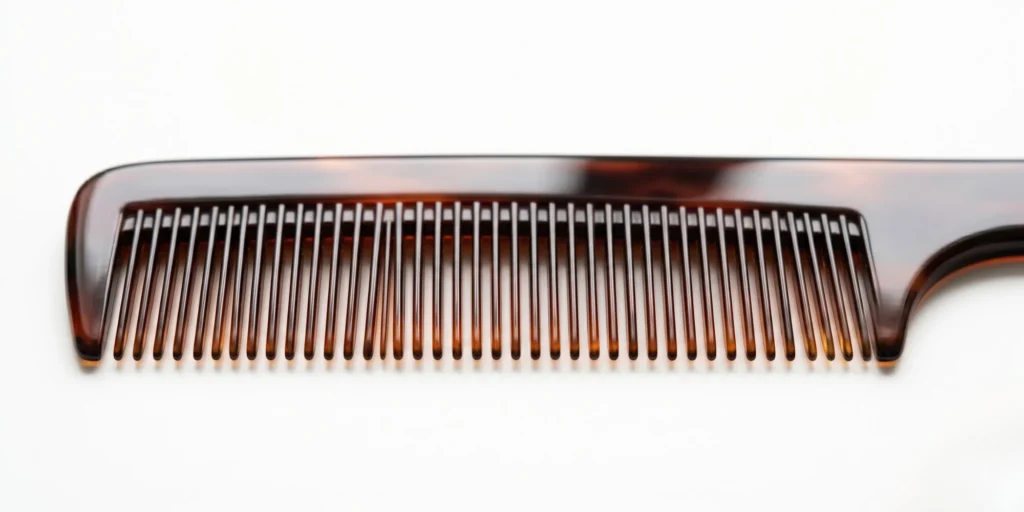
A fine tooth comb has teeth spaced typically 1mm to 2mm apart, sometimes less for precision styling applications. Each pass engages the maximum number of strands simultaneously and creates a high-density contact surface across the hair. This produces smooth, aligned, polished results because every strand is contacted and directed simultaneously — but it also means that any resistance encountered during a pass is distributed across many simultaneous contact points, amplifying the effective force on each individual strand at that resistance point.
On smooth, unknotted hair, this high-contact density is exactly what produces the sleek, polished finish that a fine tooth comb is designed to deliver. On knotted or tangled hair — and particularly on wet hair — the same high-contact density converts each knot into a high-force event across multiple strands simultaneously, which is a reliable mechanism for breakage.
Wide Tooth Comb: When and Why to Use It
Wet Hair Detangling
The wide tooth comb is the most consistently recommended tool for wet hair detangling across all hair types. As covered in our guide on whether it is bad to brush wet hair, wet hair has reduced structural rigidity because water disrupts the hydrogen bonds that give the shaft its normal resilience. At this point of maximum vulnerability, the low contact point density of a wide tooth comb minimises the cumulative mechanical load per pass — limiting the force applied to individual strands during knot resolution.
For consumers who wash their hair daily or several times a week, the wet detangling session is the highest-risk mechanical event in their routine. Using a wide tooth comb rather than any bristle brush or fine tooth comb at this stage is one of the most effective single interventions for reducing breakage over time.
Curly and Coily Hair
For curly and coily hair types (Type 3 and 4), the wide tooth comb on wet, conditioner-saturated hair is not just the recommended tool — it is the structurally correct tool for detangling without disrupting the curl pattern. The widely spaced teeth pass through the curl structure without compressing it, allowing knots to be resolved while maintaining the shape and integrity of the curl formation. Fine tooth combs on curly hair — particularly dry curly hair — produce the same pattern disruption and frizz generation that any brush causes, for the same mechanical reasons.
The relationship between combing approach, curl pattern, and frizz outcome is covered in our article on why brushing makes hair frizzy and what to do instead.
Product Distribution
Running a wide tooth comb through product-coated hair distributes conditioner, styling cream, or leave-in treatment more evenly than a brush because the defined tooth spacing creates a consistent application path through the hair. For curly hair application of gel, cream, or foam, working the product through with a wide tooth comb is the standard technique for even distribution without disrupting the forming curl pattern.
Thick and Dense Hair
For thick and dense hair where the volume of strands per section is high, the wide spacing between wide tooth comb teeth reduces the resistance encountered per pass — the comb moves through the hair mass with less total friction than a fine tooth comb would generate across the same section. This makes the wide tooth comb the appropriate primary detangling tool for thick hair before transitioning to a brush or fine tooth comb for finishing.
Fine Tooth Comb: When and Why to Use It
Finishing and Smoothing Dry Hair
The fine tooth comb is most effective on already-smooth, unknotted dry hair where the goal is polishing and alignment rather than detangling. The high contact density of fine teeth produces a smooth, even surface on straight and lightly wavy hair by directing all strands simultaneously in a single pass. This is the function that makes a fine tooth comb the standard finishing tool for sleek styles, smooth updos, and polished ponytails.
For straight and lightly wavy hair (Type 1 and 2) that has already been detangled, a fine tooth comb used on dry hair delivers the surface smoothness that a wide tooth comb cannot — the wider spacing leaves gaps between passes that produce a less uniform surface finish.
Precision Sectioning
Fine tooth combs — and rat-tail combs with fine tooth sections — are the standard tool for creating precise sections before styling, colouring, or cutting work. The closely spaced teeth create a clean, defined line through the hair that a wide tooth comb cannot replicate because the gaps between teeth are too wide to produce a sharp section boundary.
For at-home consumers, precision sectioning is relevant for creating clean parts, dividing hair for braiding, and separating sections for heat styling. For professional stylists, the fine tooth comb is essential for all sectioning work during chemical services, colour applications, and precision cuts.
Fine and Thin Hair
For fine hair on which the primary goal is daily maintenance and smoothing rather than detangling, a fine tooth comb with polished, seamless teeth used on dry hair is among the most appropriate tools for gentle daily use. The high contact density that makes fine tooth combs unsuitable for knotted or wet hair becomes an advantage on already-smooth fine hair — producing maximum strand alignment per pass with fewer total passes required.
The caveat is that the fine tooth comb should only be used on fine hair that is already free of knots. Using a fine tooth comb to work through tangles in fine hair — particularly wet fine hair — is one of the most reliable ways to generate the breakage that fine hair consumers most commonly report.
Scalp and Edge Styling
For creating precise edge lines, smoothing baby hairs, and styling the scalp-proximate hair in updos and formal styles, a fine tooth comb provides the control and precision that a wide tooth comb cannot. The closely spaced teeth grip and direct individual strands at the scalp level, allowing precise direction of short hairs along the scalp surface.
Hair Type Guide: Wide or Fine?
Straight Hair (Type 1)
Detangling: Wide tooth comb on wet or damp hair, or a flexible detangling brush. The wide tooth comb is the appropriate pre-finishing tool before transitioning to fine tooth for the final pass.
Daily finishing: Fine tooth comb on dry, unknotted hair for maximum smoothness and alignment. The fine tooth comb is the finishing tool of choice for Type 1 hair where a polished, sleek appearance is the goal.
Summary: Both tools serve distinct functions in the Type 1 hair routine — wide tooth for detangling and wet use, fine tooth for dry finishing.
Wavy Hair (Type 2)
Detangling: Wide tooth comb on wet, conditioner-coated hair, working from ends to roots. Fine tooth combs on wet wavy hair disrupt the wave formation and amplify frizz.
Dry styling: Use depends on the style being created. For sleek, smoothed styles, a fine tooth comb on dry, lightly product-coated hair. For maintaining wave definition, finger styling or a wide tooth comb — fine tooth combs separate wave sections and reduce definition.
Summary: Wide tooth comb is the primary tool for wavy hair; fine tooth comb is appropriate only for specific sleek styling outcomes.
Curly Hair (Type 3)
Detangling: Wide tooth comb exclusively on wet, conditioner-saturated hair, starting from ends and working to roots. Fine tooth combs on any curl type produce significant disruption and frizz.
Dry styling: Neither comb type is typically recommended for dry Type 3 hair. Finger styling and diffusing preserve curl formation better than any combing tool on dry curly hair.
Summary: Wide tooth comb is the only appropriate comb for Type 3 hair. Fine tooth combs should be avoided entirely for this hair type.
Coily Hair (Type 4)
Detangling: Wide tooth comb or an afro pick on heavily product-saturated, soaking wet hair. The tooth spacing must be wide enough to work through the tight coil structure without compressing or ripping through it.
Dry styling: Afro pick for volume and shape restoration. Wide tooth comb for redistributing product on lightly damp hair. Fine tooth combs are not appropriate for Type 4 hair in any regular use context.
Summary: Wide tooth comb for detangling and product distribution. Fine tooth combs are not appropriate for Type 4 hair.
Fine and Thin Hair
Detangling: Wide tooth comb on damp hair with conditioner or detangling spray. Fine hair has limited structural resilience per strand — wet fine hair is particularly vulnerable to breakage from high-density combing tools.
Dry finishing: Fine tooth comb with polished, seamless teeth on fully dry, unknotted fine hair. The high contact density produces the smooth, aligned surface that fine hair responds well to when it has sufficient structure to absorb the contact without breakage.
Summary: Wide tooth for wet use, fine tooth for dry finishing — both applied with lighter pressure than for medium or thick hair.
Material Considerations for Both Comb Types
The material a comb is made from affects the friction generated against the hair shaft per pass — and this friction difference, accumulated over months of daily use, has a measurable effect on cumulative cuticle wear.
Cellulose Acetate
Cellulose acetate combs — wide and fine tooth — are produced with polished, seamless tooth edges that generate lower friction against the hair shaft than standard injection-moulded plastic. The smooth surface allows teeth to pass through the hair with less snagging at each contact point. For both wide and fine tooth applications, acetate is the premium material choice that produces the least mechanical stress per pass.
Seamless-Cut Plastic
Standard injection-moulded plastic combs have a visible seam line running along the tooth edge — a production artefact that creates a micro-abrasive surface at each tooth contact point. Seamless-cut plastic combs, finished by hand or machine to remove this seam, generate significantly less friction than standard moulded alternatives. For consumers who cannot access acetate combs, seamless-cut plastic is the next most appropriate choice.
Wood
Wooden combs — bamboo, sandalwood, or hardwood — have a naturally smooth surface that generates low static during combing. The porous surface absorbs a small amount of scalp oil during use, which can contribute a light conditioning effect. The limitation for both wide and fine tooth wooden combs is moisture sensitivity — they should not be soaked and should be dried promptly after wet-hair contact.
Carbon Fibre
Carbon fibre combs are anti-static, heat-resistant, and extremely lightweight. They are particularly appropriate for wide tooth applications on fine hair that generates significant static, and for fine tooth applications in professional styling environments where heat resistance is relevant.
Using Wide and Fine Tooth Combs Together
The most effective approach for most hair types is to use both tools sequentially at different stages of the hair care routine rather than choosing one over the other permanently.
The Recommended Sequence
Stage 1 — In-shower or post-wash: Wide tooth comb or flexible detangling brush on conditioner-saturated wet hair, working from ends to roots in sections. This stage removes knots with minimal mechanical force.
Stage 2 — Damp to dry transition: For straight and wavy hair, a light pass with a wide tooth comb to maintain organisation as the hair dries. For curly and coily hair, no combing at this stage — diffuse or air-dry with product.
Stage 3 — Fully dry, finishing: For straight and lightly wavy hair pursuing a smooth, polished style, a fine tooth comb on dry unknotted hair produces the maximum surface alignment and finish. For other hair types, finishing with a brush appropriate to the hair type is generally more appropriate than a fine tooth comb.
This sequence is consistent with the broader brush-and-comb tool integration framework covered in our guide on hair brush vs hair comb: differences and when to use each.
Quick Reference Comparison
| Variable | Wide Tooth Comb | Fine Tooth Comb |
|---|---|---|
| Tooth spacing | 5–8mm or wider | 1–2mm |
| Contact point density | Low | High |
| Best hair condition | Wet or tangled | Dry and unknotted |
| Best hair type | All types (esp. curly, thick) | Fine to medium straight |
| Primary function | Detangling, product distribution | Finishing, smoothing, precision |
| Wet hair safe | Yes | No |
| Curly hair safe | Yes (wet) | No |
| Precision styling | No | Yes |
| Breakage risk on knots | Low | High |
Sourcing Considerations for B2B Buyers
For buyers building hair comb ranges that include both wide and fine tooth options, the functional distinction between the two types supports a clear segmentation approach — one that positions each tool by hair type and use case rather than by price tier alone.
Wide tooth combs should be positioned explicitly for wet use, detangling, and curly-to-thick hair care. Packaging should communicate the hair-type and moisture-state guidance that helps consumers select correctly, reducing the misuse that generates breakage complaints. Wide tooth combs in acetate or seamless-cut plastic at the premium end, and standard plastic at the entry level, provide a natural price architecture within the category.
Fine tooth combs should be positioned for dry finishing and precision styling on straight and lightly wavy hair. The professional styling context — precision sectioning, edge control, scalp-proximate work — is a distinct positioning that supports professional channel distribution alongside consumer retail.
Material tiering across both types — standard plastic, seamless-cut plastic, cellulose acetate, carbon fibre — creates a coherent premium progression that is justified by genuine performance differences rather than cosmetic differentiation.
Dual-zone styling combs — with a fine tooth section at one end and a wider tooth section at the other — offer a multi-function positioning suited to medium hair consumers who use both functions in a single grooming session.
Both wide and fine tooth comb formats are available through OEM and private label manufacturing routes, with tooth spacing, material, handle design, and packaging specification adjustable to range positioning requirements. The broader framework for selecting and positioning hair tools by hair type is covered in our guide on how to choose the right hair brush for your hair type, which applies the same use-case differentiation logic to the brush category.
Frequently Asked Questions
Can I use a fine tooth comb on wet hair?
No. Fine tooth combs have high contact point density that amplifies the mechanical force applied at each knot contact point on wet hair. Wet hair has reduced structural rigidity and is more susceptible to breakage under tension than dry hair. Using a fine tooth comb on wet, tangled hair is one of the most reliable mechanisms for generating the breakage that accumulates as split ends and reduced density over time. A wide tooth comb or flexible detangling brush is the appropriate tool for wet hair across all hair types.
Is a wide tooth comb better for curly hair than a brush?
Yes, for detangling. A wide tooth comb on wet, conditioner-saturated curly hair is generally preferable to any brush for the detangling function. The low contact point density of the wide tooth comb limits friction and preserves curl formation during knot resolution in a way that no brush can replicate. For curl-type hair, the wide tooth comb replaces the brush as the primary detangling tool — it is not a budget alternative but the structurally correct choice.
What material is best for a fine tooth comb?
Cellulose acetate with polished, seamless tooth edges generates the least friction per pass of any standard material. For fine hair — the hair type most appropriately served by a fine tooth comb for daily finishing — the smooth acetate surface minimises the cuticle friction that a standard plastic seam-line edge would generate across hundreds of daily passes over months of use. Seamless-cut plastic is the next best alternative where acetate is not available.
Should I use a wide or fine tooth comb on fine hair?
Both, at different stages. Wide tooth on wet or damp fine hair for detangling — fine hair has limited structural resilience per strand and wet fine hair is particularly vulnerable to breakage from high-density combing. Fine tooth on dry, unknotted fine hair for finishing — the high contact density produces smooth, aligned results on fine hair that is already in good condition. Never use a fine tooth comb on fine hair that is wet or knotted.
What is the difference between a wide tooth comb and a detangling brush?
A wide tooth comb has rigid teeth with consistent stiffness and works through knots with the full force of each combing pass. A flexible nylon detangling brush has tapered, flexible pins that bend under tension at each knot contact point, reducing the peak force applied per knot. For most hair types and knot severities, either works for wet detangling. For very tangled, fragile, or fine hair, the flexible brush’s force-reduction mechanism produces lower breakage than a rigid wide tooth comb — though both are significantly safer than a fine tooth comb on wet or tangled hair.
Can I use one comb for both detangling and finishing?
Not optimally, for most hair types. A wide tooth comb performs detangling well but does not produce the polished surface finish of a fine tooth comb on straight hair. A fine tooth comb performs finishing well but is damaging on knotted or wet hair. A dual-zone styling comb — with a wide section at one end and a fine section at the other — offers a compromise for medium straight hair where both functions are needed in a single grooming session, but it does not fully match the performance of dedicated tools at either function.
Conclusion
Wide tooth and fine tooth combs are complementary tools designed for different mechanical functions at different stages of the hair care routine. The wide tooth comb’s low contact point density makes it the safe, appropriate choice for wet hair detangling, curly hair maintenance, and product distribution across all hair types. The fine tooth comb’s high contact point density makes it the precise, polished choice for dry finishing and precision styling on straight and lightly wavy hair that is already free of knots. Using each in its correct context — and avoiding the fine tooth comb on wet or tangled hair of any type — eliminates the most common sources of comb-related breakage and styling failure in daily hair care.
For brand developers sourcing hair comb ranges with clear functional differentiation at each tooth spacing tier, manufacturers such as JunYi Beauty — which produces wide tooth, fine tooth, and dual-zone comb formats across acetate, carbon fibre, and plastic materials from its Dongguan facility, with full OEM and private label manufacturing capability — represent the type of production partner suited to ranges built around genuine functional distinction rather than price-only differentiation.